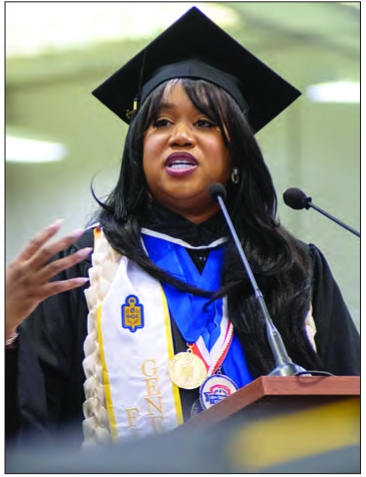
Quiana
Wilson, a new Roxbury Community College graduate, speaks at the
school’s 50th commencement ceremony, May 15. Wilson, the ceremony’s
student speaker, received her associate’s degree after she pivoted away
from her first attempt at college, years before.
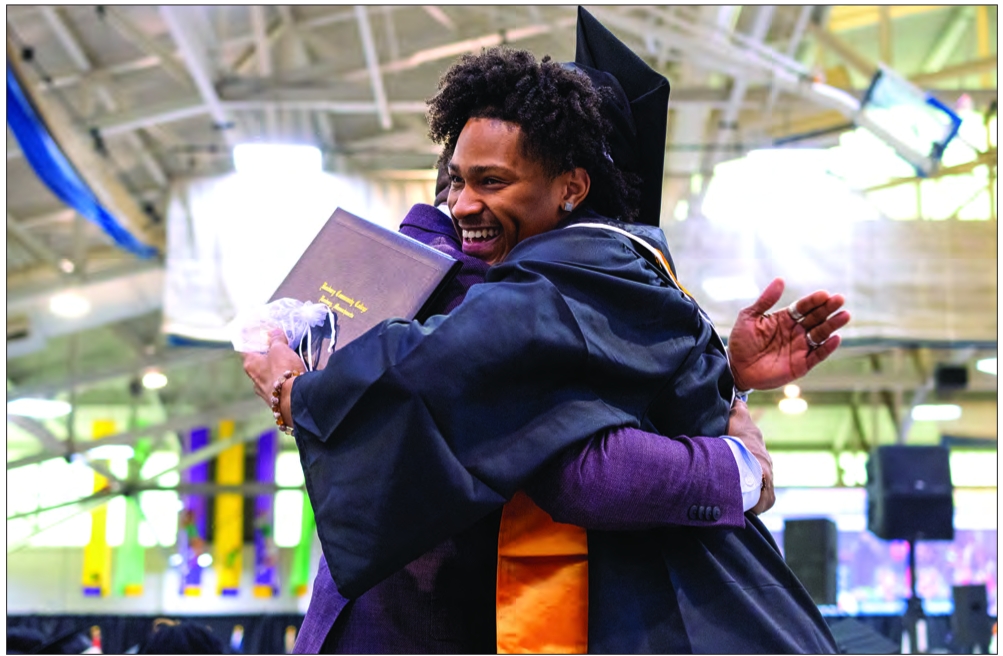
Roxbury
Community College graduate celebrates with a supporter at the school’s
50th commencement ceremony, May 15. At the ceremony, a cohort of more
than 300 students received their diplomas.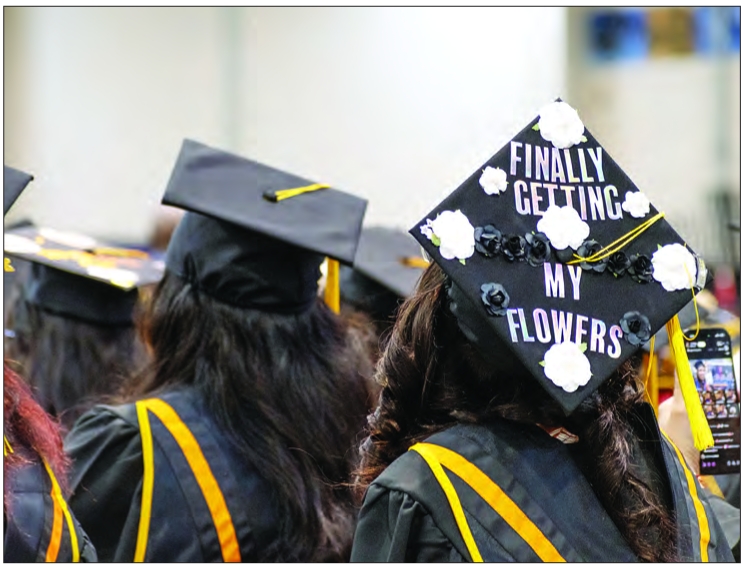
Some graduates got creative with their mortarboards.
Twenty years ago, Quiana Wilson tried her hand as a college student but had to put her degree on pause when circumstances in her life changed. Instead, she pivoted into years of working in corporate sales.
Though she found stability and success, she battled doubts and imposter syndrome. Attending a networking breakfast a few years ago, faced with accomplished professionals and academics, she shrunk into herself and grew silent.
“Instead of sitting in that self-pity, I made a decision that I never wanted to feel that way again,” Wilson said.
Roxbury Community College would be her path to change, she decided. The next day, she went to register for classes. Months later, when she attended another networking breakfast in a banquet hall that was “eerily similar to the first one,” she didn’t second-guess herself.
“When you start to move like your best days are ahead of you, your entire life can shift,” Wilson said.
Now a graduate of Roxbury Community College, Wilson marked the culmination of a step on that path at the institution’s commencement ceremony, held at the Reggie Lewis Track and Athletic Center on May 15. She served as the ceremony’s student speaker.
When she shared her story with the crowd, it was met with cheers and applause.
“The
question isn’t whether your ‘future is golden,’” Wilson said, referring
to the ceremony’s theme. “The question is, will we be able to design
it?”
For the school’s
leadership and the many speakers brought to the ceremony to celebrate
the new graduates, the answer to that question was a resounding yes.
“We
want you to know there are even brighter days ahead for you, and that
determination, that grit, and that little voice that said, ‘You can do
this,’ that got you here, can take you even farther,” said James
Whitley, RCC’s vice president of academic affairs.
Richard
O’Bryant, incoming chair of the RCC Board of Trustees and chief
belonging officer at Northeastern University, said “our belief in a
better future is possible and because of you, it is brighter.”
The
more than 300 graduates marked the institution’s largest class in
recent memory, said RCC President Jonathan K. Jefferson. Over 70% of the
graduates were Boston residents and nearly three-quarters of them
graduated with honors.
“In
every sense, this class reflects excellence, but what truly defines the
class of 2026 cannot be captured in numbers alone,” Jefferson said. “It
is found in your stories.”
He ceremony also honored a handful of RCC community members, in addition to the graduates.
Charles
Anderson, president and CEO of the Dimock Center, received the
Community Service Award. Roeshana Moore-Evans, founder and principal of
the social equity consulting firm Equity Empowerment, received the
Distinguished Alumni Award. Judge Leslie Harris, who served
as a justice for Suffolk County Juvenile Court and who died last
October, was posthumously awarded the Lifetime Achievement Award.
Speakers
encouraged graduates to give back to support their communities. Suzanne
Walsh, president of City University of Seattle and the event’s
commencement speaker, said the graduates set new standards for their
families and communities.
“You’ve
had that hustler’s ambition this whole journey. You could see your
vision for what got you here today, so you now have a
heavy responsibility to serve in new ways that people expect and that
they need,” Walsh said. “You have to
show them that you didn’t just get here fully formed, you have to show
them that you started from the bottom, and now you’re here.”
Jefferson
challenged the graduates to stay connected to the school and its alumni
network, and to “never underestimate the impact you can have on those
who follow behind you.”
The commencement ceremony, the college’s 50th, comes as the school celebrates its more-than-half-acentury in the community.
“Over
50 years ago, this campus rose from land once intended to divide a
community. Today, it does just the opposite. It connects, uplifts, and
transforms,” Jefferson said, in reference to the highway originally
slated to cut through Roxbury where the school now stands. The 1960s
project never saw construction due to community activism.
Instead,
he called the graduates “living proof of that transformation” and
called the college itself “a true highway for economic mobility.”
The
ceremony also comes after Jefferson was officially inaugurated as
president of college at the end of April. He took over leadership of the
school in 2024.
For
the program’s many speakers, the commencement marked a milestone for the
class of 2026, as well a chance to look forward to their “golden”
future.
“May they go
forth and be all right — more than all right,” said Rev. Ray Hammond,
pastor of Bethel AME Church in Jamaica Plain and chair of the RCC
Foundation Board, at the start of the ceremony. “May they be bold. May
they be purposeful. May they be unstoppable.”


