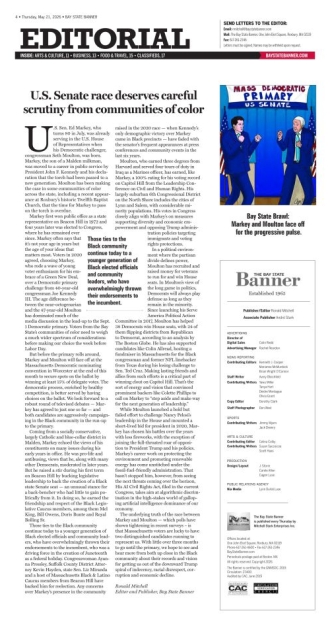
U.S. Sen. Ed Markey, who turns 80 in July, was already serving in the U.S. House of Representatives when his Democratic challenger, congressman Seth Moulton, was born. Markey, the son of a Malden milkman, was moved to a career in public service by President John F. Kennedy and his declaration that the torch had been passed to a new generation. Moulton has been making the case in some communities of color across the state, including a recent appearance at Roxbury’s historic Twelfth Baptist Church, that the time for Markey to pass on the torch is overdue.
Markey first won public office as a state representative on Beacon Hill in 1972 and four years later was elected to Congress, where he has remained ever since. Markey often says that it’s not your age in years but the age of your ideas that matters most. Voters in 2020 agreed, choosing Markey, who rode a wave of young voter enthusiasm for his embrace of a Green New Deal, over a Democratic primary challenge from 40-year-old congressman Joe Kennedy III. The age difference between the near-octogenarian and the 47-year-old Moulton has dominated much of the media discussion in the lead-up to the Sept. 1 Democratic primary. Voters from the Bay State’s communities of color need to weigh a much wider spectrum of considerations before making our choice the week before Labor Day.
But before the primary rolls around, Markey and Moulton will face off at the Massachusetts Democratic nominating convention in Worcester at the end of this month to secure spots on the ballot by winning at least 15% of delegate votes. The democratic process, enriched by healthy competition, is better served by having choices on the ballot. We look forward to a robust round of televised debates — Markey has agreed to just one so far — and both candidates are aggressively campaigning in the Black community in the run-up to the primary.
Coming from a socially conservative, largely Catholic and blue-collar district in Malden, Markey echoed the views of his constituents on many issues during his early years in office. He was pro-life and antibusing, views that he, along with many other Democrats, moderated in later years. But he raised a stir during his first term on Beacon Hill by bucking legislative leadership to back the creation of a Black state Senate seat — an unusual stance for a back-bencher who had little to gain politically from it. In doing so, he earned the friendship and respect of the Black Legislative Caucus members, among them Mel King, Bill Owens, Doris Bunte and Royal Bolling Sr.
Those ties to the Black community continue today to a younger generation of Black elected officials and community leaders, who have overwhelmingly thrown their endorsements to the incumbent, who was a driving force in the creation of Juneteenth as a federal holiday. Congresswoman Ayanna Pressley, Suffolk County District Attorney Kevin Hayden, state Sen. Liz Miranda and a host of Massachusetts Black & Latino Caucus members from Beacon Hill have backed him for reelection. Any concerns over Markey’s presence in the community raised in the 2020 race —
when Kennedy’s only demographic victory over Markey came in Black
precincts — have faded with the senator’s frequent appearances at press
conferences and community events in the last six years.
Moulton,
who earned three degrees from Harvard and served four tours of duty in
Iraq as a Marines officer, has earned, like Markey, a 100% rating for
his voting record on Capitol Hill from the Leadership Conference on
Civil and Human Rights. His largely suburban 6th Congressional District
on the North Shore includes the cities of Lynn and Salem, with
considerable minority populations. His votes in Congress closely align
with Markey’s on measures supporting diversity and economic empowerment
and opposing Trump administration policies targeting immigrants and
voting rights protections.
In
a political environment where the partisan divide defines power,
Moulton has recruited and raised money for veterans to run for and win
House seats. In Moulton’s view of the long game in politics, Democrats
will always play defense as long as they remain in the minority. Since
launching his Serve America Political Action Committee in 2017, Moulton
has helped 38 Democrats win House seats, with 24 of them flipping
districts from Republican to Democrat, according to an analysis by The
Boston Globe. He has also supported candidates like Colin Allread,
hosting a fundraiser in Massachusetts for the Black congressman and
former NFL linebacker from Texas during his losing challenge to Sen. Ted
Cruz. Making lasting friends and allies from such efforts is a critical
part of winning clout on Capitol Hill. That’s the sort of energy and
vision that convinced prominent backers like Colette Phillips to call on
Markey to “step aside and make way for the next generation of
leadership.”
While
Moulton launched a bold but failed effort to challenge Nancy Pelosi’s
leadership in the House and mounted a short-lived bid for president in
2020, Markey has chosen his battles over the years with less fireworks,
with the exception of joining the full-throated roar of opposition to
President Trump and his policies.
Markey’s
career work on protecting the environment and promoting renewable
energy has come unstitched under the fossil-fuel-friendly
administration. That hasn’t stopped him, however, from seeing the next
threats coming over the horizon, His AI Civil Rights Act, filed in the
current Congress, takes aim at algorithmic discrimination in the
high-stakes world of galloping artificial intelligence dominance of our
economy.
The
underlying truth of the race between Markey and Moulton — which polls
have shown tightening in recent surveys – is that Massachusetts voters
are lucky to have two distinguished candidates running to represent us.
With little over three months to go until the primary, we hope to see
and hear more from both up close in the Black community about their
records and vision for getting us out of the downward Trump spiral of
indecency, racial disrespect, corruption and economic decline.
Ronald Mitchell
Editor and Publisher, Bay State Banner