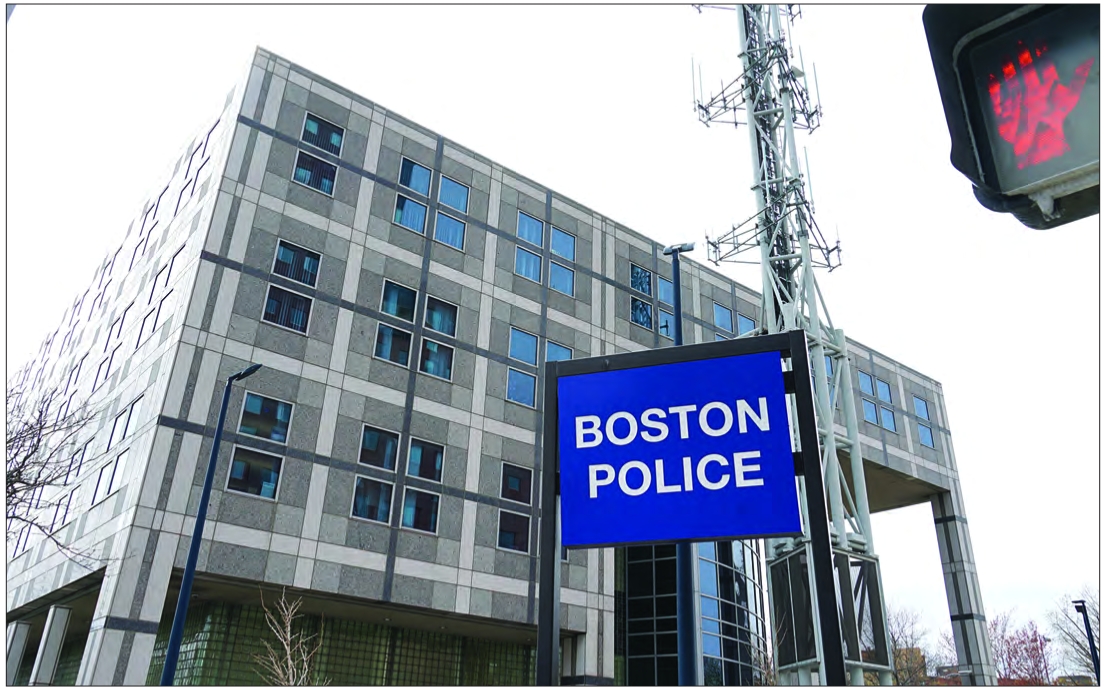
A
Citizens for Juvenile Justice report found widespread information
sharing between Boston police and other local police departments and
federal immigration officials.Massachusetts lawmakers are poised to pass the Act Promoting Rule of Law, Oversight, Trust and Equal Constitutional Treatment (PROTECT Act), legislation aimed at curbing local cooperation with federal immigration officials on civil immigration enforcement and restricting ICE agents from making arrests in court houses.
But even if Gov. Maura Healey signs the PROTECT Act. into law, immigrant advocates warn that without changes to current regulations, practices and local/federal partnerships in local police departments could continue to allow a continual flow of information that enables ICE agents to target noncriminal immigrants for deportation.
“The PROTECT Act does place limitations on ICE and on contact with ICE, but it could go a lot further,” said Leon Smith, executive director of Citizens for Juvenile Justice (CfJJ), an advocacy group that in April released a report documenting different ways local police departments, courts and correctional facilities collaborate with ICE. “If we’re going to take a shot at reducing the harm ICE is causing, we should really dot the ‘i’s and cross the ‘t’s.”
The CfJJ report detailed numerous instances of collaboration that court officers and police undertake with ICE, some of it including direct communication with federal agents about the immigration status of people charged with, but not convicted of misdemeanor crimes. For instance, Massachusetts police departments, including Boston’s, routinely fingerprint people arrested for misdemeanors, even though state law only requires them to fingerprint suspects charged with felonies.
Fingerprints
taken by BPD and other police departments are immediately uploaded into
a Massachusetts State Police database and shared with the FBI, which
then shares them with ICE. ICE agents can then show up at arraignments
to take immigrants into custody before they’re able to defend themselves
in court.
Muslim
Justice League Executive Director Fatema Ahmad was arrested and
fingerprinted after allegedly participating in a demonstration during
Mayor Michelle Wu’s 2024 State of the City address, but had her charges
dismissed before arraignment. At a time when Boston police are arresting
demonstrators, such as the Emerson College students who in 2024
occupied an alley off Boylston Street, fingerprinting can have severe
consequences for immigrants, regardless of the legal status.
“Fingerprinting is one of the essential ways people get targeted by ICE,” she said.
In
multiple incidents cited in the CfJJ report, local and state police
have detained people not charged with crimes to comply with ICE civil
immigration detainers in violation of the Lunn v. Commonwealth decision—
a 2017 Supreme Judicial Court ruling that
found that law enforcement in this state does not have the legal right
to detain an individual solely based on their having violated civil
immigration law. Entering the United States without authorization or
overstaying a visa does not constitute a crime, under U.S. law.
The
report cites the Deportation Data Project in citing 210 ICE arrests
that came through 32 Massachusetts police departments, with a third of
that number coming from Lawrence, Boston and Lynn.
The
PROTECT Act would make it illegal for police and court officers to
continue collaborating with ICE, but criminal defense attorney Carl
Williams says many of the ICE detentions that happen inside and outside
of court houses and police precincts are happening through direct,
unofficial communication between police officers and ICE agents even in
the absence of detainer requests.
“In
court houses, jails and houses of correction and in police departments,
people are making calls to ICE,” he said. “We know that. All the
undocumented community knows that.”
Ahmad, too, said the informal communications between local officers and ICE are a widespread problem.
“Often, we don’t know that it’s happened,” she said. “The communication could be verbal. It’s really hard to track.”
The
direct communications between local law enforcement and ICE, have
far-reaching implications for the justice system, Williams says.
“People
aren’t going to the police to file reports, to get restraining orders,”
he said. “If police departments wanted to, they could start firing
people for that.”
Until
now, there appears to have been little incentive for local police
departments to crack down on individual officers who communicate with
ICE outside of offices channels.
Boston
Police Detective Juan Seoane, who faced an internal investigation after
a 2017 incident where he reported a construction worker to the BPD ICE
liaison and coordinated his arrest with ICE — a violation of Boston’s
2014 Trust Act ordinance. BPD no longer has an ICE liaison, but Seoane
who was in 2022 recognized as a “detective of the year” by the Boston
Police Detectives Benevolent Society, was still in the department’s
employ as of February this year.
While
the actions of individual police and court officers and, in many cases,
police and court policies affect immigrants facing arrest, local police
departments’ formalized information sharing with federal officials have
long been seen as a means for targeting immigrants who have never been
arrested.
Through
fusion centers including the Boston Regional Intelligence Center (BRIC)
and the Massachusetts Fusion Center, local and state police share
information with the FBI, the Department of Homeland Security (DHS)
under which ICE operates and other federal authorities. Boston’s gang
database, its surveillance reports on nonviolent demonstrators — such as
those supporting police reform, opposing Israel’s genocide in Gaza or
the Occupy Wallstreet movement — are shared with federal officials who
work directly with ICE.
Additionally,
BPD and other local departments participate in federal policing task
forces and memoranda of understanding under which officers are
designated as customs officers who can assist ICE.
The
CfJJ report quotes the memorandum of agreement between BPD and the DHS,
noting that it requires the Boston department to: “(3) provide access
to Host databases, reports, investigations, and other information
produced, retained, and/or controlled by the Host in order to review
this information and assist the Host in identifying the types of
information, including enforcement information, that may assist DHS or
other entities with homeland security responsibilities.”
Smith
pointed to Boston’s gang database, which is administered by and housed
in the BRIC office, as a potential means for ICE to target immigrants. A
2022 decision in a case of an immigrant incorrectly labeled as a gang
member and targeted by DHS for deportation found the BPD database relied
on an “erratic point system built on unsubstantiated inferences” to
determine whether an individual is gang affiliated.
“If someone’s in that database, even if they’re not gang-affiliated, it can be fatal to an immigration case,” Smith said.
Boston
police officials have long maintained that they do not share
information directly with ICE. But they do share information with the
FBI, which works with ICE on civil immigration enforcement and a DHS
officers shares office space with Boston and other local police
officials at the BRIC.
While
citing its limitations in combatting ICE overreach, the CfJJ report
recommends passage of the PROTECT Act, a version of which passed in the
Senate last week. In its current form, the legislation would make it
illegal under Massachusetts law for police to engage in civil
immigration enforcement.
“It prevents any kind of inquiries about immigration status with very limited exemptions,” said Sen.
Lydia Edwards, who notes any communications with ICE must now be approved by supervising officers and documented.
“They
have to document it,” she said. “They have to get the permission from a
supervisor and they have to put down in writing who gave them
permission. When we see patterns from certain police stations and
certain police officers, we can call and say, ‘you’re giving out too
much information.’”


