(Above)
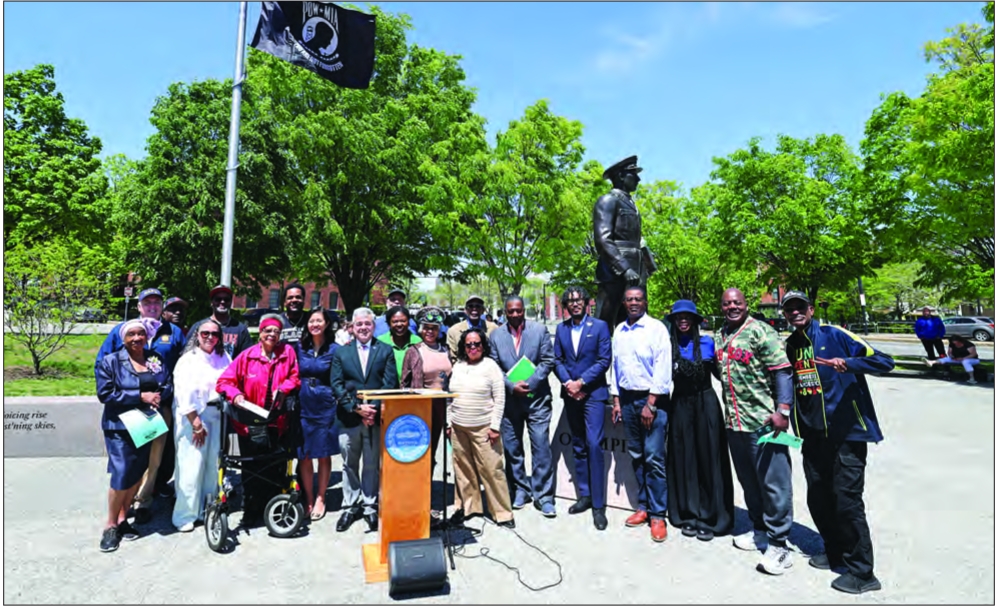
Celebrants gather for “We Were There: African American Military
Heritage Day” at Edward O. Gourdin African American Veterans Memorial
Park. (Below) Statue of General Edward O. Gourdin. Gourdin was the first
Black judge appointed to the Roxbury District Court. 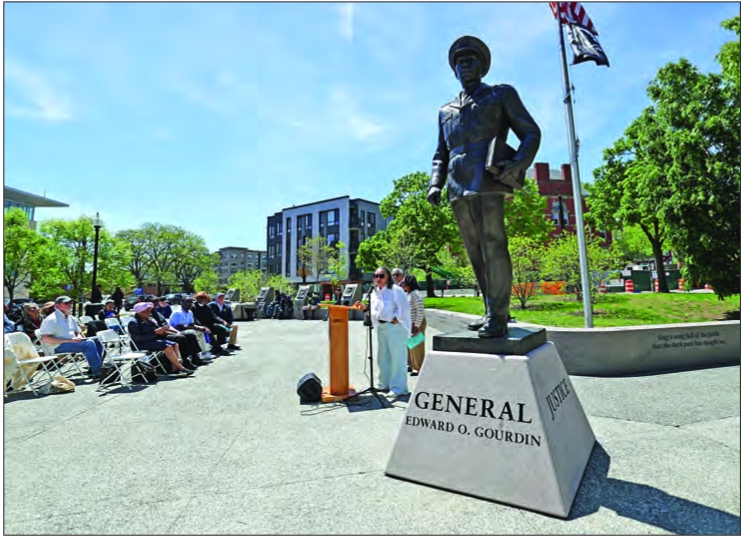
The Veterans and Friends of Gourdin Memorial Park gathered in Nubian Square on May 16 for the 21st annual African American Military Heritage Day with the direct and powerful theme of “We Were There.”
Those three words carried the weight of centuries, speaking not only to military service, but also to recognition long delayed.
Cohosted by Roxbury Cultural District, Roxbury Main Streets, Concerned Black Men of Massachusetts and Everyone 250, the gathering honored African Americans present at every stage of the American military story: the Revolution, Civil War, World Wars I and II, Korea, Vietnam, Iraq and Afghanistan.
Attendees completed a brief parade before being addressed by speakers, including Imari Parris Jeffries, CEO of Embrace Boston and an Iraq War veteran, at Gourdin Memorial Park. Formerly Dudley Park, the space has transformed from a pass-through plaza into one of Boston’s most important public memorials.
The park honors Brigadier General Edward O.
Gourdin, whose life embodied the theme “We Were There.” Raised in Cambridge and ultimately settling as an adult in Roxbury, Gourdin became the first Black judge appointed to Roxbury District Court and the first Black justice appointed to the Massachusetts Superior Court. He was also the first man in
history to break 25 feet in the long jump and won a silver medal for the
United States at the 1924 Paris Olympics.
Gourdin
represented a generation of African Americans who achieved greatness
while navigating a society that often denied their humanity, patriotism
and equal citizenship.
That larger story is written throughout the park.
The
memorial includes a life-size bronze statue of Gourdin by the late
Boston artist Fern Cunningham-Terry, accompanied by 10 bronze reliefs
sculpted by Karen Eutemey, which depict African American participation
in 10 military conflicts.
The
memorial tells a story that is national and deeply local. Roxbury
becomes a place where military history, civil rights history, public art
and community memory intersect.
“Seeing
this all come together reminds me that it was worth it,” said Rachelle
Brown, whose father, Ralph, served under Gourdin. With her mother,
Thelma, the Browns have led the effort to create and steward Gourdin
Park over two decades.
The
park does not solely celebrate military victory. It also acknowledges
contradiction: that African Americans fought for freedoms abroad while
often being denied full freedom at home. Black veterans returned from
wars only to encounter segregation, discrimination, limited housing
opportunities, exclusion from institutions and unequal treatment under
the law.
Often, Black
military contributions were withheld from monuments, textbooks and
public memory. That reality is in part why Gourdin Memorial Park, and
its stewards, continue working: to transform public space into public
memory and to shape civic identity. The area communicates whose
sacrifices matter, whose stories deserve permanence and whose
contributions are considered part of the American narrative.
Organizers
behind the memorial have long emphasized education as central to the
mission. The vision saw the installation of statues and plaques as a
beginning, a foundation for a living civic space where future
generations could learn hidden history and understand that it is not
abstract but personal. It lives in neighborhoods, families, churches,
schools and parks.
In
Roxbury, residents can walk through Gourdin Memorial Park and encounter
not only the memory of military service, but the memory of aspiration,
struggle, sacrifice and civic contribution.
When
communities are erased from public memory, denied recognition or
excluded from civic narratives, it affects identity, belonging,
aspiration and the ability of future generations to see themselves as
fully part of the American story.
Gourdin
Memorial Park pushes against erasure by centering Black visibility and
dignity. In that sense, African American Military Heritage Day was not
only about honoring veterans of the past. It was also about
strengthening the emotional and civic foundations for the future.