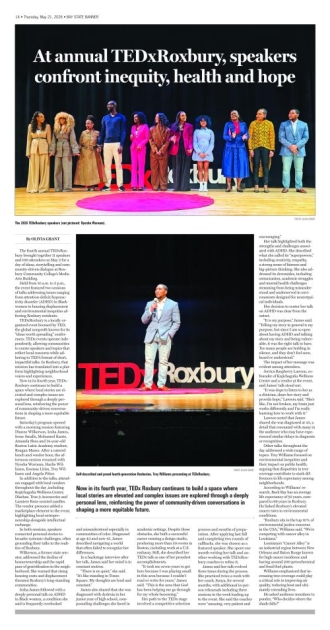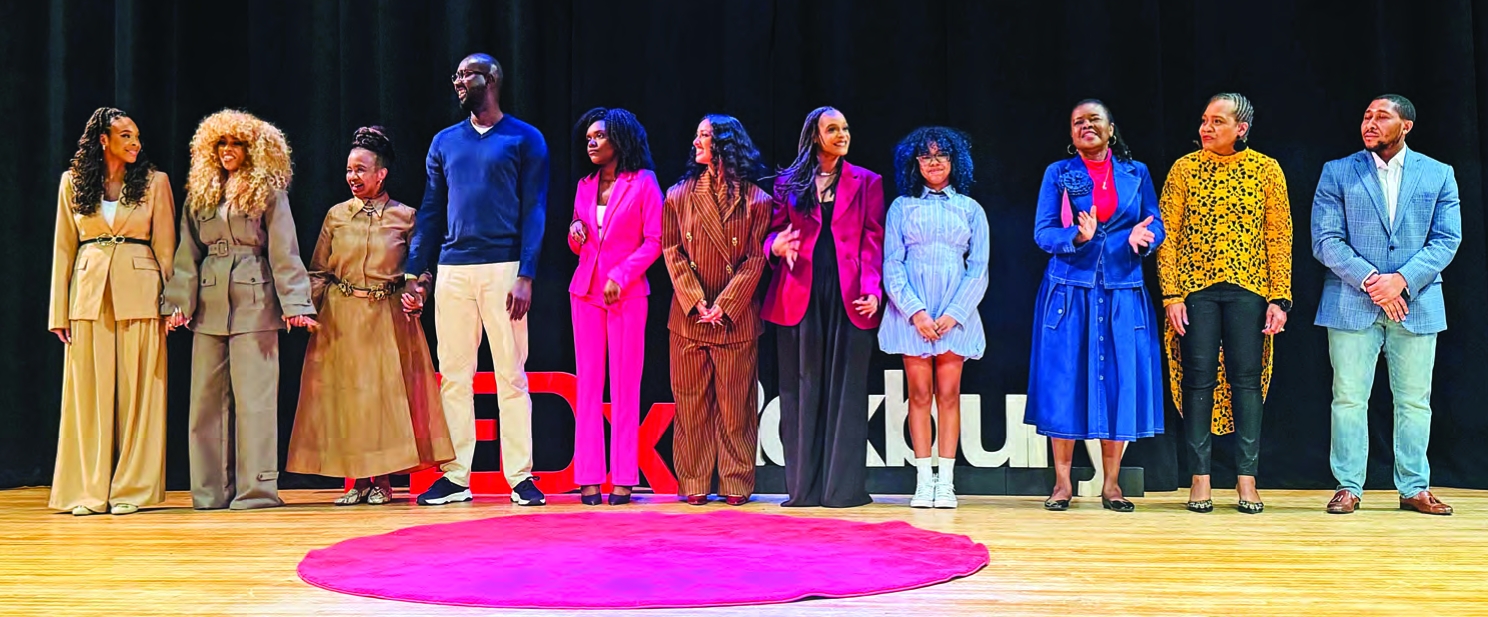
The 2026 TEDxRoxbury speakers (not pictured: Nyesha Wornum).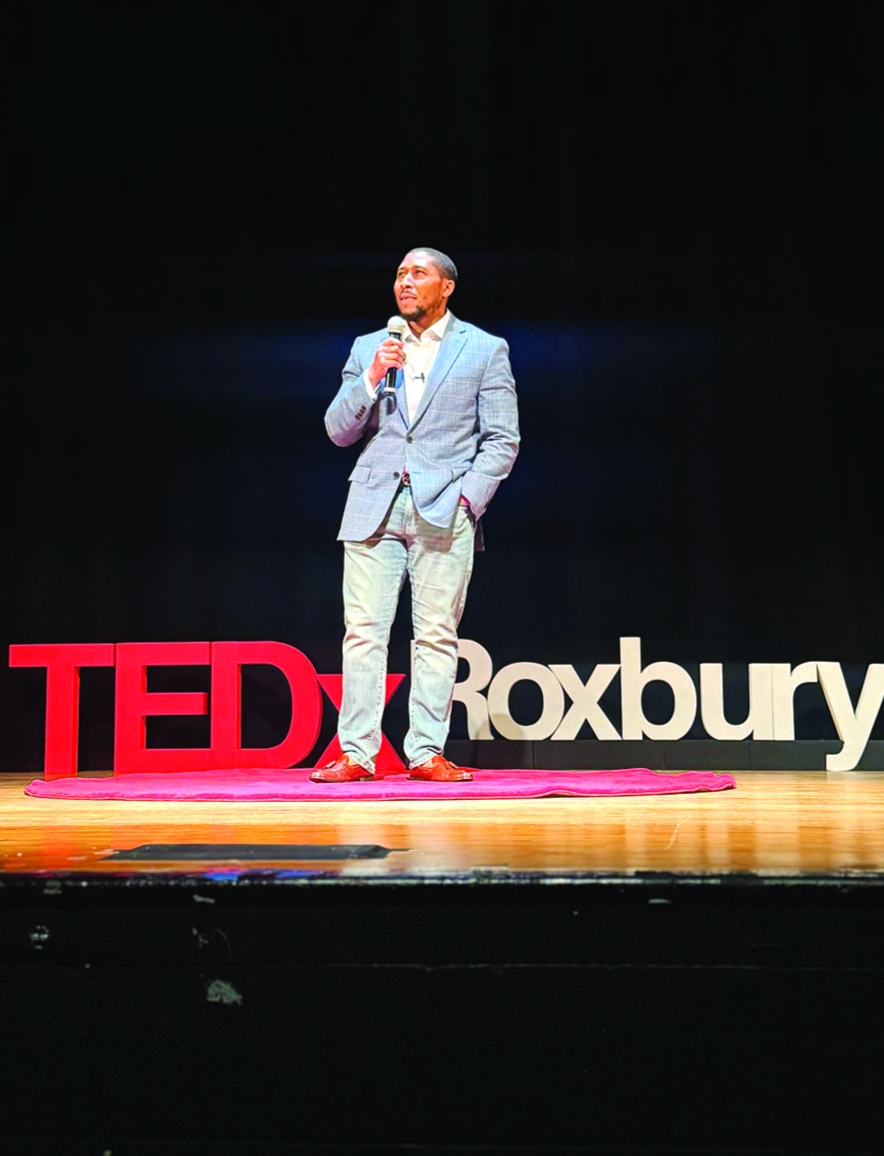
Self-described and proud fourth-generation Roxburian, Trey Williams presenting at TEDxRoxbury.
The fourth annual TEDxRoxbury brought together 11 speakers and 100 attendees on May 2 for a day of ideas, storytelling and community-driven dialogue at Roxbury Community College’s Media Arts Building.
Held from 10 a.m. to 3 p.m., the event featured two sessions of talks addressing issues ranging from attention-deficit/hyperactivity disorder (ADHD) in Black women to housing displacement and environmental inequities affecting Roxbury residents.
TEDxRoxbury is a locally organized event licensed by TED, the global nonprofit known for its “ideas worth spreading” conferences. TEDx events operate independently, allowing communities to curate speakers and topics that reflect local concerns while adhering to TED’s format of short, impactful talks. In Roxbury, that mission has translated into a platform highlighting neighborhood voices and experiences.
Now in its fourth year, TEDx- Roxbury continues to build a space where local stories are elevated and complex issues are explored through a deeply personal lens, reinforcing the power of community-driven conversations in shaping a more equitable future.
Saturday’s program opened with a morning session featuring Dianne Wilkerson, Iesha James, Irene Smalls, Mohamed Kante, Amanda Shea and 14-year-old Boston Latin Academy student, Reagan Masso. After a catered lunch and vendor hour, the afternoon session resumed with Nyesha Wornum, Harlie Williams, Essmaa Litim, Trey Williams and Angela Pitter.
In addition to the talks, attendees engaged with local vendors throughout the day ,including Kujichagulia Wellness Center, Dlachae, True 9 Accessories and Lumiere Rene scented candles. The vendor presence added a marketplace element to the event, highlighting local entrepreneurship alongside intellectual exchange.
In both sessions, speakers connected personal stories to broader systemic challenges, often grounding their talks in the realities of Roxbury.
Wilkerson, a former state senator, addressed the decline of homeownership and the rapid pace of gentrification in the neighborhood. She warned that rising housing costs and displacement threaten Roxbury’s long-standing communities.
Iesha James followed with a deeply personal talk on ADHD in Black women, a condition she said is frequently overlooked and misunderstood
especially in communities of color. Diagnosed at age 43 and now 45,
James described navigating a world that often failed to recognize her
differences.
In a backstage interview after her talk, James said her mind is in constant motion.
“There is no quiet,” she said.
“It’s like standing in Times Square. My thoughts are loud and constant.”
James
also shared that she was diagnosed with dyslexia in her junior year of
high school, compounding challenges she faced in academic settings.
Despite those obstacles, she built a successful career running a design
studio, producing more than 50 events in Boston, including work at a
U.S. embassy. Still, she described her TEDx talk as one of her proudest
accomplishments.
“It
took me seven years to get here because I was playing small in this area
because I couldn’t read or write for years,” James said. “This is the
area that God has been helping me go through for my whole becoming.”
Her
path to the TEDx stage involved a competitive selection process and
months of preparation. After applying last fall and completing two
rounds of callbacks, she was chosen as a featured speaker. She spent one
month writing her talk and another working with TEDxRoxbury coaches to
refine it.
James said
her talk evolved three times during the process. She practiced twice a
week with her coach, Sonya, for several months, with additional
in-person rehearsals including three sessions in the week leading up to
the event. She said the coaches were “amazing, very patient and
encouraging.”
Her
talk highlighted both the strengths and challenges associated with
ADHD. She described what she called its “superpowers,” including
creativity, empathy, a strong sense of fairness and big-picture
thinking. She also addressed its downsides, including ostracization,
academic struggles and mental health challenges stemming from being
misunderstood and underserved in environments designed for neurotypical
individuals.
Her decision to center her talk on ADHD was clear from the outset.
“It is my purpose,” James said.
“Telling
my story in general is my purpose, but since I am so open about having
ADHD and talking about my story and being vulnerable, it was the right
talk to have.
Too many people are holding in silence, and they don’t feel seen, heard or understood.”
The impact of her message was evident among attendees.
Jerrica Raspberry Lawson, cofounder of Kujichagulia Wellness Center and a vendor at the event, said James’ talk stood out.
“It
was dope to listen to her as a clinician, share her story and provide
hope,” Lawson said. “She’s like, I’m not broken, my brain just works
differently and I’m really learning how to work with it.”
Lawson
noted that James shared she was diagnosed at 43, a detail that
resonated with many in the audience who may have experienced similar
delays in diagnosis or recognition.
Other
talks throughout the day addressed a wide range of topics. Trey
Williams focused on environmental inequities and their impact on public
health, arguing that disparities in tree coverage contribute to stark
differences in life expectancy among neighborhoods.
According to Williams’ research, Back Bay has an average life expectancy of 92 years, compared to 69 years in Roxbury.
He linked Roxbury’s elevated cancer rates to environmental conditions.
“Roxbury
sits in the top 10% of environmental justice concerns in the USA,”
Williams said. “We’re competing with cancer alley in Louisiana.”
Louisiana’s
“Cancer Alley” is an industrial region between New Orleans and Baton
Rouge known for high cancer incidence and having around 200
petrochemical and fossil fuel plants.
Williams
emphasized that increasing tree coverage could play a critical role in
improving air quality, reducing heat and ultimately extending lives.
He asked audience members to ponder, “Who decides where the shade falls?”