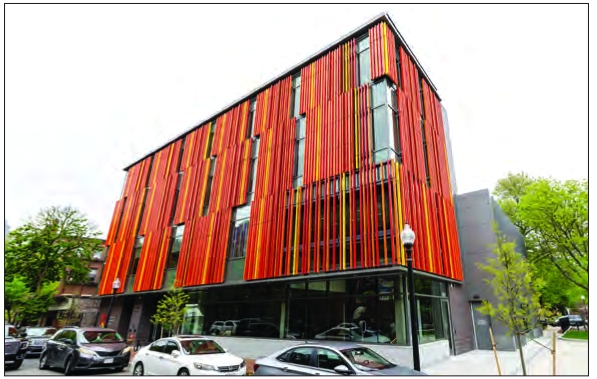
La CASA: The Center for Arts, Self-determination and Activism opened May 15.New England’s largest Latino cultural center officially opened its doors on May 15 with a jubilant ribbon-cutting ceremony in Boston’s South End, marking a major milestone for one of the city’s longest-standing Latino community organizations.
Nonprofit Inquilinos Boricuas en Acción, known as IBA, has worked for years to open La CASA at 85 West Newton St., so named as a center for arts, self-determination and activism.
The $33 million, 26,440- square-foot building rises four stories and includes a 220-seat multipurpose performance hall, gallery and arts spaces including a soundproof rehearsal room, administrative offices and a rooftop terrace.
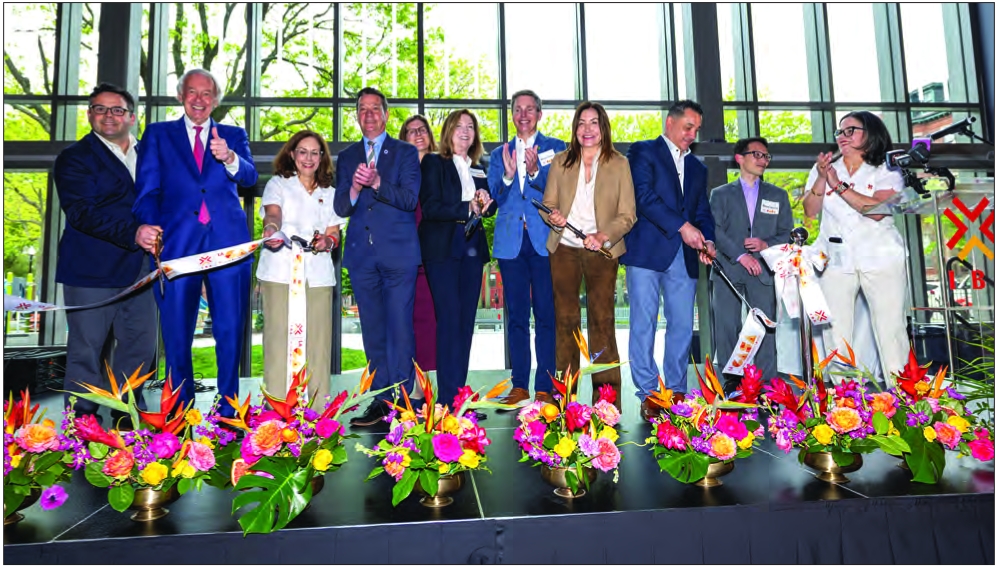
More than 200 people gathered in the new Jean and Tom Yawkey Hall performance space for the celebratory opening last week. The event drew elected officials, artists, residents and community advocates, including U.S. Sen. Ed Markey and Mayor Michelle Wu.
LaCASA
Latino cultural center officially opened its doors on May 15. Elected
officials, artists, residents and community advocates gathered for a
ribbon-cutting ceremony.
Throughout
the opening, speakers emphasized that the building represents more than
its brick-andmortar face. Many described it as a declaration that
Latino culture, history and creativity belong permanently in Boston’s
civic and cultural landscape.
The
ceremony blended politics, spirituality and culture, reflecting the
organization’s deep roots in Boston’s Puerto Rican and broader Latino
communities. A pastor blessed the new building and read from 1 Kings 8,
the biblical passage describing the dedication of King Solomon’s temple.
La
CASA, which also means “home” in Spanish, now serves as the
headquarters and primary programming hub for the South End nonprofit
founded in 1968 to help displaced Puerto Rican families secure
affordable housing amid urban renewal and displacement in Boston.
Over
nearly six decades, the organization transformed from a tenant rights
and housing advocacy group into a multifaceted community institution.
IBA eventually developed Villa Victoria, the affordable housing
community in the South End that contains 667 units.
Its
services now include an English-Spanish early childhood education
center, youth development initiatives, arts programming, financial
empowerment services and first-time homebuyer workshops. The new center
will enable the organization to expand its reach.
Vanessa
Calderón-Rosado, IBA’s chief executive officer, said the journey to
opening day took roughly six years and involved navigating significant
bureaucratic and financial hurdles.
Now
that the center is complete, she said she feels overwhelming gratitude
toward the organization’s supporters and the broader community that
helped bring the vision to life.
“I
think the space creates opportunities not just for the local community,
but the at-large Boston and New England communities, and especially
Latino communities at a time like this,” Calderón-Rosado said.
Echoing
Calderón-Rosado’s sentiments, Markey said in his speech during the
ceremony that it was crucial to “protect safe spaces such as La CASA.”
La
CASA stands on the former site of All Saints’ Lutheran Church, a
German, Gothic-style structure built in 1899. Portions of the historic
church remain embedded in the new building’s design, including preserved
. stained glass windows located in the lower-level reflection space.
The area was described by a couple of IBA employees as their favorite.
The project also carries the legacy of the former Villa Victoria Center for the Arts, which the city condemned by
in 2019 due to structural instability and demolished in 2020. After its
forced closure, IBA began to envision a larger and more modern cultural
facility.
According
to the Boston Planning Department, IBA spent nearly two years securing a
certificate of approval for the project. Once funding was assembled
through federal and state sources along with support from organizations
including the Yawkey Foundation and TD Bank’s Community Development
Corporation, construction lasted 22 months, finishing just ahead of
schedule.
The project was led by the architecture firm Studio ENÉE in collaboration with Ann Beha Architects.
During
Friday’s ceremony, representatives from the governor’s office presented
IBA with an official proclamation declaring May 15 “La CASA Day.”
In her remarks, Wu praised IBA’s long-standing role in the South End.
“For
more than 50 years IBA has stood at the heart of this community as a
hub for residents and families to gather, to connect, and to dream of
what’s possible for the future,” Wu said.
The center’s inaugural
exhibition features work by renowned Puerto Rican artist Antonio
Martorell, whose acrylic paintings on fabric portray Puerto Rican
historical figures and everyday people across generations. Among those
featured in his work are his father and María Cívico, a formerly
enslaved woman who later became an haute couture fashion designer and
activist.
Martorell said he felt “very proud” to participate in the opening weekend festivities.
For many staff members, the building’s significance is deeply personal.
Leesandra
Merced, director of IBA’s financial empowerment program, said placing
the organization’s services in the center of the Villa Victoria
community strengthens connections with residents.
“We are in the core of where our residents live,” Merced said in an interview with The Banner. “Every single department here
works with the residents to bring the best to them, and now we’re in the
center of it. Our doors are here just for them.”
Her
department helps residents budget, improve credit, partner with
financial institutions and navigate homeownership opportunities. The
organization launched its first-time homebuyer program last year; Merced
said one participant has already successfully purchased a house.
At
a time when Boston’s rising housing costs continue reshaping
neighborhoods across the city, speakers repeatedly returned to themes of
resilience, cultural preservation and community ownership.
State Rep. John Moran reflected on IBA’s decades-long presence in the South End during his remarks.
“Two
words came to mind — la persistencia y la alegría — persistence and
joy,” Moran said. “During my 27 years in the South End, I’ve watched IBA
persist through rising costs, a changing neighborhood and the challenge
that comes with protecting culture and community. And that persistence
creates joy.”
Throughout
the ceremony guests listened, cheered, mingled and shared snacks
beneath the center’s soaring ceilings. Organizers described the moment
as both a culmination and a beginning: a permanent cultural home
intended to serve generations to come.
“La
CASA is more than a building. It’s a home for artists, dreamers and
future generations of leaders,” Moran said. “And frankly, I have to say
that in Boston real estate terms, this might be the nicest house any of
us can afford to hang out in.”


