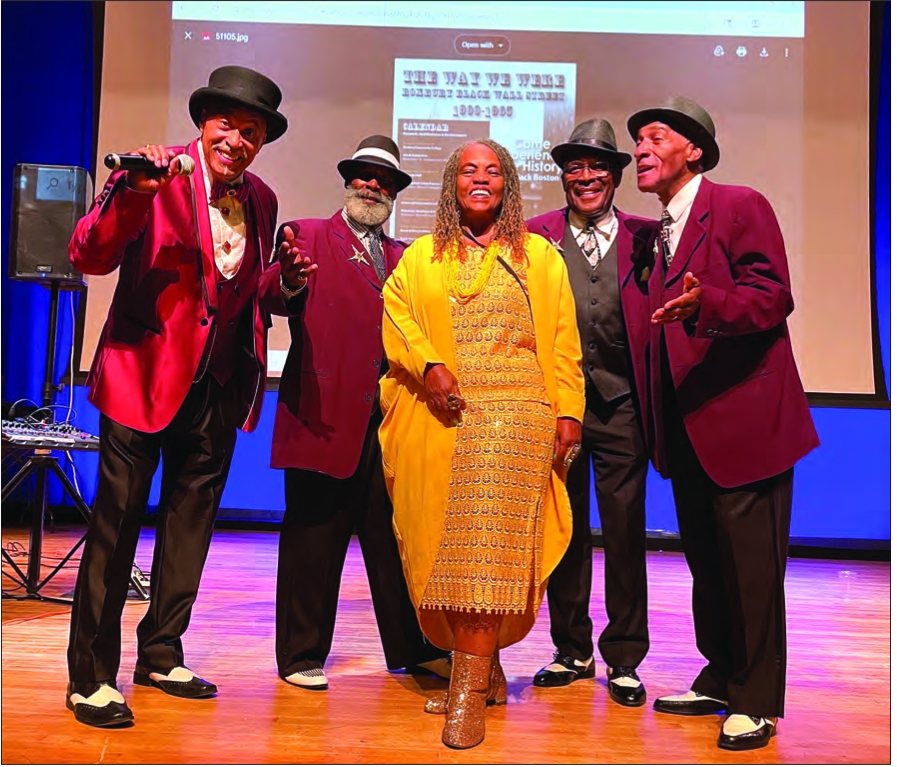
President/CEO
Marie K. Firmin (center) joined The Harmonizing Stars of Boston at
Roxbury Community College after their performance of songs from the
1960s. 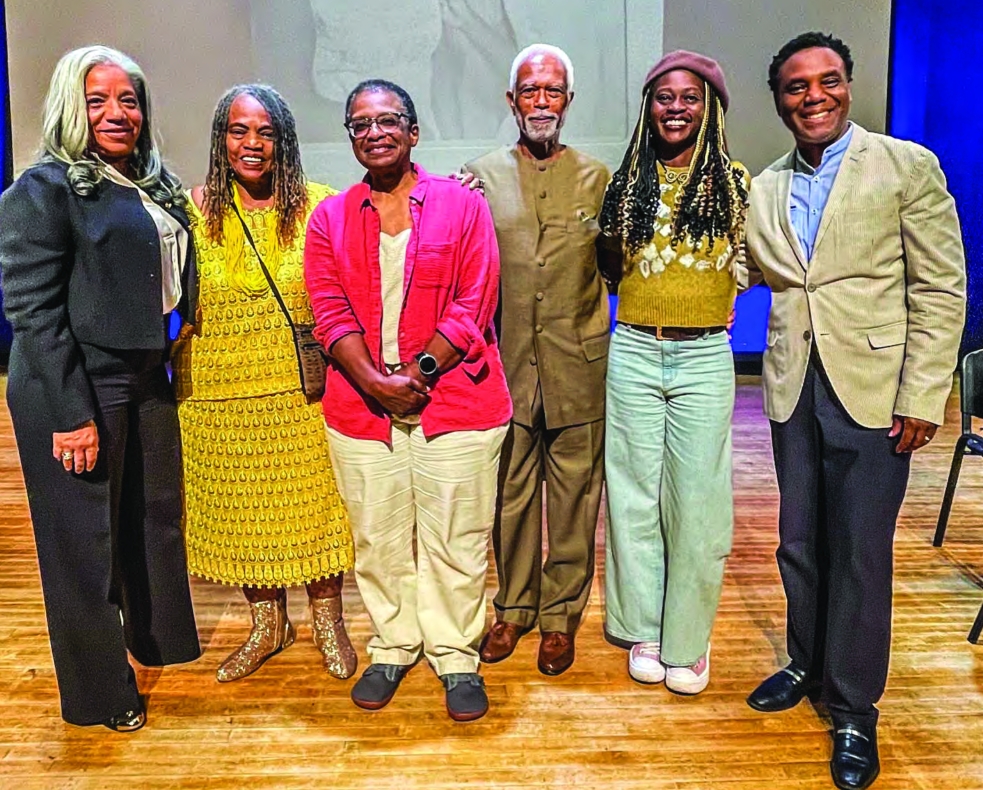
(From
left) Lita Rosario Richardson, Esq. Music Entertainment; Marie K.
Firmin, president/CEO, Black Biz Dev, Inc.; Gina Norton-Smith, chief
archivist, Northeastern’s Snell Library; Dr. Jamadari Kamara, University
of Massachusetts; Ola, moderator; and Yoron Isreal
As September came to a close, Roxbury celebrated the legacy of one of the Black community’s most prosperous eras in Boston.
The weeklong community conference, titled “The Way We Were:
Roxbury Black Wall Street 1900- 1965,” was created to honor the spirit of Black enterprise that once defined the neighborhood, bringing to life the vibrant history of Boston’s own Black Wall Street.
Marie Firmin, the founder of The Way We Were and CEO of BlackBiz Development Group, explained that she used three different methodologies to capture the entrepreneurial spirit that marked Boston’s Black Wall Street era. The first was through extensive research; the second, collecting oral histories from families whose relatives were entrepreneurs. Finally, she and her team transformed these stories into live performances featuring more than 60 local musicians, artists, singers and dancers.
Scholars were present during the morning of each event, hosting discussions with community members about the rich history of Boston’s Black Wall Street. These conversations were followed by performances that aimed to preserve and amplify the stories of the era.
The gathering was made up of four different events held at different locations throughout Roxbury, each focusing on a different aspect of Black Wall Street from 1900 to 1965.
The conference began at Roxbury Community College with a conversation on the arts and automotive industries. Day two at Hibernian Hall featured a discussion on housing, real estate, finance, churches and health. The third day, held at the Universal Unitarian Church, covered education, medical and legal systems.
The final day was held at the Bruce Bolling Building, where the dialogue turned to food, travel and nightlife.
The
area that is known as Nubian Square today was once a prosperous center
of Black commerce and culture, filled with a number of Black
entrepreneurs who built their own infrastructures and established a
foundation for self-sufficiency and economic independence throughout the
community.
Although
it was not destroyed by an act of racial terrorism and violence like
Tulsa’s Black Wall Street, Robury’s Black Wall Street was dismantled by
systemic factors such as redlining, urban renewal projects that
displaced the Black community, and the loss of an economic foundation.
While
Nubian Square is heading in the right direction of becoming the
successful hub it once was with event spaces and marketplaces like Black
Market Nubian, Firmin believes it’s important to look back on past
accomplishments in order to rebuild the community.
“To
be Black and be an entrepreneur, you know, has additional layers, and
that when we know our history, when we love ourselves, when we know what
we’ve accomplished, we are better able to face any kind of issue that
may come our way, because we have the self-determination,” said Firmin.
With
a career deeply rooted in education, entrepreneurship and community
empowerment, Firmin has always put a strong emphasis on preserving the
story of successful Black entrepreneurs by inspiring the youth today.
Firmin
taught at Madison Park Technical Vocational High School for several
years, where she ran a six-month class on entrepreneurship. It was there
she focused on developing an interactive curriculum, writing skits and
stories to make the lessons more interesting for her students.
Infusing
Black entrepreneurial history into her curriculum, Firmin crafted a
class to help boost morale and creativity among her students who wanted
to start their own businesses, like clothing and sneaker lines. But
Firmin convinced them that they could do even more.
“Entrepreneurship
is about having a number of efforts that help to fuel your action and
your passion,” said Firmin. She explained the importance of teaching her
students about the broader context, learning from those who come before
them to take a more comprehensive approach to business.
Besides her vast experience in entrepreneurial education, this work is also deeply personal.
Eloine
Green Gomes, Firmin’s grandmother, was an entrepreneur in the 1920s.
Coming to Boston from Antigua, Gomes was a fashion designer and taught
piano lessons at the Robert Gould Shaw House.
Firmin
was approached by a family friend, Lolita Parker Jr., who had been
commissioned by Northeastern University to do a study on Roxbury.
Through this connection, Parker included a photo of Firmin’s grandmother
along with many others, among her archival research.
It wasn’t until the photo started appearing
on brochures, and even a trolley, according to Firmin, that she decided
to visit Northeastern, where she discovered that the university was not
aware they were utilizing her grandmother’s photo.
After
providing them her grandmother’s name and story, it was then that
Firmin proposed the idea of doing a study on Roxbury from 1900 to 1965,
focusing on entrepreneurship and the Black Wall Street in Boston. This
eventually led to the development of “The Way We Were.”
The
conference wrapped up with the 5th Annual Black Biz Ball. Launched in
2020, it was first hosted by Black Business Enterprises (BBE) and
presented by the Black Biz Development Group LLC and Black Biz Dev Inc.
The
Black Biz Ball is a galvanizing celebration of Boston’s Black
businesses, with an emphasis on community development and youth
empowerment. The Biz Ball has honored more than 80 local businesses in
the last five years. Firmin says that the purpose is to highlight
businesses that support youth and recognize them for their resilience
while encouraging professional standards and fostering business
collaboration.
“Many
of them were referred to each other to get services from each other,
therefore increasing their ability to be able to survive,” said Firmin,
“To be able to write a grant, to be able to do all of the things that we
do to sustain ourselves in this economy.”
Of
the many guest speakers, performers, and scholars that participated in
both events, George “Chip” Greenidge, the founder of Greatest MINDS
Boston, served as a moderator of the panel on nightlife, restaurants and
hotels, and was the keynote speaker at the Black Biz Ball, where 10
businesses were recognized this year.
Greatest MINDS is a nonprofit that was founded
in 2008 to help address community issues and foster civil leadership
among young people of color throughout the Boston area.
Given
his over 35 years of experience in helping develop civic leaders in
Boston, Greenidge explained that his participation was purely driven by
his drive to help shape the next generation.
He also shared that he had a particular interest in the period from 1900
to 1965 — a time that was crucial to the Black community’s success —
that he felt is often overlooked.
“We
believe in our brain that everything happened after Martin Luther King
[Jr.] died in 1968, however, there are many unwritten stories and
unwritten oral history and research that can talk about the strengths
and the comradeship and business acumen that Black Bostonians had in the
1900s to build their economic prosperity,” said Greenidge.
Greenidge
said that following the Grove Hall riot of 1967, the Blue Hill Avenue
area was neglected for over 30 years after numerous businesses were
looted. But then there was hope, Greenidge said; a turning point in the
early 2000s came when several significant developments began to
revitalize the area.
The
Mecca Mall in Grove Hall, the establishment of a CVS, Stop & Shop,
Dunkin’ Donuts, and Bank of America all helped create economic anchors,
which, according to Greenidge, signals a renewed commitment to investing
in the neighborhood.
“We
have always been creative, we have always been entrepreneurial, and
that we come from this legacy, and that we expect everyone to continue
with it to show you role models and examples,” said Greenidge.
The
Way We Were and the Black Biz Ball are only the beginning, according to
Firmin. Her goal is to create a digital community archive, which she
eventually hopes to turn into a museum. The museum would feature a
training center utilizing the curriculum that she developed specifically
for inner-city youth to help foster the growing entrepreneurial success
in Boston’s Black community.
“Our
history should not be a mystery,” said Firmin. “We should know what
happened and how we got to where we are, and ways of getting to the next
phase of our lives.”