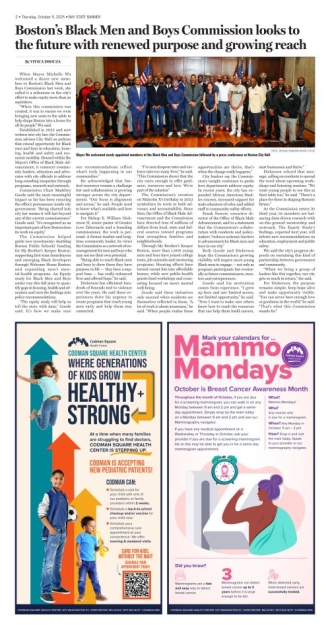
Mayor
Wu welcomed newly appointed members of the Black Men and Boys
Commission followed by a press conference at Boston City Hall.When Mayor Michelle Wu welcomed a dozen new members to Boston’s Black Men and Boys Commission last week, she called it a milestone in the city’s effort to make equity more than an aspiration.
“When this commission was created, it was to ensure we were bringing new seats to the table to help shape Boston into a home for all its people” Wu said.
Established in 2022 and now written into city law, the Commission advises City Hall on policies that extend opportunity for Black men and boys in education, housing, health and safety and economic mobility. Housed within the Mayor’s Office of Black Male Advancement, it connects community leaders, educators and advocates with city officials to address long-standing inequities through programs, research and outreach.
Commission Chair Maddrey Goode said the most meaningful impact so far has been ensuring the office’s permanence inside city government. “Being charted into city law means it will last beyond any of the current commissioners” Goode said. “It’s recognized as an important part of how Boston does its work on equity.”
The Commission helped guide new investments: doubling Boston Public Schools’ funding for My Brother’s Keeper Boston; supporting first-time homebuyers and emerging Black developers through Welcome Home Boston; and expanding men’s mental-health programs. An Equity study for Black Men and Boys under way this fall aims to quantify gaps in housing, health and education and turn the findings into policy recommendations.
“The equity study will help us tell the story with data,“ Goode said. It’s how we make sure our recommendations reflect what’s truly happening in our communities.”
He
acknowledged that limited resources remain a challenge but said
collaboration is growing stronger across the city departments. “Our
focus is alignment and access,” he said. People need to know what’s
available and how to navigate it.”
For
Bishop E. William Dickerson II, senior pastor of Greater Love
Tabernacle and a founding commissioner, the work is personal. A former
teacher and longtime community leader, he views the Commission as a
network of encouragement for men and boys who may not see their own
potential.
“Being able
to reach Black men and boys to show them they have purpose in life —
they have a support base — has really enhanced lives and offered hope,”
he said.
Dickerson has
officiated hundreds of funerals tied to violence over the years. He
said those experiences drive his urgency to create programs that reach
young men early and help them stay connected.
“I’ve seen dropout rates and violence take too many lives,” he said.
“This Commission shows that the city cares enough to offer guidance, resources and love. We’re part of the solution”
The
Commission’s creation on Malcolm X’s birthday in 2022 symbolizes its
roots in both advocacy and accountability. Since then, the Office of
Black Male Advancement and the Commission have directed tens of millions
of dollars from local, state and federal sources toward programs that
strengthen families and neighborhoods.
Through
My Brother’s Keeper Boston, more than 1,000 young men and boys have
joined college tours, job summits and mentoring programs. Housing
efforts have turned vacant lots into affordable homes, while new
public-health grants fund workshops and counseling focused on men’s
mental well-being.
Goode
said these initiatives only succeed when residents see themselves
reflected in them. “A lot of work is about awareness,” he said. “When
people realise these opportunities are theirs, that’s when the change
really happens.”
City
leaders say the Commission’s insight continues to guide how departments
address equity. In recent years, the city has expanded African American
Studies courses, increased support for male educators of color, and
added staff to community-safety efforts.
Frank
Farrow, executive director of the Office of Black Male Advancement,
said in a statement that the Commission’s collaboration with residents
and policymakers “reduces systemic barriers to advancement for Black men
and boys in our city.”
Both
Goode and Dickerson hope the Commission’s growing visibility will
inspire more young Black men to engage — not only as program
participants but eventually as future commissioners, mentors and
entrepreneurs.
Goode
said his motivation comes from experience. “I grew up here and saw
limited access, not limited opportunity,” he said. “Now I want to make
sure others know how to reach the resources that can help them build
careers, start businesses and thrive.”
Dickerson
echoed that message, calling on residents to spread the word about
upcoming workshops and listening sessions. “We want young people to see
this as their table too,” he said. “There’s a place for them in shaping
Boston’s future.”
As
the Commission enters its third year, its members are balancing
data-driven research with on-the-ground mentorship and outreach. The
Equity Study’s findings, expected next year, will inform new
recommendations on education, employment and public safety.
Wu said the city’s progress depends on sustaining this kind of partnership between government and community.
“When we bring a group of leaders like this together, our city gets so much in return.” she said.
For
Dickerson, the purpose remains simple: keep hope alive and make
opportunity visible. “You can never have enough love or goodness in the
world,” he said. “That’s what this Commission stands for.”