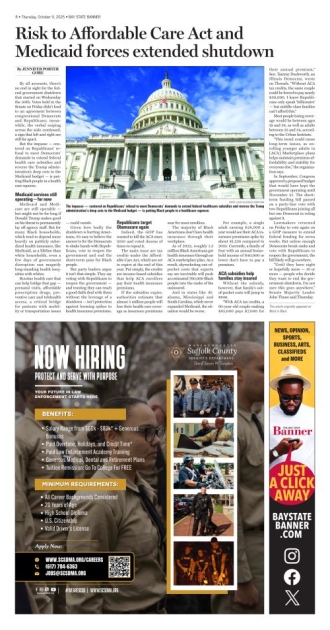
The
impasse — centered on Republicans’ refusal to meet Democrats’ demands
to extend federal healthcare subsidies and reverse the Trump
administration’s deep cuts to the Medicaid budget — is putting Black
people in a healthcare squeeze.By all accounts, there’s no end in sight for the federal government shutdown that started on Wednesday the 30th. Votes held in the Senate on Friday didn’t lead to an agreement between congressional Democrats and Republicans; meanwhile, the verbal sniping across the aisle continued, a sign that left and right are still far apart.
But the impasse — centered on Republicans’ refusal to meet Democrats’ demands to extend federal health care subsidies and reverse the Trump administration’s deep cuts to the Medicaid budget — is putting Black people in a health care squeeze.
Medicaid services still operating — for now
Medicaid and Medicare are still operable — but might not be for long if Donald Trump makes good on his threat to permanently lay off agency staff. But for many Black households, which tend to depend more heavily on publicly subsidized health insurance, like Medicaid, as a lifeline than white households, even a few days of government disruption can magnify long-standing health inequities with whites.
Routine health care that can help bridge that gap — prenatal visits, affordable prescription drugs, preventive care and telehealth access, a critical bridge for patients with mobility or transportation issues — could vanish.
Given
how badly the shutdown is hurting Americans, it’s easy to believe the
answer is for the Democrats to shake hands with Republicans, vote to
reopen the government and end the short-term pain for Black people.
But
party leaders argue it isn’t that simple. They say voting with
Republicans to reopen the government — and trusting they can reach a
good-faith deal with them without the leverage of a shutdown — isn’t
protection against looming spikes to health insurance premiums.
Republicans target Obamacare again
Indeed, the GOP has wanted to kill the ACA since 2010 and voted dozens of times to repeal it.
The
main issue are tax credits under the Affordable Care Act, which are set
to expire at the end of this year. Put simply, the credits are
income-based subsidies that help ACA enrollees pay their health
insurance premiums.
If
the subsidies expire, authorities estimate that almost 5 million people
will lose their health care coverage as insurance premiums soar for
most enrollees.
The majority of Black Americans don’t have health insurance through their workplace.
As
of 2022, roughly 1.3 million Black Americans got health insurance
through an ACA marketplace plan. As a result, skyrocketing out-ofpocket
costs that experts say are inevitable will push an estimated 760,000
Black people into the ranks of the uninsured.
And in states like Alabama, Mississippi and South Carolina, which never expanded Medicaid, the situation would be worse.
For
example, a single adult earning $28,000 a year would see their ACA
insurance premiums spike by about $1,238 compared to 2025. Currently, a
family of four with an annual household income of $40,000 or lower don’t
have to pay a premium.
ACA subsidies help families stay insured
Without the subsidy, however, that family’s outof-pocket costs will jump to $840.
“With ACA tax credits, a 60-year-old couple making $85,000 pays $7,000 for their annual premium,” Sen.
Tammy Duckworth, an Illinois Democrat, wrote on Threads. “Without ACA
tax credits, the same couple could be forced to pay nearly $30,000. I
know Republicans only speak ‘billionaire’ — but middle-class families
can’t afford this.”
Most
people losing coverage would be between ages 19 and 34, as well as
adults between 35 and 54, according to the Urban Institute.
“This
trend could cause long-term issues, as enrolling younger adults in
[ACA] Marketplace plans helps maintain premium affordability and
stability for everyone else,” the organization says.
In
September, Congress approved a proposed budget that would have kept the
government operating until November 21. The shortterm funding bill
passed on a party-line vote with two Republicans joining all but one
Democrat in voting against it.
Lawmakers
returned on Friday to vote again on a GOP measure to extend federal
funding for seven weeks. But unless enough Democrats break ranks and
vote with Republicans to reopen the government, the bill likely will go
nowhere.
“Until they
have eight or hopefully more — 10 or more — people who decide they want
to end the government shutdown, I’m not sure this goes anywhere,” Senate
Majority Leader John Thune said Thursday.
This article originally appeared on Word in Black.