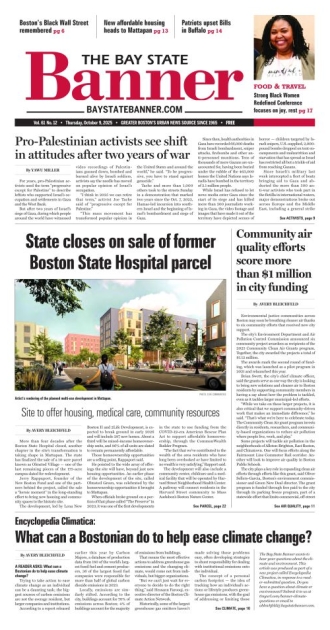
Artist’s rendering of the planned multi-use development in Mattapan.
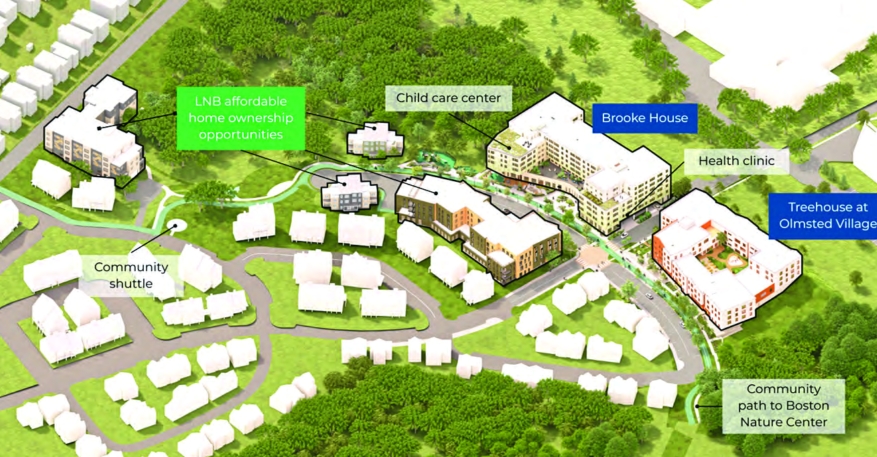
Overhead rendering of planned Olmstead Village housing developmentSite to offer housing, medical care, community resources
More than four decades after the Boston State Hospital closed, another chapter in the site’s transformation is taking shape in Mattapan. The state has finalized the sale of a 10-acre parcel known as Olmsted Village — one of the last remaining pieces of the 175-acre campus slated for redevelopment.
Jerry Rappaport, founder of the New Boston Fund and one of the partners behind the project, called the sale a “heroic moment” in the long-standing effort to bring new housing and community spaces to the historic site.
The development, led by Lena New Boston II and 2Life Development, is expected to break ground in early 2026 and will include 287 new homes. About a third will be mixed-income homeownership units, and 86% of all units are slated to remain permanently affordable.
Those homeownership opportunities are a selling point, Rappaport said.
He pointed to the wide array of offerings the site will have, beyond just new housing opportunities. An earlier phase of the development of the site, called Olmsted Green, was celebrated by the homeownership opportunities it brought to Mattapan.
When officials broke ground on a portion of that phase called “The Preserve” in 2023, it was one of the first developments in the state to use funding from the COVID-19-era American Rescue Plan Act to support affordable homeownership, through the CommonWealth Builder Program.
“The fact that we’ve contributed to the wealth of the area residents who have long been overlooked or have limited to no wealth is very satisfying,” Rapport said.
The development will also include a community center, childcare and a medical facility that will be operated by Harvard Street Neighborhood Health Center.
A pathway will connect residents in the Harvard Street community to Mass Audubon’s Boston Nature Center.
In
a statement in the press release published by the state, Rappaport, in
addition to Lizbeth Heyer, president of 2Life Communities, called the
area a “hub of community benefits.”
“It
takes tremendous vision and commitment for complex projects like this
to move from vision to reality,” they said in the statement.
In
the interview, Rappaport said there’s a “sense of pride and ownership”
for the work, given the long road to get to this point.
The
masterplan guiding development at the site was created in 1993. The
first acquisitions — by University of Massachusetts Chan Medical School
for the construction of the Mattapan campus of Mass Biologics, a
nonprofit vaccine manufacturer and by Mass Audubon for the establishment
of the Boston Nature Center — occurred in the late 1990s and early
2000s.
The first acquisition on the site for the development of housing occurred in 2003.
State
officials touted the development as a step to bring more affordable
housing to the area. Gov. Maura Healey called it an “important
milestone.”
“The new
homes that will be built on this site, alongside amenities such as
childcare and community centers, will provide a great place for seniors
and young people alike to build their futures,” she said in a statement.
Lt. Gov. Kim Driscoll called it a demonstration of “the power of repurposing public land for the public good.”
For
Rappaport, the development represents a strong opportunity to support
people across generations. That intergenerational model was celebrated,
too.
It’s a set-up that Rappaport said is possible due to the partners who have come together in the work.
“The
intensive program elements that they run to add to people’s lives is
the cherry on the sundae, in the sense of what a great addition to all
of the affordable rental and home ownership housing that we’ve been
doing,” Rappaport said of 2Life.
The
partnership also includes Lena Park CDC, a long-standing collaborator
which Rappaport called “a strong partner,” as well as Jewish Vocational
Services, which is providing job training.
Rappaport
also credited the leadership of officials like Sheila Dillon, the city
of Boston’s chief of housing, as well as state Rep. Russell Holmes, who
represents the area, and state officials who have been involved.
“It’s
just very holistic, comprehensive, empathetic, equity-sharing in these
turbulent times that makes me very proud to be a part of it with my
great partners,” Rappaport said.