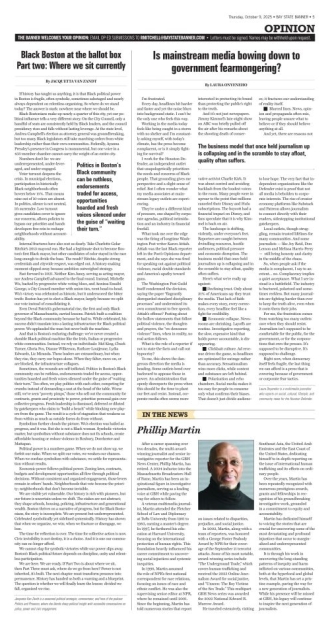
Phillip Martin
After a career spanning over two decades, the multi-awardwinning journalist and senior investigative reporter for the GBH News Center, Phillip Martin, has retired. A 2024 inductee into the Massachusetts Broadcasters Hall of Fame, Martin has been an inspirational figure in investigative journalism, serving as a leading voice at GBH while paving the way for others to follow.
A veteran multimedia journalist, Martin attended the Fletcher School of Law and Diplomacy at Tufts University from 1981 to 1983, earning a master’s degree. In 1997, he furthered his education at Harvard University, focusing on the international protection of human rights. This foundation heavily influenced his career commitment to uncovering social injustices and systemic inequities.
In 1998, Martin assumed the role of NPR’s first national correspondent for race relations, focusing on issues of race and ethnic conflict. He was also the supervising senior editor at NPR, where he remained until 2001. Since the beginning, Martin has told numerous stories that report on issues related to disparities, prejudice, and social justice.
In 2002, Martin, along with a team of reporters, was honored with a George Foster Peabody Award by NPR for their coverage of the September 11 terrorist attacks. Some of his most notable, award-winning series include “The Underground Trade,” which covers human trafficking and received the 2023 Online Journalism Award for social justice, and “Unseen: The Boy Victims of the Sex Trade.” This multipart GBH News series was awarded the 2022 National Edward R. Murrow Award.
He traveled extensively, visiting Southeast Asia, the United Arab Emirates and the East Coast of the United States, dedicating himself to in-depth reporting on the issue of international human trafficking and its effects on ordinary people.
Over the years, Martin has been repeatedly recognized with numerous prestigious awards, grants and fellowships in recognition of his groundbreaking investigative work, grounded in a commitment to equity and accountability.
Martin has dedicated himself to voicing the stories that are crucial for uncovering some of the most devastating and profound injustices that occur to marginalized and underrepresented communities.
It is through his work in uncovering the long-standing patterns of inequity and harm inflicted on various communities, both at the hyperlocal and global levels, that Martin has set a pristine example, paving the way for a new generation of journalists. While his presence will be missed at GBH, his legacy will continue to inspire the next generation of journalists.