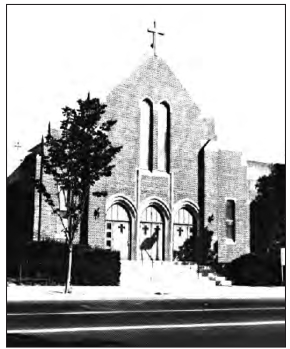
St. Cyprian’s Church in Roxbury became Boston’s first Black Episcopal parish in 1913. At the corner of Tremont and Walpole streets, St. Cyprian’s Episcopal Church stands as a century-old symbol of faith and community for Boston’s Black and West Indian residents. The congregation formed in the early 1900s, meeting in the parlor of Ida Gross on Northampton Street. At a time when Roxbury had no Episcopal churches open to people of color, the group created its own sacred space, sustaining spiritual life in living rooms until they could build a permanent home.
In 1911, the Episcopal Diocese of Massachusetts formally recognized the congregation as St. Cyprian’s Mission, named after the third-century North African bishop and martyr. That recognition gave the fledgling community a place in the wider diocese and the resources needed to grow. In 1913 it became Boston’s first Black Episcopal parish. A cornerstone was laid in 1923 and the present brick sanctuary was completed in 1924 under the leadership of Rev. Leroy Ferguson.
From the start, the church served both West Indian immigrants and African Americans from the South. “In the beginning, the church was really involved with a majority West Indian community and Southern Blacks,” said James S. Dilday, a longtime parish member and community leader. “By the 1950s, it was very important with Black youth. It had after-school programs and a drum and bugle corps that was one of the best in the city, marching in all the major parades.”
The Pythagoreans Drum and Bugle
Corps became one of the parish’s most recognizable groups, providing
music, discipline and pride for young people. The church also fostered
artistic expression through its Literary and Music Guild, which
organized readings, concerts and gatherings that gave space for cultural
traditions to flourish.
These
programs reflected a broader pattern among Black churches in the early
20th century: Congregations were not only places of worship, but also
institutions that preserved culture, trained youth and built leadership
in communities facing exclusion from many civic spaces.
The
parish has ties to one of the most recognizable names in American
religious life. “One of the most famous people to come out of the church
would be Minister Louis Farrakhan,” Dilday said. “His name was Eugene
Walcott at the time. He grew up in the church, sang in the choir and was
also in the drum and bugle corps.”
In
addition to Farrakhan, Dilday recalled that many professionals —
doctors, lawyers and politicians — also emerged from St. Cyprian’s.
Their stories reflect the way the church became a launching point for
civic leadership in Roxbury and beyond.
Next
week, the church will mark the 100th anniversary of its building with a
pair of community celebrations. A centennial dinner is scheduled for
Sept. 13 at Prince Hall in Dorchester and a luncheon is planned for
Sept. 14 at Granite Links in Quincy. Organizers say the events are
intended not only to celebrate a century of worship but also to
recognize the generations who built and sustained the parish.
Parish
leaders expect current members, descendants of the original West Indian
founders and visitors from across the Episcopal Diocese to attend. The
gatherings will honor those who laid the foundation for Black and
Caribbean Episcopalians in Boston while pointing toward the church’s
next century.
The
sanctuary’s stained glass windows are one of its defining features. “The
church is welcoming to all who are interested in attending,” Dilday
said. “We invite people to come in, see what’s happening and explore the
stained glass windows, which in contrast
to other churches include images of Martin Luther King and other people
of color active in Black history.”
The
brick building itself, completed in 1924, was a statement of permanence
in a city where immigrant and minority communities often faced
displacement. For the founders, it represented resilience as well as
devotion.
Through the
decades, St. Cyprian’s has extended its mission beyond worship. Church
records and community accounts describe food programs, support for
families in need and space for civic meetings in Roxbury. Before the
COVID-19 pandemic, the church ran a solid food pantry, which members
hope to restart in the near future. Its continued activity in the
Episcopal Diocese of Massachusetts demonstrates the lasting importance
of institutions founded by immigrants for their own survival and
solidarity.
In recent
years, Dilday noted, the congregation has also welcomed students from
nearby universities and new residents of different backgrounds. This
reflects a shift from being primarily West Indian and African American
to serving a more diverse population while holding onto its historic
role in Boston’s Black community.
As
it enters its second century, parish leaders say St. Cyprian’s aims to
maintain that balance of faith and service. “For over 100 years, the
church has been an integral part of the Roxbury community,” Dilday said.
“Now we are seeking to grow into a voice in the Greater Boston
community as well, enriching our membership and reaching out more to the
community around us.”
The
upcoming centennial gatherings will celebrate a church that began in a
Roxbury parlor, built its own sanctuary in 1924 and endures today as a
pillar of Black life in Boston.