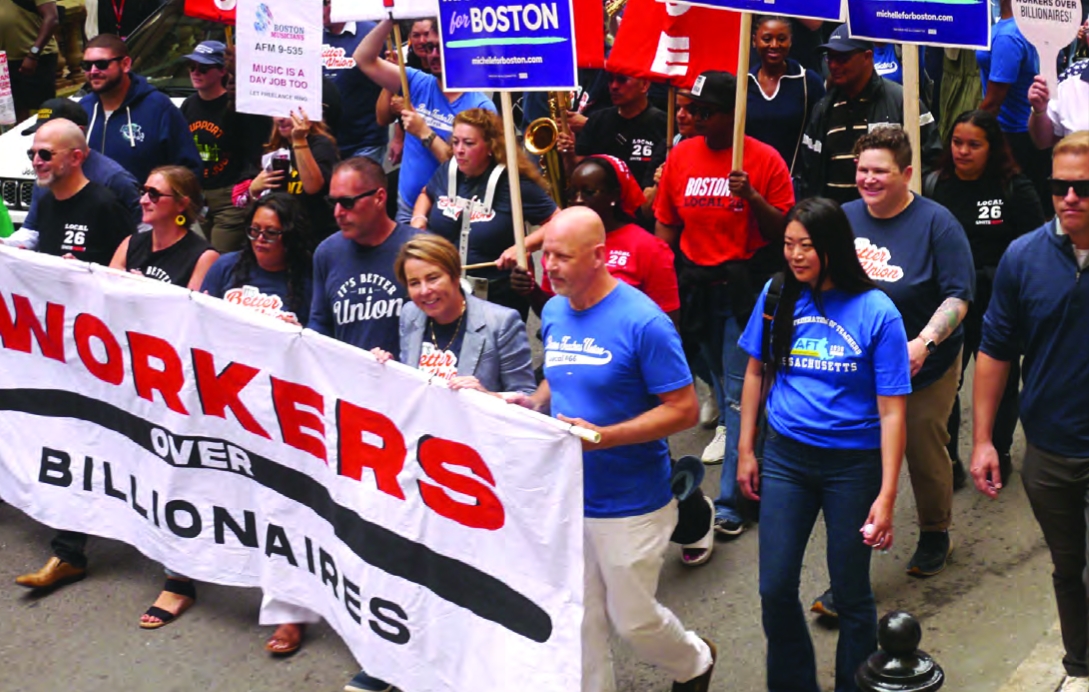
Union leaders and elected officials lead a Labor Day march through downtown Boston. 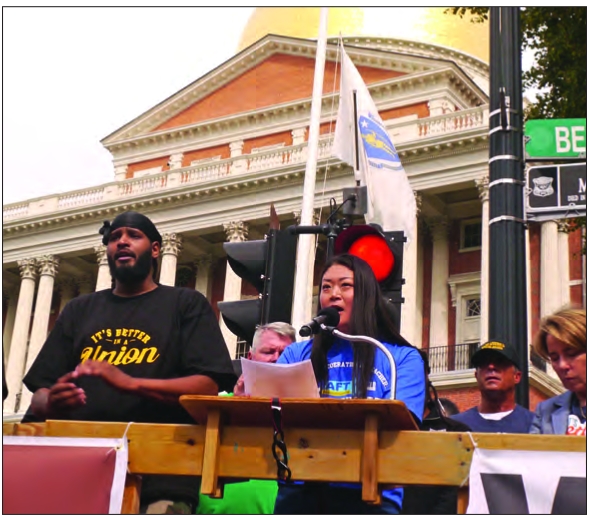
American Federation of Teachers President Jessica Tang speaks to activists gathered in front of the State House.
Markey, Warren, Pressley, Healey join unions in march to City Hall Plaza
Boston’s union movement took to the streets Monday, breaking with the local tradition of Labor Day breakfasts held at a downtown hotel. Labor activists, members of community-based organizations and elected officials gathered in front of the State House before marching through downtown Boston to City Hall Plaza, with many speaking out against the encroachment of the Trump administration and big business on labor rights.
“It is the working class that is the backbone of America, not the billionaire class,” said AFL-CIO Massachusetts President Chrissy Lynch. “This is a day that we recommit ourselves to an economy that actually works for the working class, because right now our economy and our laws are rigged to favor the billionaire and corporate executive class.”
Several thousand activists lined the streets as the march made its way through downtown. Building trade union members, Service Employee International Union workers, Local 26 Hotel workers and others, including base-building activist groups such as Lynn United for Change, Community Labor United and the Chinese Progressive Association, filled the downtown streets, their chants echoing off office buildings.
Among those marching in the parade were U.S. senators Ed Markey and Elizabeth Warren, U.S. Rep. Ayanna Pressley and Gov. Maura Healey.
Marching through downtown, Pressley said she appreciated the local labor movement’s decision to move the march from the ballroom at the Park Plaza Hotel, where it has traditionally been held, to the streets. Pressley said that President Trump and the authors of the Project 2025 plan that has guided much of his administration’s work have set unions in their crosshairs.
“This hostile government in the midst of an active march toward authoritarianism is degrading rights that we have fought for and attacking working families,” she said. “We have to match their energy. We have to
be disruptive. This isn’t business as usual, and I think a breakfast
would have felt that way. We need to be out here. We need to be in
solidarity.”
Carrying a
“Labor against genocide in Gaza” sign, Somerville City Councilor and
mayoral candidate Willie Burnley said the U.S. labor movement has long
embraced solidarity with international movements.
“Working
people here know they’re getting a raw deal,” he said. “Workers are
being downsized, departments are being cut so that a few wealthy
individuals and industries, including the war machine, can profit. The
fact that we are sending billions of dollars overseas to fund a genocide
and to fund an apartheid regime in Israel when workers here can barely
feed their families is a crime against the American people. We need to
have a labor movement that is militant, that stands up for the rights of
all people and that is making the connections between workers’ rights
in America and workers’ rights in Palestine, because they’re connected.”
The
labor activists stopped at historic sites where activists drew
connections to the labor movement. At the site of the first public
school in the nation on School Street, activists with teachers’ unions
celebrated recent wins, including smaller class sizes and increased
staffing of school nurses and counselors. Locally, teachers’ unions
fought for and won a ballot referendum that instituted a 4% tax
surcharge on annual income over $1 million and dedicated that more than
$2 billion in revenue the tax generated to education and transportation
in Massachusetts.
“Union
busting is part of the billionaires’ strategy,” said American
Federation of Teachers President Jessica Tang. “That’s because unions
are on the front lines of fighting for not just the working conditions
and wages of union members, but a better life for all.”
Union activists didn’t confine their criticism to the Trump administration or the Republican Party.
AFL-CIO’s Chrissy Lynch had strong words for both political parties.
“I’m
going to say this with love to every elected official who is standing
with us today: We feel shut out by both political parties, neither of
whom have done enough about economic security for the working class,”
she said.
Monday’s
march came amid local labor struggles, including a weeks-long strike by
sanitation workers with Republic Services who are pushing for higher
wages.
“If we can’t
treat the people who pick up our trash with respect, who are we?” said
2nd Suffolk District state Sen. Nick Collins. “We’ve come a long way
with the labor movement, but it doesn’t take much to take things
backward.”
State Rep.
Sam Montaño, who represents the Jamaica Plainbased 15th Suffolk
District, said the gathering of labor activists Monday demonstrated the
power of collective organizing.
“People
are ready to fight back,” Montaño said. “The majority of people want a
world where working people are paid well and treated fairly.”
This story originally appeared on flipsidenews.net.