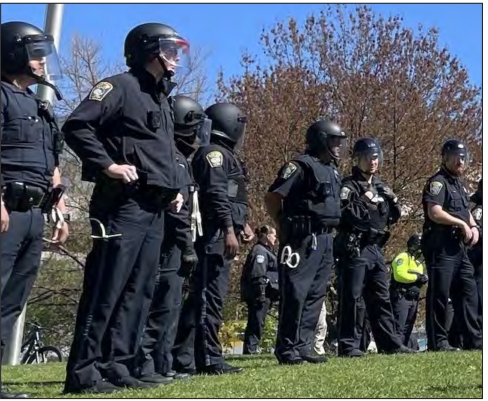
Boston police officers face off against student protestors at Northeastern University in 2024. City councilors on Tuesday voted against approving the use of three social media surveillance tools by the Boston Regional Intelligence Center.
The report on these tools will be sent to the Surveillance Oversight Advisory Board, which will make recommendations to Mayor Michelle Wu.
“I think there’s a sliding scale between public safety and civil liberties,” said District 6 Councilor Ben Weber, who voted against approving the technology. “None of us want to see civil liberties trampled on.”
This vote came a week after city councilors gathered for a hearing on these tools in which Fatema Ahmad, executive director of the Muslim Justice League; and Nasser Eledroos, a computer scientist
and former staffer at the Suffolk County District Attorney’s Office,
expressed opposition to this technologies and their use against the
Muslim community.
The
social media surveillance tools SourceFeed and Search Feed Databases,
Chorus Intelligence Suite and Tangles, were said to have been used
during “exigent circumstances.” The Boston Police Department gained
access to SITE technologies and Chorus in February 2025. The police
department did not have access to Tangles as of June 2025.
These
technologies had been used in 2023 and 2024, prior to the June 5 letter
sent by the Boston Police Commissioner Michael Cox to City Council
President Ruthzee Louijeune to report on them this year.
According
to the city’s Ordinance on Surveillance Oversight and Information
Sharing, the Boston Police Department must report on the use of
technologies employed under exigent circumstances 30 days after the end
of use.
Ahmad stated during the hearing that the police did not follow correct procedures when using these technologies.
“The
point of this ordinance was to provide transparency and make sure that
the City Council, and logically through City Council that community
members, get to have a say in what technology BPD has access to,” said
Ahmad in an interview.
During
last week’s hearing, Atlarge Councilor Henry Santana said that the
administration acknowledged at a hearing the week prior that the report
was late and that it would not be late next time. Santana also pointed
out that the administration did not explain why it was late.
During
Tuesday’s hearing, councilors expressed concern about approving the
department’s use of the technology after police failed to notify them of
its use within 30 days, as required by the ordinance.
“I think it’s important as a body that we don’t render this ordinance toothless,” Louijeune said.
Louijeune
joined District 9 Councilor Liz Breadon, At-large Councilor Julia
Mejia, District 5 Councilor Enrique Pepén, Weber and District 4
Councilor Brian Worrell in voting against approving the technology.
Voting in favor were District 8 Councilor Sharon Durkan, District 3
Councilor John FitzGerald, District 2 Councilor Ed Flynn, Santana and
At-large Councilor Erin Murphy.
Durkan,
who spoke with representatives of the police department prior to the
hearing, said she believed they would not violate the ordinance again.
“I
got an assurance that would make more of an effort to make sure that
they’re going to the council and abiding by the ordinance,” she said.
In
addition to having concerns about following the correct procedures set
out in Boston’s Surveillance Ordinance, Ahmad and Eledroos expressed
their concern over BRIC’s targeting of Muslim communities and
pro-Palestine groups and their activities.
“It’s
not just that they are looking at the events that are happening,” said
Ahmad, “but they are putting out situational awareness reports about
these movements and sharing out to both private and public agencies and
partners about these events as if they are of concern.”
Documents
obtained by The Flipside show BRIC surveillance of events and
activities related to the Israel-Hamas conflict. Social media
surveillance of these events mainly focused on the activities of
pro-Palestinian protest groups, including those at local universities.
The document stated that the information in this report involved
activities protected by the First Amendment and was only meant for
“operational planning in the interest of assuring the safety and
security of the demonstrators and the public.”
During
the hearing, Eledroos explained that social media surveillance
algorithms are not put under the same scrutiny as forensic evidence.
“They
can deprive someone of rights or due process simply by making
generalized assumptions about what someone might say online,” said
Eledroos.
Flynn, however, believes that these technologies are an important part of keeping Boston safe.
“I
believe surveillance tools make the city safer. And the men and women
of the Boston Police Department, and their professionalism and how they
conduct their job is also important,” said Flynn.
Weber,
who serves as the City Council representative on the Surveillance
Oversight Advisory Board, said that he believes social media
surveillance raises issues about whether it can increase public safety.
“It
certainly seems like a majority of the time it ends up flagging only a
certain kind of activism and it’s not obvious to me what the benefit is
to the public of us doing that,” he said
Ahmad
also said of potential civil rights violations: “All of these tools,
particularly these social media analysis tools, sweep up data and
information about people who are not suspected of any violence or
anything, and so it’s pretty concerning that they could be looking at
folks who are just engaging in free-speech activities.”
According
to the city’s surveillance ordinance, after the council rejects
surveillance technology acquisition, the matter is referred to the
city’s Surveillance Oversight Advisory Board, which includes
representatives from the police department, appointees from the mayor’s
office and a city councilor.
After the board makes a recommendation to the mayor, she can resubmit a request for the technology acquisition to the council.
This story originally appeared on flipsidenews.net.