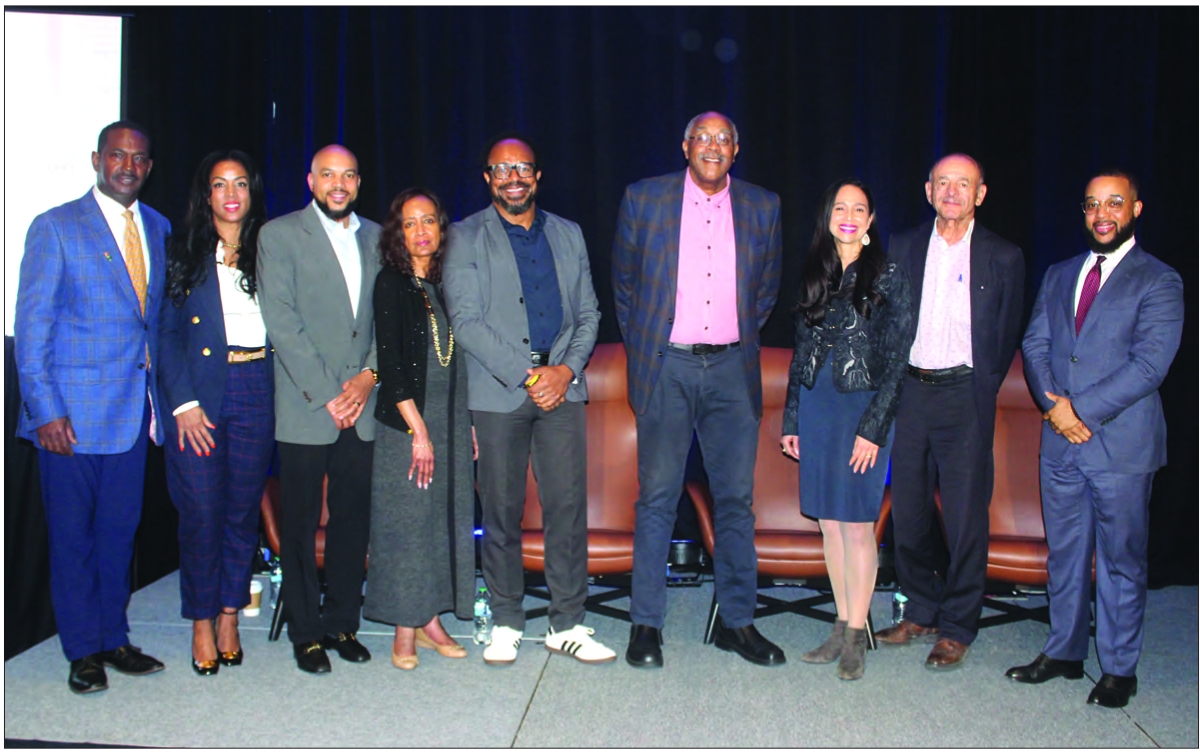
(From
left) Ronald Mitchell, Banner Publisher and Editor; Shellee Mendes,
founder CEO of Salon Monet; Kern Tyler Edward, L. Cooper Com. Garden;
Edwidge Lafleur Bayas, RCC Business Innovation Center; Lecollion
Washington, Community Music Center Boston; André Stark, Banner Associate
Publisher; Celina Barrios-Millner, Mass Convention Center Authority;
John Cruz, President Cruz Companies; Segun Idowu Former chief of
Economic Opportunity and inclusion City of Boston. 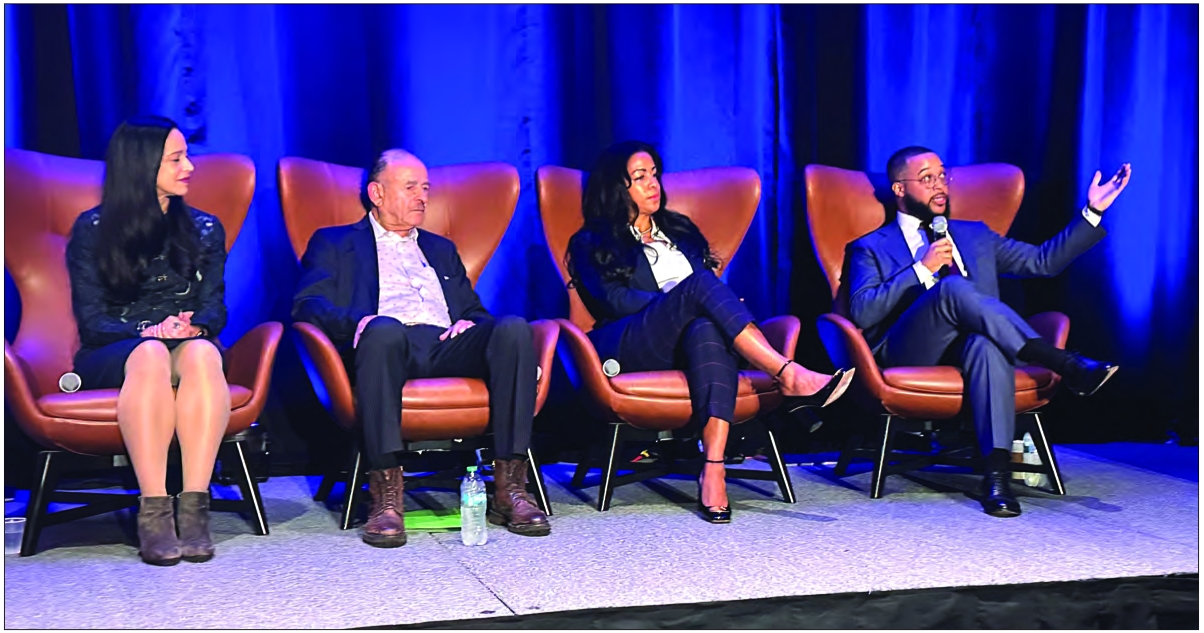
During
the forum, Celina Barrios-Millner, John Cruz, Shellee Mendes and Segun
Idowu share their thoughts on Black business ownership in Boston.

(From
left) Host Ron Mitchell of the Banner, Colette Phillips, owner of
Colette Phillips Communications; Marvin Gilmore, Western Front, LLC;
Nicole Obi, president and CEO of BECMA and John Barros, Executive
Director of the Mass. Convention Center Authority.
Local business leaders gather for Bay State Banner’s ‘State of Black America’ forum series
The Bay State Banner’s 60th anniversary forum series recently hosted a vibrant community discussion on “Black-Owned Businesses: Building Wealth and Strengthening Communities.” The event brought together seasoned business leaders, policy experts, and community advocates to share insights, lessons learned, and strategies for fostering sustainable economic growth within Black communities. From the critical role of partnerships and allyship to the transformative potential of AI and the enduring fight for equitable procurement, the conversation offered a multifaceted view of the challenges and opportunities facing Black entrepreneurs in Boston and beyond.
A recurring theme throughout the discussion was the indispensable power of partnerships and allyship. John Barros, a prominent voice at the forum, highlighted how mergers among smaller companies can ease access to contracts, enabling growth that might be unattainable individually. He recounted his successful $2 million contract partnership with Colette Phillips for the “All Inclusive Boston” marketing campaign, emphasizing that the collaboration was based on her competence, not just her race. This sentiment was echoed by Colette Phillips herself, who stressed the importance of allyship — white partners willing to collaborate with Black and other businesses of color. She cited Gloria Larson’s pivotal role in creating partnerships between the Massachusetts Convention Center Authority (MCCA) and the Black Economic Council of Massachusetts (BECMA), leading to successful ventures like the Omni Seaport hotel involving Black investors. Phillips underscored that trust is the cornerstone of any successful partnership, advocating for starting with small collaborations to gauge compatibility before pursuing larger endeavors.
The importance of trust extended beyond individual partnerships to the broader business landscape. Segun Idowu, former Director of Economic Inclusion for the City of Boston, lamented the persistent “less than 1%” statistic concerning capital and contracts awarded to Black businesses. He attributed this significantly to a lack of trust in Black entrepreneurs, often resulting in heightened scrutiny and skepticism compared to their white counterparts. Idowu argued that despite evidence that Black companies are plentiful, often less than1% of investments, or grants issued, go to those businesses, which continue to face systemic barriers.
This stark reality underscores the need for continued advocacy and policy changes to dismantle these entrenched biases.
Indeed, policy and inclusive procurement emerged as critical levers for change. Nicole Obi of BECMA highlighted the significance of policy trends, urging the community to actively push back against efforts to dismantle diversity, equity and inclusion (DEI) initiatives. She pointed out that “what is good for Black America works for America,” emphasizing the economic impact of Black purchasing power, citing Target’s $12 billion loss after scaling back DEI efforts. Celena Barrios-Milner, director of economic opportunity for the MCCA, underscored her commitment to leveraging the MCCA’s substantial economic activity ($1.4 billion annually) to benefit Black communities through inclusive procurement. She plans to implement a “buying plan” and proactive information sessions to help Black businesses prepare for upcoming contract opportunities, a strategy praised by community members like Ricardo Lewis, who lauded Idowu and Barrios-Milner for their instrumental roles in helping his minority-owned business secure a vital stadium contract.
The
discussion also touched on the role of technology, particularly AI, in
business growth. Barros and Obi both highlighted AI’s potential to
streamline administrative tasks, simplify procurement processes, aid in
marketing, and optimize small teams, making businesses more efficient.
However, they also acknowledged the potential for job displacement,
urging businesses to assess their sectors and strategically pivot to
leverage AI as an opportunity rather than a threat. Phillips even shared
her use of AI-driven project management (Asana) and email drafting
(Fixer) platforms to enhance her business operations.
Beyond
policy and technology, the panel emphasized the enduring values of
resilience, hard work, and mentorship. John Cruz, a third-generation
Black business leader, shared his family’s journey in the construction
industry, highlighting his father’s perseverance in the face of racial
discrimination. Cruz stressed the importance of a strong work ethic and
the longterm vision needed for sustained success, advising against a
yearto-year focus.
Shellee
Mendez, owner of two successful salons on Newbury Street, shared a
powerful personal story of overcoming homelessness to achieve her
entrepreneurial dreams. Her “wake-up call”led her to set clear goals,
seek mentorship, and relentlessly pursue her vision. Mendez emphasized
the need for Black entrepreneurs to mentor each other and to be
consistently present in their businesses. She also cautioned against
rapid expansion, advocating for a “start small” approach, noting that
“big is not always” better.
The
Roxbury Community College Business Innovation Center, represented by
Director Edwidge Lafleur Bayas, highlighted institutional support
available to local entrepreneurs. The center offers education, training
programs, co-working spaces, and vital connections to mentors and
organizations like the Small Business Administration, actively working
to cultivate a thriving entrepreneurial ecosystem.
This
60th anniversary forum painted a comprehensive picture of the concerted
effort required to foster Black business success. It’s a journey
propelled by strategic partnerships and strong allyship, bolstered by
supportive policies and inclusive procurement, and increasingly
empowered by technological advancements
like AI. More profoundly, it’s a testament to the unwavering resilience,
dedication, and community spirit of Black entrepreneurs who, through
mentorship and mutual support, continue to build wealth and strengthen
the fabric of their communities. The call to action is clear: to
continue challenging systemic barriers, advocating for equitable
opportunities and investing in the collective growth of Black-owned
businesses.