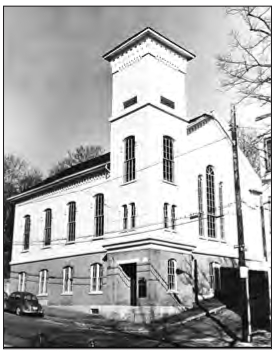
Congdon Street Baptist Church
As the smallest state, Rhode Island’s involvement in the Underground Railroad is often overlooked. When the freedom movement was covered by historians in the 1970s, Rhode Island was largely excluded from the conversation, while states like Ohio, Indiana and Michigan were centered. A local nonprofit, however, is working to change the narrative.
Cofounders and directors Ray Rickman and Robb Dimmick opened Stages of Freedom in 2015 to bring Black literature, history and legacy to the streets of Providence, Rhode Island. The organization also serves as a marker for the preservation of Black cultural representation. Working from downtown Providence’s Westminster Street, these longtime historians developed a relationship through their cultivation of research.
“African American history is not a separate history. It is American history,” said Dimmick.
Along with the rise of the Black Panther Party in the late 1960s and early 1970s came the resurgence of Black literature, thought and independence. At the time, there were only three identifiable sites in Rhode Island. Today, there are more than 25.
The locations offered safe spaces for Black and white abolitionists to work together, ensuring the escape of enslaved people. While most of these sites are not documented by the National Park Service’s
Underground Railroad Network to Freedom program, locals have publicized
their state’s historical involvement.
Some
of these sites include the John Brown House, built 1786-1788 for slave
trader John Brown, a supporter of Brown University; Market House, built
by enslaved people during the 1700s; and the Providence Gazette, which
published runaway slave notices. Additional landmarks include Congdon
Street Baptist Church, long associated with Black abolitionists and
African American community members, and Pond Street Baptist Church.
Other
sites reaffirm this historical network, including a burial ground at
the Cathedral of St. John, which memorializes enslaved people; the
Providence African Union Meeting House, representing Black life across
the 18th, 19th and 20th centuries; and Scalloptown in East Greenwich, a
historic free Black community.
Maritime
escape routes also contributed to Rhode Island’s Underground Railroad
network, bridging coastal transportation with other systems of
resistance.
Together,
these sites, alongside resources featured by Stages of Freedom, form a
growing archive. With the help of historians Rickman and Dimmick, the
list continues to expand, highlighting a central question: “How can you
serve the people, if you don’t understand their lives, their history and
their being?” The answer, as this history reveals, requires empowerment
of Black Americans.
Through
erasure, New England’s historical relevance has become solely
associated with the American Revolution, Rickman and Dimmick explained.
Wealthy, white men were put on pedestals by historical societies,
instead of the abolitionists who fought for freedom. In conversation
with the Banner, Rickman and Dimmick noted that their efforts to expand
historical memory have spanned more than 40 years.
Censorship
of Black history is detrimental on a regional and national level,
stripping families of the connection to their roots. As Rickman said,
“Things are promoted by somebody, and if you don’t have anyone to
promote it, it doesn’t get promoted.”
Additionally,
developing markers — monuments, statues or signs — can be financially
and logistically taxing. Stages of Freedom puts up one to three markers
per year.
One recently
honored Christiana Carteaux Bannister, a renowned 19th-century
abolitionist and businesswoman. The plaque recognizes her impact on
society and key role in Rhode Island’s Underground Railroad.
Years
ago, Rickman helped create a plaque marking the First Baptist Church in
the country. The plaque honoring the Providence church took three days
to be installed by the city, while another took 11 years to be
finalized. Dimmick said this exhaustive process is an example of the
“resistance to celebrating and honoring this history.”
It
was later revealed that some plaques had been stolen or vandalized with
acid, particularly the one at the John Brown House on Power Street.
While the culprit remains unknown, the damage is still felt by
neighboring communities. The carved inscription withstood the acid — a
symbol that history cannot be erased.
Rhode
Island’s involvement as a key port in the transatlantic slave trade and
as a refuge for freed enslaved people is well known, but today,
infrequently acknowledged. Frederick Douglass visited Newport multiple
times before traveling to New Bedford, Mass. Enslaved Africans in
Newport contributed to art, cuisine and culture, in addition to building
the very sidewalks residents walk on today.
Newport
is far from the only part of Rhode Island that historians and advocates
hope will confront its role in slavery. Brown University was built by
enslaved Africans. In acknowledgement, Ruth Simmons, the first Black
president of an Ivy League institution, created the Steering Committee
on Slavery and Justice in 2003. This ensured that students would know
the university’s origin, including its painful past.
Similar
to Simmons’ approach, Stages of Freedom uses educational initiatives to
protest misinformation. After being in contact with the National Park
Service, they were told there was no listing for the National
Underground Railroad Network to Freedom in Rhode Island. While this
absence illustrates a common theme of erasure in the state’s history, it
does not take away from its Black abolitionist roots.
In
dedication his brother, one enslaved Rhode Islander, Pompe Stevens,
also known as Zingo, created the first known signed piece of art by an
African American. Around the same period, Newport Gardner also made
history publishing sheet music, an early representation of Black musical
impact in the United States.
These findings had been buried for years.
The mission of Stages of Freedom, Dimmick said, has been to “unearth” these stories.