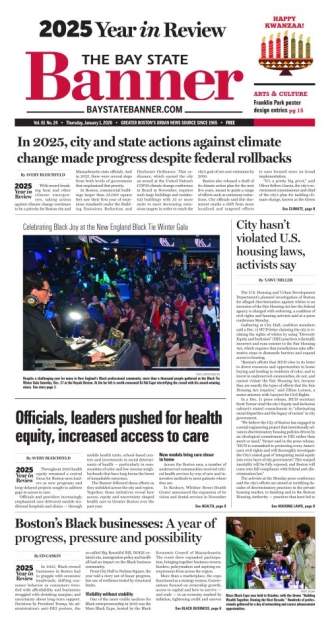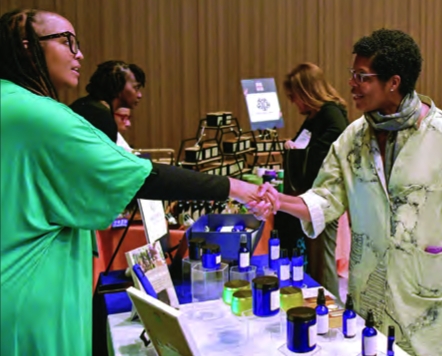
Mass Black Expo was held in October, with the theme “Building Wealth Together, Owning the Next Decade.” Hundreds of professionals gathered for a day of networking and career advancement opportunities.
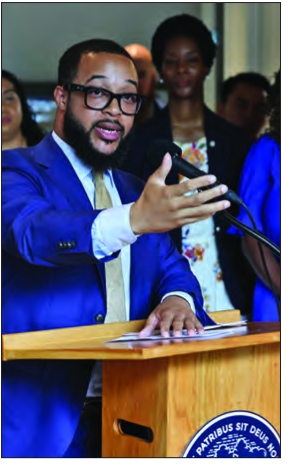
City of Boston’s Chief of Economic Opportunity and Inclusion Segun Idowu addresses SCALE grant recipients.
Maria Storms started MVS Welding in 2020 through the city’s Supplying Capital and Leveraging Education (SCALE) assistance program.
2025 Year in Review
In 2025, Black-owned businesses in Boston had to grapple with economic headwinds; shifting consumer behavior as consumers wrestled with affordability and businesses struggled with shrinking margins; and uncertainty about long-term support. Decisions by President Trump, his administration’s anti-DEI posture, the so-called Big Beautiful Bill, DOGE-related cuts, immigration policy and tariffs all had an impact on the Black business community.
From City Hall to Nubian Square, the year told a story not of linear progress, but one of resilience tested by structural limits.
Visibility without stability
One of the most visible anchors for Black entrepreneurship in 2025 was the Mass Black Expo, hosted by the Black Economic Council of Massachusetts. The event drew expanded participation, bringing together business owners, funders, policy-makers and aspiring entrepreneurs from across the region.
More than a marketplace, the expo functioned as a strategy session. Conversations focused on ownership growth, access to capital and how to survive — and scale — in an economy marked by inflation, tightening credit and uneven consumer demand. Across industries, the message was consistent: exposure helps, but ecosystem-level support determines survival.
At the same time, many Black business owners reported a noticeable drop in consumer and institutional support. Local reporting and interviews pointed to waning enthusiasm following earlier surges in racial equity spending, compounded by inflation, rising operating costs, and pullbacks from corporate diversity commitments.
For some entrepreneurs, the shift felt abrupt: fewer contracts, softer foot traffic and more difficult conversations with lenders.
Symbolic gestures — shoutouts, lists and proclamations — did not always translate into sustained purchasing or long-term investment. The experience reinforced a recurring reality for Black businesses: visibility without demand does not create stability.
City Hall’s response: symbolism and structure
Against that backdrop, Boston’s elected officials took both symbolic and material steps to reinforce support for Black-owned businesses.
The Boston City Council formally designated August as Black Business Month, recognizing the economic and cultural contributions of Black entrepreneurs while drawing attention to persistent disparities in access to capital, commercial space and contracting opportunities.
More substantively, the city expanded the SCALE (Supplying Capital and Leveraging Education) program, offering grants of up to $200,000 to minority- and women-owned businesses.
For Black entrepreneurs, SCALE represented one of the most significant direct-investment tools available in 2025, pairing capital with education and technical assistance. While competitive and limited in scope, the program reflected a growing recognition that grants — not just loans — are critical for businesses historically excluded from wealth-building pathways.
Even as Boston doubled down locally, national policy shifts reshaped the economic terrain in ways the city could not fully control.
Liquor licenses as an equity lever
Another long-running issue gained momentum in 2025: the redistribution of liquor licenses. City and state efforts to place new licenses in underserved neighborhoods were widely viewed as a potential game-changer for Black restaurateurs, who have historically faced steep financial and regulatory barriers to entry.
For many food entrepreneurs, access to a liquor license was not a luxury. It was the difference between operating at a loss and achieving sustainability. The renewed push reframed licensing not as a technical detail but as an economic equity tool with real consequences for neighborhood-based businesses.
Leadership moves into the mainstream
The year also brought recognition for Black business leadership at the regional level. The president of the Black Economic Council of Massachusetts was named to the Boston Business Journal’s Power 50 list, highlighting the growing influence of advocates pushing for supplier diversity, fair contracting and inclusive growth across Greater Boston.
The acknowledgment reflected a broader shift: Black business advocacy was no longer operating solely at the margins of economic policymaking. It was increasingly shaping the conversation itself.
Federal policy: uneven impacts, real consequences
Local efforts unfolded amid a challenging national policy environment. Federal legislation, trade policy and immigration enforcement shaped conditions for Black-owned businesses in Boston — often indirectly, but meaningfully.
The so-called Big Beautiful Bill, promoted nationally as a pro-business tax and deregulation package, delivered uneven results for Black entrepreneurs. Many Black-owned businesses are microenterprises or sole proprietorships, structures that often lack the scale or profitability needed to fully benefit from broad tax relief. At the same time, reduced emphasis on targeted small-business development and minority contracting raised concerns that earlier equity gains could erode.
Tariff policy added another layer of strain. Many Black-owned businesses rely on imported goods — from food ingredients and packaging to apparel and beauty products. Tariffs increased costs across supply chains, squeezing margins for businesses with little room to absorb price increases. For some owners, tariffs slowed hiring, delayed expansion or forced price hikes that risked customer loss.
Immigration policy also reshaped the business landscape.
Heightened enforcement and uncertainty tightened labor markets, particularly in hospitality, construction and caregiving. Black-owned businesses that employ immigrant workers — or serve immigrant-heavy neighborhoods — faced higher labor costs, increased turnover and operational instability.
A public reckoning
In February, Boston.com and The Boston Globe, in partnership with the Black Economic Council of Massachusetts, hosted a live community discussion titled “The State of Black-Owned Businesses in Boston.” Held at Roxbury Community College and streamed online, the conversation brought together business owners and leaders to speak candidly about rising costs, shrinking margins, access to capital and what meaningful support should look like going forward. The event served as both a reality check and a call to action, grounding policy debates in lived experience rather than abstract metrics.
Looking ahead
Taken together, 2025 revealed both the resilience and the vulnerability of Black-owned businesses in Boston. There were moments of celebration, investment and recognition — but also clear signs that progress remains fragile without sustained commitment from government, corporations and consumers alike.
As Boston moves into 2026, the question is no longer whether Black businesses matter to the city’s economy. That is settled. The real question is whether the support structures built in moments of urgency will endure long enough to produce lasting equity — or whether attention will fade once again before opportunity fully takes root.
Ed Gaskin is the Greater Grove Hall Main Streets executive director and a graduate of MIT’s Sloan School of Management.