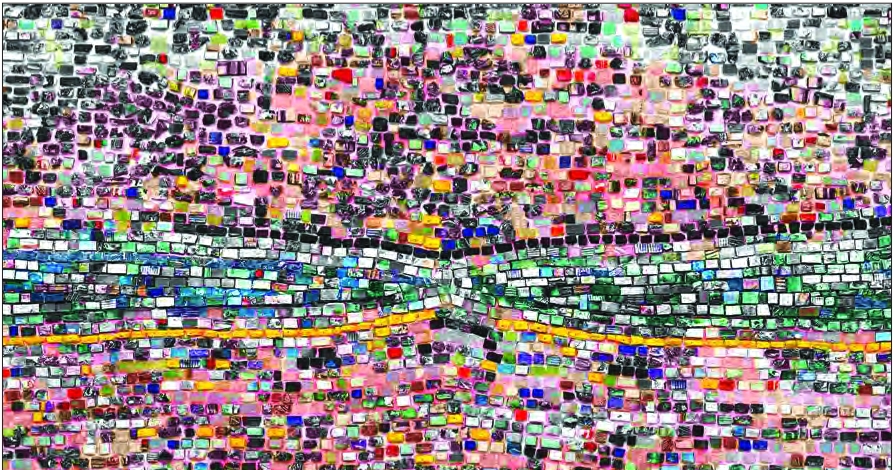
“Quantum Wall” by Jack Whitten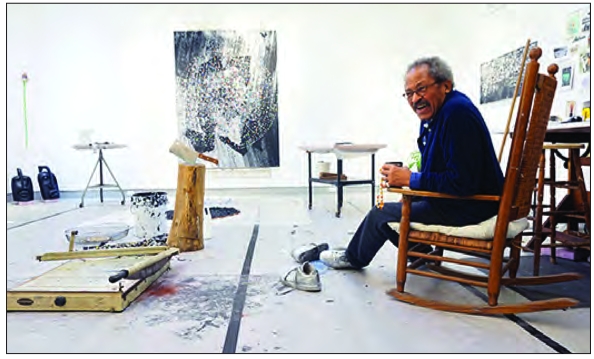
Jack Whitten in his studio in Queens, New York on Oct. 26, 2015.
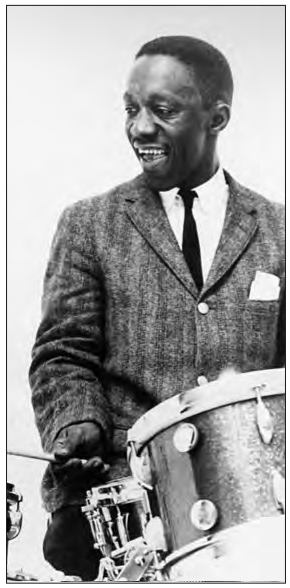
Drummer Art Blakey was a friend and mentor to Jack Whitten.
“This is not just a Harlem story. It is an American story — a story of artists who refused to disappear, who transformed struggle into song, and who have made the stage a sanctuary for our collective voice. As we celebrate this new exhibition and the journey that led us here, remember: Every generation must defend the arts anew — not just with words, but also with attendance, funding, and fierce advocacy. And as long as there are stories to tell, curtains will rise on our watch.” — Voza Rivers
I love that line, “And as long as there are stories to tell, curtains will rise on our watch.”
That’s exactly what these challenging days embolden us to do as artists: step out on the stage to create expression and love, and to be committed to doing things for the truthful betterment of our society. That’s our story; we remain committed to the work of lifting excellence and inspiring stories, doing so with love and care.
When arts paint life, cultural significance
Jack Whitten (1939-2018) lived as a visual artist, conceptualist and advocate of art and social meaning, becoming one of the most prolific contemporary visual/sculptural artists of our time. He believed in being a “messenger” in culture. It was said that he created “wholly new ways of working and making art.”
In the ways we have spoken about innovation, forward thinking and speaking for the good of all people, Jack Whitten, as an artist, is exemplary. He lived through some of America’s biggest social/cultural shake-ups: segregation, civil rights, the Black arts movement, hip-hop culture in New York, the 9-11 attack, the rise of contemporary digital expression and the emergence of President Barack Obama. Whitten said that “jazz” was his “metaphor,” a very powerful and meaningful association and commitment to excellence in cultural expression and experience.
The most prevalent and impactful periods in African American arts movements were the Harlem Renaissance (1920s-1935), Black arts movements (1965-1970s), hip-hop culture and up to today’s urban exposition in the integration of global cultural identities heard on numerous media platforms.
In these, we find all the arts in a robust embrace, equally essential: music, literature, dance, social media platforms, painting, poetry and theater.
And there in this brew among all the poets, dancers, painters, philosophers, teachers and musicians… the telling, meaning of the tales and singing the new representative song. Jack Whitten embraced jazz as a partner form in conception.
In this way, he was moved by the broader cultural embrace of two art forms he was familiar with: jazz and hip-hop. Coltrane and Jean-Michel Basquiat, as artists, were both part of Whitten’s personal embrace of style representations, each providing essential influences on his psyche and process. And these artists all brewed together in modern New York City.
Painting pathways: Whitten life paths, creative work
Whitten, who was born in the Southern town of Bessemer, Alabama, died of leukemia on Jan. 20, 2018, at age 78. Michelle Kuo, author and curator of Jack Whitten’s “The Messenger,” states, “How fast is an image? How far can it go?
“Whitten believed that images could travel farther and faster than almost anything…. Like waves, or codes, or cosmic vibrations, sources of energy from the most ancient of times that were only just reaching us now… images could also slow or even stop time, or radiate outward, ‘infinite in all directions,’ in a kind of perpetual present.”
He inherited the art tools of his mother’s first husband, James Monroe Cross, a commercial sign painter who was a Black man with a skilled occupation and owned his own business in the deeply segregated Jim Crow South. Whitten was moved by this and considered that, as a Black artist, his work would be under threat of suspicion, making images that could be seen as a form of rebellion and a risk. Over his nearly 60 working years, he challenged the industry, and doing so changed what images could do, through painting, sculpture, drawing, photography, printing, technology and alchemy.
As an adult he participated in the Civil Rights Movement, the rise of Black Power and the move to Black Lives Matter as it was ramping up. Toni Morrison said of his kind of art, “If you think of slavery as a reign of terror in which the victims were stripped of the normal places for sustenance and had to invent and reinvent, in that sense, they were modern, not clinging to tradition for the sake of it. They were thinking up new ways to survive and flourish, whether in music, language, or social behavior. ... It was life under duress, but new forms came. ... What was repression and cruel necessity at one time became a statement of liberation at another.”
In 1957 Whitten, a student at Tuskegee, traveled to hear Rev. Martin Luther King Jr. deliver a speech. He ended up meeting King and was reported to have had a transformative experience.
Whitten played tenor saxophone since high school and went to all the New York jazz clubs. He came to know Art Blakey and became a follower, whom he called a “witch doctor on drums.” His exposure to Blakey’s polyrhythmic “thunder” impacted him sonically, and he became the drummer’s friend. Kuo wrote, “The Jazz Messengers were important to Whitten’s understanding of musical improvisation, where the body, the air, and the room all reverberated in unpredictable ways.
Through both jazz and carpentry, Whitten searched for a balance between gesture and structure to find himself even within traditional forms of making do and letting go.”
After the assassinations of John F. Kennedy, Malcolm X, and King, Whitten stated, “The world as we knew it was turned upside down, and I could see no way out.” Soon, he began teaching at Queens College, amid the campus heat of demonstrations and worldwide student movements protesting the war in Vietnam, U.S. imperialism and the global military-industrial complex.
This larger historical moment grabbed his attention from all sides, and his dedication to the development of his art and its place as a “sounding” in the world he followed until his death in 2018.
Griotology
Jack Whitten was a model of a modern griot artist. He was acutely aware of his Black identity in justice-stained America of the 1940s through the mid-1960s, the pre-Civil Rights years, and he raised his artistic voice to pose questions about injustices in the system. Early on, he made a commitment to document and celebrate the life’s work of noteworthy individuals, their ideas and stories about Black struggle and excellence. He was a teacher and mentor, supported and mentored by the best: Jacob Lawrence and Romare Bearden. He hung out with Jean-Michel Basquiat, Art Blakey, Willem de Kooning and Andy Warhol. And he was a chronicler of the times, the Civil Rights unrest, the rise of the global industrial complex, through the election of the first Black president.
I believe Whitten’s work transmits, transfers, translates and transforms the times he lived in. As an interdisciplinary materials artist, imbued with both aesthetic and social philosophy, he worked across many media: paint, wood, acrylics, furniture, stone and photographs, and employed technology. His studios were his laboratories, and he studied nature, another one of his passions, to understand the world he lived in and worked to transform. When you see his work, you can sense these reverberations in all of it. It was a huge pleasure seeing the largest exhibition of contemporary Black artists I had ever seen, recently at the Museum of Modern Art in New York City. I was completely blown away.
Whitten spent his summers creating sculptures that fused the arts of Africa and Mediterranean culture with contemporary technologies. His works are homages to Black artists, history, as he is a voice in art of the people, a messenger, and his art a way of sending meaning out into the world.
“I am a conduit for the spirit. … It flows through me and manifests in the materiality of paint.”
Black Monolith IV for Jacob Lawrence
While visiting MOMA at the end of July, I witnessed the largest art display of a Black contemporary artist I had ever seen. Paintings, sculptures, archival reproductions. It was a breathtaking breakthrough in art, culture and sound installations, with Coltrane, a friend, playing overhead in prominence. And again, he was a neighbor and friend of the iconic hip-hop cultural visionary, Basquiat.
On my visit, I met two New York arts enthusiasts, Rene and Kaye. This is what they shared:
“We don’t get to see this too frequently. ... He used all his experiences, and kept and held that up in his art. ...He’s been doing work since the 1960s. This is amazing. I’m so proud to see a fellow African American artist being displayed at this level.
“This is the embodiment of everything Black artists have strove for, in sound, paintings, sculpture, textiles, configurations, aesthetics and science theory connected to the arts. With tributes to Toni Morrison, James Baldwin, and Basquiat, he used his experiences to redefine approaches in every medium in modern art. I love it! They don’t all look the same. He’s an innovator. And all this takes time, not rushing through time, you can’t do that in the arts.”
Griotology, painting pathways
Our goal here is to continue to underline the idea that arts education and curation embolden us to control the content and dissemination of our cultural heritages.
This ensures that, no matter what, stories about people and culture are created, told and discussed for the good of the people. Arts in the public area for many are pathways to journeys. Because an “arts perspective” is a life journey, it is just singing, painting, dancing, acting out or written about from an artist’s literary vision.
That idea is that cultural values instill fundamental, powerful life and human practices and processes. That’s what sustainable communities look like because we took the time and care to curate usable information that ensures our stories and our survival.
It’s important today to use all the channels of our creative calling to maximize impact, to issue clarion calls and to tell the stories so people are lifted and the culture and heritages remain as our mantras provide instruction. This is the only way our imprints can never be erased, because we used the ink of human existence and experience, and made it translatable.
That’s our work as griots.