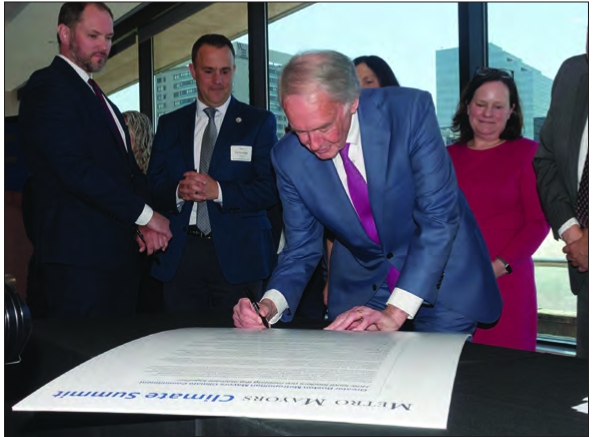
Sen. Ed Markey signs the Greater Boston Metropolitan Mayors Climate Commitment, a 10-year update on a regional agreement between the Metro Mayors Climate Task Force, during the Metro Mayors Climate Summit in May. The commitment, which included priorities around siting clean energy, addressing resilience of vulnerable infrastructure and reducing emissions from transportation and buildings, was one of a number of ways that cities and towns in the Greater Boston area looked to bring climate action across municipal borders.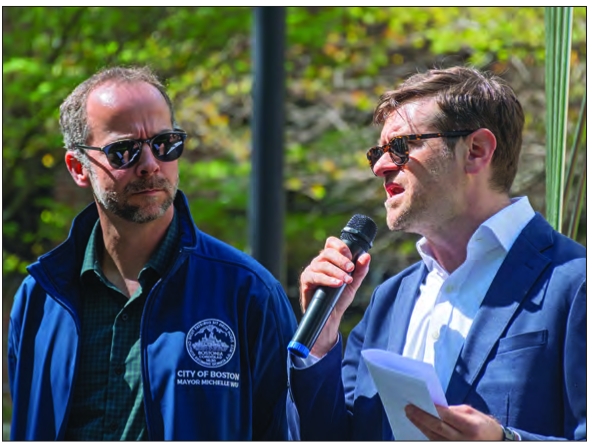
Oliver Sellers-Garcia (right), city of Boston environment commissioner, with Chief Climate Officer Brian Swett at a May press conference announcing city funding for three projects across Boston supporting climate-focused retrofit projects. The dollars came through a fund created as part of a city ordinance aimed at getting to net-zero emissions, and offered an alternative, if smaller, pot of money as federal dollars focused on climate dried up in 2025.
2025 Year in Review
With record-breaking heat and other climate emergencies, taking action against climate change continues to be a priority for Boston city and Massachusetts state officials. And in 2025, there were several steps from both levels of government that emphasized that priority.
In Boston, commercial buildings larger than 35,000 square feet saw their first year of emissions standards under the Building Emissions Reduction and Disclosure Ordinance. That ordinance, which earned the city an award at the United Nation’s COP30 climate change conference in Brazil in November, requires such large buildings and residential buildings with 35 or more units to meet decreasing emissions targets in order to reach the city’s goal of net-zero emissions by 2050.
Boston also released a draft of its climate action plan for the next five years, meant to guide a range of efforts such as emissions reductions. City officials said this document marks a shift from more localized and targeted efforts to ones focused more on broad implementation.
“It’s a pretty big pivot,” said Oliver Sellers-Garcia, the city’s environment commissioner and chief of the city’s plan for tackling climate change, known as the Green New Deal. “This plan is really all about things that we’re going to get done from 2026 to 2030.”
The final version of the climate action plan is expected to be released in spring 2026.
The city also took steps to respond to the extreme heat in 2025.
A heat wave in June brought a 102-degree day that broke the city’s record for hottest June day, and Boston declared three heat emergencies over the summer — periods when the heat index reaches 95 degrees for two or more days.
One of the responses was the passage of an ordinance in August that creates protections for municipal employees and workers that the city contracts or subcontracts. Under the ordinance, employers must develop a heat illness prevention plan that includes access to shade, water and rest as well as response plans in case of emergency.
“If an employer isn’t able to figure out how to get water or some shade in place for workers, we don’t want them sort of doing business in Boston,” District 6 City Councilor Ben Weber said when the ordinance was passed.
These city initiatives are among others led by groups around Boston, such as a project by a Boston University team to install sensors inside city schools to track air quality and heat and develop a plan of response; a separate BU project in Chelsea and East Boston to track and try to address high heat; and the Boston Region Metropolitan Planning Organization’s Neutralizing Onerous Heat Effects on Active Transportation, or NO-HEAT, initiative, to identify areas where pedestrians and cyclists are most exposed to extreme heat.
While efforts at the city level work to address some of the downstream effects of climate change, officials are increasingly pushing for efforts to cross municipal borders to tackle issues like coastal resilience or heat instead at a regional level.
To that end, 17 mayors and city officials from across the Metro Boston area gathered in May to sign an updated joint commitment to address climate challenges facing the area.
Cross-municipal collaboration can also make solutions more cost-effective by preventing duplication of resilience efforts and prioritizing higher impact projects that can protect more than one community, said Deanna Moran, the state’s chief coastal resilience officer.
“We have a lot of risk on our coast, and we have probably millions of projects that we could do here and there in every community,” Moran said in a November interview.
While cross-community efforts continued, such as through the ResilientCoasts initiative introduced in 2023, state-level efforts were also rolled out this year. The Healey-Driscoll administration in June filed a $3.1 billion bond bill, potentially the state’s largest environmental investment, called the MassReady Act. If passed, the bill would include funding for protective infrastructure, particularly around flooding, for climate-smart agriculture and other environmental protections such as a proposed $68 million to protect farmland across Massachusetts.
The bill also includes the creation of a new funding source for high-priority resilience work, something that climate justice advocates say is needed.
Hessann Farooqi, executive director of the Boston Climate Action Network (BCAN), an advocacy organization with a focus on climate justice, said he’d like to see more alternative funding measures. Massachusetts already has one in the form of the Massachusetts Community Climate Bank, which was launched in 2023 to support green affordable housing efforts.
“We have an opportunity to build on that, to both fund additional types of climate measures and to substantially increase the amount of money that we’re putting towards this,” Farooqi said.
Federal policy effects
Despite some of the progress, changes at the federal level — to federal funding sources, to investments in clean energy infrastructure and in access to data on climate and environmental topics — have impacted the landscape of climate resiliency work.
“It’s hard to talk about anything climate-related without talking about what the federal government is doing,” said Farooqi.
Shifts in federal funding have resulted in a big loss of grants to support climate action. An analysis from the National Resources Defense Council (NRDC) found that, as of September, over $9 billion in federal climate and environment funding had been cancelled by the Trump administration. This includes the U.S. Environmental Protection Agency’s Thriving Communities grants, $50 million of which was supporting grassroots moves across New England. The NRDC report found another $20 billion in grants remained in limbo as groups sought to fight the cancellations.
“The federal government has taken that away,” Farooqi said. “The people who really suffer are regular residents and their community organizations who don’t have a ton of money to begin with.”
Changes at the federal level have also meant that many of the tax credits, such as for electric vehicle purchases and other climate infrastructure, that were included in the Inflation Reduction Act of 2022 were rolled back when the Trump administration in July passed the legislation known as the One Big Beautiful Bill.
The federal government has also increased barriers to permitting clean energy infrastructure that shift away from fossil fuels, including working to halt offshore wind leases off the coast of the eastern United States. Another major change has been the removal of public access to federal climate-focused data, including most recently the plan to shutter the National Center for Atmospheric Research, or NCAR, in Colorado. A leading center for climate and weather science founded in the 1960s, NCAR and its discoveries — which range from everyday meteorological knowledge to aid weather forecasts to broader impacts of climate change — are hailed by experts as being crucial to the scientific community. The Trump administration, however, branded it “one of the largest sources of climate alarmism in the country.”
In the face of all the cutbacks at the federal level, advocates have called for city and state officials to step up their investment in climate efforts.
“As we acknowledge the leadership on both the state and local levels during these challenging times, in the same breath we must strongly encourage our leaders to do more to protect our communities,” Britteny Jenkins, vice president of environmental justice at the nonprofit Conservation Law Foundation, said in a statement.
She said she’d like to see state officials pursue new environmental justice initiatives, pointing to a bill at the State House, called the Act to Eliminate Disparate Impact, which would create broad new guardrails to protect vulnerable groups, including from disparate environmental concerns.
And even though federal projects, like the U.S. Environmental Protection Agency’s clean-up of the Neponset Superfund site (the EPA in November announced a clean-up plan that is slated to begin by 2027), bolster local efforts to safeguard the environment, advocates said they expect to see more moves from the federal government that will limit work around climate and environment, underscoring the importance of local policies.
“I have no doubt that the Trump administration is not done — we will see more attacks on climate and our communities in 2026,” Jenkins said. “We need strong local and state leaders to not only push for progress, but [also] to build an inclusive green economy where everyone can prosper.”