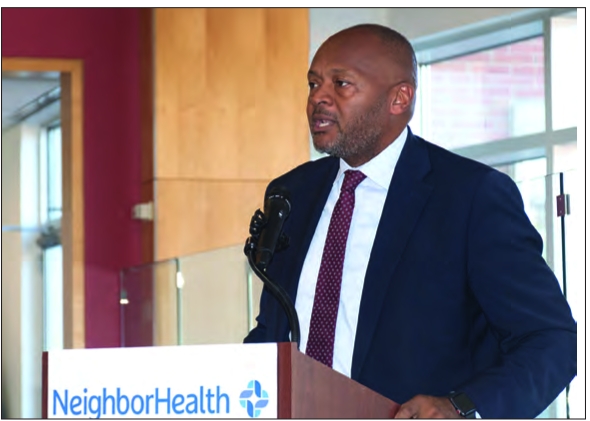
Michael Curry, president and CEO of the Massachusetts League of Community Health Centers, welcomes attendees at a panel on maternal health at NeighborHealth’s South End community Health Center in October. The panel was part of a broader series of pushes to improve maternal health disparities in 2025.
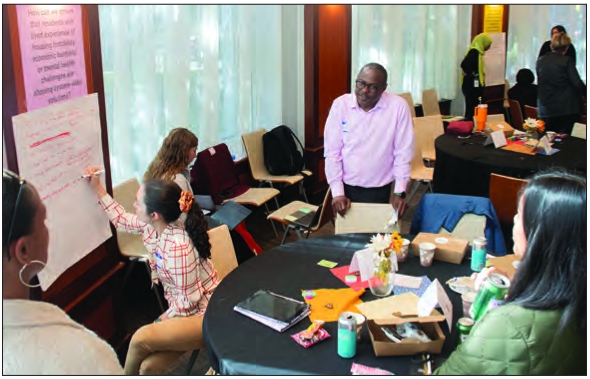
Attendees at a Boston Public Health Commission summit brainstorm ways to support change in mental health outcomes in October. The summit, which focused on the social determinants — factors outside of the health care system — that impact mental health in Boston, was one of a number of efforts focused on new ways to address health and mental health.
2025 Year in Review
Throughout 2025 health equity remained a central focus for Boston-area leaders as new programs and long-delayed projects sought to address gaps in access to care.
Officials and providers increasingly emphasized care delivered outside traditional hospitals and clinics — through mobile health units, school-based centers and investments in social determinants of health — particularly in communities of color and low-income neighborhoods that have long borne the brunt of inequitable outcomes.
The Banner followed those efforts as they unfolded across the city and region. Together, those initiatives reveal how access, equity and uncertainty shaped health care in Greater Boston over the past year.
New models bring care closer to home
Across the Boston area, a number of underserved communities received critical health services by way of new and innovative methods to meet patients where they are.
In Roxbury, Whittier Street Health Center announced the expansion of its vision and dental services in November with a new mobile clinic that will drive around the community.
“These services are critical in addressing health equity, social justice and the economic well-being of our diverse patients and community,” Frederica Williams, president and CEO of Whittier Street Health Center, said at the ribbon cutting.
Matilda Drayton, chair of the nearby Alice Taylor Apartments Advisory Council, said access to care and the ongoing relationship between the health center and housing development is essential.
“There is nothing better than someone coming to you to provide you with the service that you need,” she said.
That mobile clinic, which was announced as part of an on-campus expansion of their dental services with three new exam rooms and new cleaning facilities, joins an existing fleet of five mobile care vans operated by the health center.
The current fleet delivers primary care, vaccinations, infectious disease treatment, behavioral health care and connections to social services at public housing developments and other communities with limited access to care, including Nubian Square and Mass and Cass.
And Whittier isn’t the only health center bringing services directly to the community. In Dorchester, Codman Square Health Center is working on getting its first mobile health care van, which will offer primary care services.
Michael Curry, president and CEO of the Massachusetts League of Community Health Centers, said this expansion of mobile care services in the 50 health centers his organization represents across the state exemplifies the mission of community health centers and their impact.
“Were increasingly adopting the approach of bringing health care to where you are, where people are most suffering,” he said.
In Randolph, community members — many of whom lived in Boston before being priced out by rising rents and costs of living — received increased access to health care services through a new school-based health center at Randolph High School, operated through a partnership with Codman Square Health Center.
The project was a long time in coming.
The effort was first announced in spring 2022 when the center received $1 million in federal funding from U.S. Rep. Ayanna Pressley’s office through community projects funding. Under initial estimates, that earmark was expected to cover the full cost and the center was expected to open in early 2023.
Complications in the construction needed to retrofit school space into a health care facility, as well as a tangled process to get approval from multiple state agencies, caused both the timeline and the price tag to increase.
Despite these challenges, the clinic opened in mid-November, serving students from Randolph High and other schools in the town during the school day and pivoting to serve the Greater Randolph community in the afternoons.
Town leaders said the school-based center fills a major gap: without local pediatric care, even routine physicals once required families to travel to other communities, sometimes all the way to Boston — a nearly half-hour drive or close to an hour by public transit.
Before mid-2023, the town didn’t have an urgent care facility.
“Being within a community where you can access care, where your insurance is accepted, where you’re able to serve an underserved population, it’s going to be very helpful to the community,” said Carme Ogando-Saintil, medical director at the new school-based clinic, in a November interview.
The new facility might mark the first step to bring even more health care services to the town in the form of a full-fledged community health center.
“Health centers typically serve [as] more than just a spot for primary care; they really are kind of the nexus of all things related to health and well-being,” said Michelle Tyler, the town’s director of planning, in November.
Back in Boston, at the tail end of 2025, a previously stalled proposal to bring new maternal health services to Roxbury received the go-ahead.
The Neighborhood Birth Center, a long-pending project to construct a freestanding birth center on Winthrop Street near Nubian Square, was approved Dec. 16 by the Boston Zoning Board of Appeal.
The birth center previously went before the zoning board in February, when its proposal to build an about 10,000-square-foot building that would have housed the birth center as well as community space and offices for five partner nonprofits was denied by the board.
The new design that was approved by the board sits at nearly 7,000 square feet, spanning three parcels and will house only the birth center. The five other nonprofits — the Center for Economic Democracy, the Matahari Women Workers’ Center, Sisters Unchained, Resist, Inc. and Movement Sustainability Commons — are seeking out space elsewhere, most likely in Roxbury, for shared office space.
At the zoning hearing, the project faced pushback from neighbors who objected to a non-residential use coming into their largely residential neighborhood — with the potential traffic and parking impacts it could bring, as well as a fear that it could open the door to more commercial development down the road. They also pointed to the need for increased housing in Roxbury and across the city.
During the hearing in February, the project faced similar opposition, as well as concerns about the potential historical legacy of the houses the project would tear down and allegations that with its five nonprofit offices it would be more “office park” than a birth center (over half of the space in the February proposal was dedicated to the birth center).
But changes to the project, or a shift on which zoning board members heard the proposal, meant unanimous approval for the smaller design, while the February design failed in a 5-2 vote to deny it without prejudice.
Any next steps on the project are pending a potential appeal process in which neighbors who own property within 300 feet of the proposed birth center can challenge its approval in court.
Supporters of the project hail it as an important step to improve health outcomes in a part of the city that has faced disparately worse health outcomes for mothers and infants.
A 2023 report from the Boston Public Health Commission found that Black infants were twice as likely to be born with a low birth weight compared to their white counterparts and nearly twice as likely to be preterm. Nationally, the Black infant mortality rate is more than three times that of white infants.
The Massachusetts Department of Public Health, in its own report from 2023, found that severe complications during labor and delivery nearly doubled over the previous decade, with Black women at the highest risk.
The approval of the birth center joins efforts across the state to address maternal health disparities, including through the DPH’s Advancing Health Equity in Massachusetts initiative, and as officials and other leaders work to implement measures passed in a maternal health omnibus bill last year. Supporters of that legislation this year started work on a follow-up bill that would help close gaps in implementation as the rubber meets the road.
For residents at Edgar Benjamin Healthcare Center in Mission Hill, ongoing efforts aim to keep the facility open and operating. This year, in a series of sometimes contentious hearings, the court-appointed receivership announced plans to sell ownership and operation of the facility to Allaire Health Services, a for-profit company that operates more than 20 facilities across Pennsylvania, Vermont and its home state of New Jersey.
The sale, especially to a for-profit company, has raised concerns with some community members and prompted a failed attempt to restart the bid process by a group of local bidders seeking to take over the facility in Allaire’s place.
But staff members from the receivership, which is led by Roxbury attorney Joseph Feaster, have said they see Allaire as the best shot to sustain and revitalize the Mission Hill facility, which nearly faced closure in 2024.
Targeting the root causes of health inequity
Throughout 2025, health care groups across the city looked to address longstanding gaps — particularly prevalent in communities of color — through a handful of programs and initiatives designed to address social determinants of health.
Those determinants, factors that impact health outside of care provided in a clinical setting, include access to healthy food, housing, health insurance and economic mobility. They have long been a focus for health officials in the city, as well as providers such as community health centers.
The year 2025 saw the first phase of action of Boston’s Live Long and Well Agenda, the first citywide population health equity agenda. It aims to reduce disparities in life expectancy through a focus on cardiometabolic diseases, preventable cancers and unintentional drug overdoses.
The Boston Public Health Commission identified those conditions as the leading cause of premature mortality in the city.
In July, the health commission announced the selection of four coalition projects that received a total of $5 million under the program through an investment by Atrius Health Equity Foundation.
Those projects, focused on economic mobility as a social determinant of health impacting cardiometabolic diseases, include efforts to train community members as patient navigators to work with Dorchester residents to connect them with financial assistance benefits; provide English-language instruction and career training with wrap-around supports focusing on Haitian residents; offer economic mobility services to Dorchester residents; and connect Roxbury and Dorchester residents to a mix of primary care, food access and economic mobility services.
A second round of funding — also $5 million — is slated to be released in 2028.
Others, too, are focused on out-of-clinic factors. A partnership between Boston Medical Center, Mass General Brigham and the Mattapan Community Health Center launched this year sought to address longstanding disparities in the occurrence of heart disease and diabetes in Mattapan.
Although primarily focused on access to medical care for cardiometabolic disease, in the spirit of addressing social determinants, the partnership also aims to increase access to healthy foods, employment, behavioral health and housing.
The Public Health Commission is also exploring the connection between social determinants and mental health. At an event hosted at Northeastern University in October, the health commission brought together mental health experts, housing and economic development advocates and community members all focused on decreasing inequity across the board.
The event posited that mental health challenges don’t exist in a vacuum.
“It is true that, often, when I engage with patients, undoubtedly, if someone’s calling me for a resource it is often not actually a resource related to a clinical appointment,” said Dr. Kevin Simon, Boston’s chief behavioral health officer, at the summit.
Equity efforts collide with shifting federal policy
Efforts around social determinants of health came as the Trump administration took steps that are expected to limit who and how people can access some of the safety net services that impact access to health and care.
In July, President Donald Trump signed a tax and domestic policy bill that created new work requirements for Medicaid recipients. Under the policy, recipients must work or volunteer 80 hours per month to be eligible for the benefits.
One estimate by the Kaiser Family Foundation found that nationwide, the new work requirements alone could cause millions of patients to go uninsured and result in $326 billion in reduced federal Medicaid spending over 10 years.
The same legislative package also limited access to Medicaid benefits to only some “qualified” immigration statuses.
Also, it changed the timeline for Medicaid redetermination — the process through which recipients must confirm they still qualify for benefits. Previously that process occurred once a year; under the new law, recipients will have to reverify every six months. Experts anticipate that change might leave some people uninsured if they miss paperwork or fall through bureaucratic cracks.
The law also created other requirements around the Supplemental Nutrition Assistance Program, through extended work requirements (the SNAP program already has some work requirements, but the new law will shift who is included in those provisions) and similar restrictions on which immigration statuses can receive food assistance.
An estimate in an October report from The Boston Foundation, found that those shifts in benefit programs could have longer-reaching impacts, creating increased financial instability for low- and middle-income families and potentially increasing racial wealth gaps.
A milestone year, with challenges ahead
In 2025, community health centers across the country marked the 60th anniversary of the first facility under the current model, which opened in Dorchester’s Columbia Point in December 1965.
Now there are more than 50 organizations with nearly 300 facilities across the state. Nationwide, delivery sites number more than 17,000.
Those facilities serve more than 1 million patients in Massachusetts and up to 52 million patients in the United States per year.
Community health centers, long considered a beacon for affordable and accessible care, have carried that torch forward from its roots through today. More than 1 in 5 uninsured patients and more than 1 in 4 Medicaid patients rely on the health centers for care.
In an August interview, Charles Murphy, president and CEO at Harvard Street, said the goal is to let health care exist as a right.
“Our mission is, ‘You need help?
Come on in,’” he said. “We’re going to help you; we’ll figure out the pay side later.”
Those facilities tout a track record of providing primary care to communities as well as increasing access to social determinants of health.
As federal policies around Medicaid shift, health centers are poised to face increased financial uncertainty. If fewer patients come who are covered by Medicaid it means fewer of those federal dollars supporting the health care center system.
Nationwide, payments through the federal insurance program make up nearly half of revenue sources for the facilities, according to data from the Kaiser Family Foundation.
Funding freezes early in the year, as the Trump administration sought to limit the flow of federal dollars to projects or organizations the president didn’t approve of, left some centers nationwide unable to access funds.
Those changes are leaving health centers bracing for impact as some consider how to restructure budgets to limit the effects on patients or staff, while others are seeking new sources of revenue or private support.
But leaders like Dr. Kyu Rhee, president and CEO of the National Association of Community Health Centers, generally said they expect health centers to survive. Rhee pointed to a number of other instances in the history of the community health center movement when the organizations faced other funding challenges.
“I would suggest that when we face those moments, we’ve been able to push forward, show our value to both sides of the aisle, show our value to the public and the private sector, and often demonstrate the importance of the work we do,” he said in a December interview.
For Curry of the Massachusetts League of Community Health Centers, this moment is also one of possibility. He said he is anticipating greater use of technology in health centers, like monitoring devices that track health metrics remotely or artificial intelligence for note-taking, to improve patient care and make staff jobs easier.
Rhee said the centers are “high-trust, but we’re not yet high-tech.”
Locally, leaders like Curry said they find hope in the work that health centers continue to do.
“Out of that tradition, out of that resilience and commitment, we come,” Curry said. “Now, as we face new challenges, I feel we’ll do the same. We’ll meet the moment.”