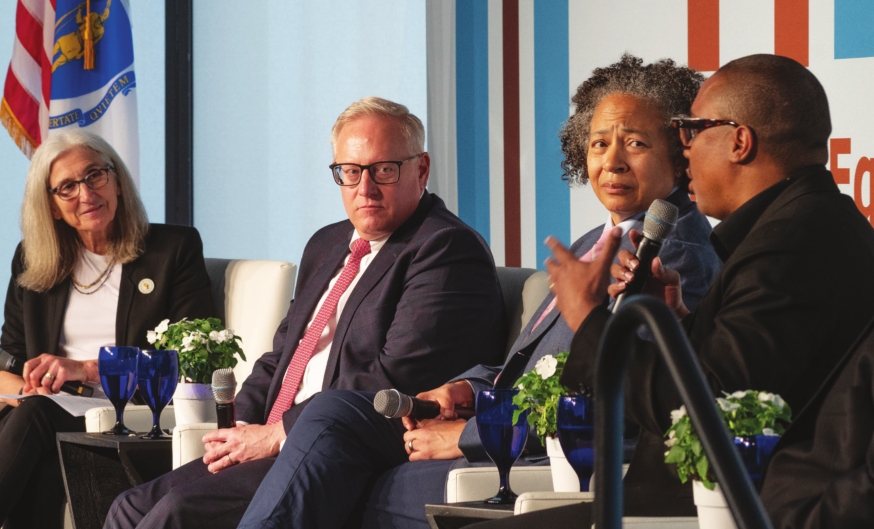
(Left
to right) Sen. Cindy Friedman; Mike Caljouw, Massachusetts Division of
Insurance commissioner; Renee Crichlow, chief medical officer at Codman
Square Health Center listen to Dr. Damian Archer, CEO at Outer Cape
Health Services during a panel about the importance of primary care at
the Health Equity Compact’s 2025 annual trends summit at the John F.
Kennedy Presidential Library, June 11. Panelists said primary care is an
important step to improve health and health equity across the state.
Mass experts call for investment to combat Trump admin. rollbacks
When health leaders gathered, June 11, for the Health Equity Compact’s annual trends summit, it was a conversation overshadowed by a changing landscape under the federal administration of President Donald Trump.
At the event, which brought together almost 1,000 attendees at the John F. Kennedy Presidential Library and online, pending federal cuts to Medicaid, the Supplemental Nutrition Assistance Program and scientific research were a persistent specter — one that organizers said advocates across the state must push back on.
“We have a choice to make.
We can wait and hope things get better on their own, or we can act now to protect our health and economic future,” said Michael Curry, president and CEO of the Massachusetts League of Community Health Centers and co-founder of the Health Equity Compact.
Cuts proposed by Trump and federal legislators that would cut programs that support access to health care and social determinants of health — like food access — as currently proposed would be “catastrophic,” said Gov. Maura Healey in opening remarks at the summit.
She called on attendees at the event to keep up the health equity work, despite challenging circumstances.
“The work of the Health Equity Compact is important work; it’s necessary work,” she said. “Do not take your foot off the gas.”
In her remarks, Healey said the state plans to try to counteract changes from the federal government that it sees as detrimental to health equity efforts, like the removal of data and disinvestment in research.
A challenging health landscape, Curry said, is not new. Throughout the day, speakers compared the challenges of the current political landscape to the struggles faced during the COVID-19 pandemic.
“Now we are in the midst of another crisis,” Curry said. “Not a viral outbreak, but a convergence of challenges to our health, our economy and our civil rights.”
Those
cuts, he said, could cause overcrowding in emergency rooms, delayed
care and costs that impact hospitals and businesses — and ultimately
could raise insurance premiums for patients.
“We
know that when we build a system that works for the most marginalized,
we build a system that works better for everyone,” Curry said. “These
cuts don’t just affect people on Medicaid or food assistance, it affects
all of us.”
The
spirit of pushing back was on display all afternoon, as speakers from
the state’s Executive Office of Health and Human Services — the
overarching state agency that includes the Department of Public Health,
Mass- Health and the Department of Transitional Assistance which
oversees programs like SNAP and WIC — prominent health systems in the
state and the attorney general’s office discussed the current landscape
and what’s next in a series of panels entitled “Meeting the Moment.”
Dr.
Kevin Churchwell, president and CEO of Boston Children’s Hospital, said
a priority for him is to work with his team to determine what the rules
of the road are, in the current landscape.
“Not
that I will follow all the rules of the road,” Churchwell said. “But
when I know the rules of the road, I know how to get around them and how
to utilize them for the best benefit of our patients and families.”
And
in response to a federal push against diversity, equity and inclusion,
Secretary of Health and Human Services Kate Walsh said she sees a need
to recognize that equity and quality are the same thing.
“Until
we knit these together in everything that we say, it’ll be really easy
to pick it apart,” Walsh said. “If you want to deliver the highest
quality care to the people you serve, looking at it through the equity
lens is absolutely fundamental to the work.”
A heightened focus on shared goals
Throughout
the conference, the Health Equity Compact pushed for support of omnibus
legislation focused on advancing health equity in the state. One
prominent focus of the legislation for speakers at the event is its
establishment of benchmarks that advocates said would make it easier to
pursue statewide change.
One
provision of the omnibus bill would create a time-limited legislative
commission to define the elements of a framework for health equity
goals, both in the short term and looking toward 2050.
That
group, and the benchmarks they create would focus on reducing premature
deaths — and reducing economic burdens from health inequities — caused
by four areas of focus: cardiometabolic diseases like diabetes, stroke
and heart attacks; maternal health; mental health and substance abuse;
and preventable cancers.
Having
a more structured framework of benchmarks will bring the Health Equity
Compact’s goals around reducing disparities into greater focus, said Dr.
Elsie Taveras, a pediatrician and chief community health and health
equity officer at Mass General Brigham.
“It’s
not enough to admire that North Star from a distance,” said Taveras,
while introducing a panel on the benchmarks. “We must take measurable
steps toward it.”
Health
equity advocates at the summit spoke in support of the bill — which is
slated for a hearing before the legislature’s Joint Committee on Health
Care Financing in July — but also called for steps to adopt the
benchmarks sooner through processes in the state’s executive branch.
“We
don’t have to wait for the legislation to pass,” Taveras said. “No one
loses sleep or doesn’t get more gray hair by waiting for any
legislation.”
In her
remarks she said the Health Equity Compact was inviting groups from
across the state — from state leaders to health care systems, CEOs,
private sector researchers and policymakers — to take action toward
creating shared benchmarks sooner rather than later.
Similar
work has already been launched by the state’s Executive Office of
Health and Human Services, to some degree. In January 2024, the
Healey-Driscoll administration announced its Advancing Health Equity in
Massachusetts (AHEM) initiative, an effort through the Executive Office
of Health and Human Services to reduce premature deaths from
cardiometabolic disease and maternal health issues.
Under
that effort the state is taking steps to reduce disparities, said Dr.
Robbie Goldstein, commissioner of the Department of Public Health. That
work has included working to certify doulas through the department and
creating a certified midwife board to support maternal health.
“We have a lot to do ahead of us, but AHEM is really energized to keep moving,” Goldstein said.
Walsh
said she believes that agency would get behind the benchmarks outlined
in the bill. She pointed to the two drivers already included in the AHEM
initiative. The four areas
identified by the Health Equity Compact are “clearly the areas where the
disparities are the worst, where there’s more years of lost life and
more opportunities for us to improve.”
Goldstein said work around benchmarks and data will help inform better solutions to health disparities.
“The
reality is that the disparities we see aren’t random and the data are
helpful for us to understand exactly where we need to focus our
efforts,” he said.
He
said the Department of Public Health has tried to operate with the
high-level strategy of establishing benchmarks across the whole
department to create a shared set of goals and metrics so each bureau
can see themselves in that number and is working toward the same goal.
That same concept, he said, could work at a broader scale beyond just the state government.
“What does that roll up to?
How
do we hold ourselves accountable to that higher-level number?”
Goldstein said. “We’ve seen it work within state government, which I
think some people thought wouldn’t happen. I think we can make it work
across the Commonwealth.”
A broad slate of equity priorities
The
far-reaching omnibus bill also includes other priorities, like
expanding access to support services like patient navigation and
interpreters, ensuring access to telehealth and removing immigration
status as a barrier to full access to MassHealth.
The
legislation also proposes steps around increasing the number of doctors
in highneed areas and expanding career growth opportunities for diverse
health workers.
At
the summit, the Health Equity Compact highlighted a health education
program in Brockton called the Hometown Healthcare Academy, which, among
other goals, looks to connect students to health care careers.
That
program includes a Youth Health Advisory Council that organizes events
in the community based on their health priorities; a general health
education session open to students at Brockton High School; a Career
Step program that connects seniors with hands-on education around health
care careers; and a youth and family mentorship effort that looks to
support parents as they support their students.
“We
were motivated to address the need for the development of health care
change agents of now as well as health care leaders and providers of
tomorrow that actually represent the community,” said Marissa Rodrigues,
youth health care program coordinator with the program.
Staff
from the program said that one need programs like theirs face is
continued financial support — something that is especially pertinent as
the federal funding landscape shifts under the Trump administration.
For
the Hometown Healthcare Academy, that call was met at the summit, when a
representative from the Atrius Health Equity Foundation, which funded
the launch of the program, announced a continuing investment of $4.5
million to keep the program running.
The
Health Equity Compact also called for an increased focus on primary
care to improve health before patients even have to visit a specialist
to address a specific problem.
“Primary care is literally the only specialty when you increase the number of clinicians in
the community, it decreases morbidity and mortality,” said Dr. Renee
Crichlow, chief medical officer at Codman Square Health Center during a
panel at the summit. “People live longer and healthier when there are
more primary care clinicians in the community.”
Speakers
on the panel called for better steps to invest in and focus on primary
care, including improvements in tracking of investments that already
exist. They suggested that steps that decrease the administrative load
for primary care physicians will help these clinicians better serve
their patients.
Already,
the state is making an effort to consider how to improve access to
primary care. A healthcare-focused law, signed by Healey in January,
included a provision to create a primary care task force, set to develop
recommendations to stabilize and strengthen the primary care system.
That landscape sets the stage for a moment of change, panelists said.
“If
we let this opportunity go by to shift this system, then it’s shame on
us,” said Sen. Cindy Friedman, co-chair of the Joint Committee on Health
Care Financing, who moderated the panel on primary care.
Throughout
the day, members and supporters of the Health Equity Compact called for
continued investment in equity generally, especially in light of shifts
at the federal level.
Curry called all the event’s attendees to action and said that each person had a role to play in decreasing health disparities.
“Because
this is Massachusetts, we have the people, the talent, the
infrastructure, the relationships to lead through this moment, if we
choose,” Curry said.


