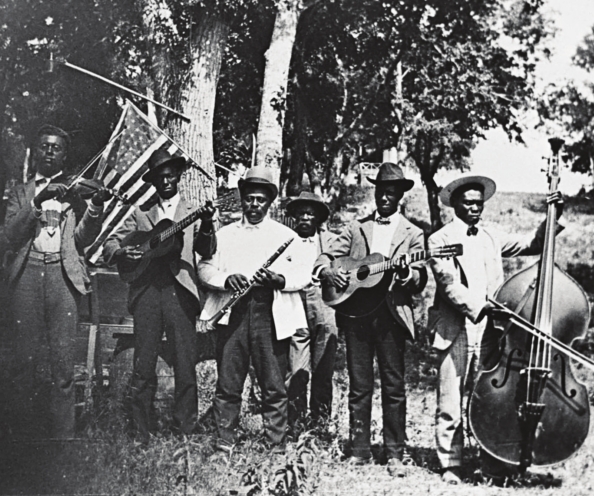
Photograph
of African American band at Emancipation Day celebration, June 19,
1900, held in “East Woods” on East 24th Street in Austin. Mrs. Grace
Murray Stephenson kept a diary of the day’s events, which she later sold
to the San Francisco Chronicle, which wrote a full-page feature on it.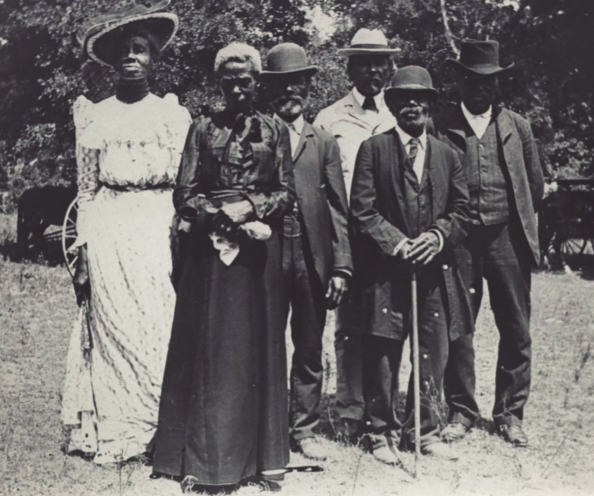
Photograph
of Emancipation Day celebration, June 19, 1900 held in “East Woods” on
East 24th Street in Austin. Mrs. Grace Murray Stephenson also kept a
diary of the day’s events which she sold to the San Francisco Chronicle
which reported a full-page feature on it.
As we gather to celebrate Juneteenth, it is vital to reflect deeply on the historical context surrounding the delayed emancipation of enslaved people in Texas. Juneteenth commemorates June 19, 1865, when Major General Gordon Granger arrived in Galveston announcing the enforcement of President Abraham Lincoln’s Emancipation Proclamation, issued more than two years earlier, on January 1, 1863. This gap between the official end of slavery and its enforcement in Texas illustrates the enduring struggle between federal authority and what would later be framed as “states’ rights.” This dynamic notably intensified during the Centennial Scandal of the presidential election of 1876, profoundly shaping America’s political and social landscape.
The delayed freedom of Texas slaves reveals much about the fragile nature of legal authority when confronted by entrenched social resistance. The Emancipation Proclamation legally ended slavery in Confederate states; however, enforcement depended heavily on the Union Army’s physical presence. Texas, geographically remote and lightly occupied by Union forces, became a haven for slaveholders fleeing stricter enforcement elsewhere.
Slaveholders took advantage of the ambiguity and the absence of federal
enforcement, maintaining their economic and social dominance through
continued exploitation. Thus, enslaved people in Texas lived in limbo,
their freedom officially granted but practically denied.
This
dynamic resurfaced powerfully a decade later in the controversial
presidential election of 1876, often referred to as the Centennial
Scandal. The fiercely contested election between Democrat Samuel J.
Tilden and Republican Rutherford B. Hayes exemplified deep national
divisions rooted in unresolved tensions from the Civil War. Tilden
secured the popular vote by approximately 250,000 votes and held 184
electoral votes, needing just one more to win. However, disputes arose
over 20 electoral votes from Florida, Louisiana, South Carolina and
Oregon, all of which involved allegations of fraud, voter intimidation
and ballot manipulation.
To
resolve the impasse, Congress formed the bipartisan Electoral
Commission composed of five members each from the Senate, the House of
Representatives and the Supreme Court. The commission ultimately awarded
all disputed electoral votes to Rutherford B. Hayes, a decision made
strictly along party lines. The outcome sparked outrage among Democrats,
risking a severe political crisis.
The
situation compelled both parties to negotiate secretly, culminating in
the Compromise of 1877. Democrats agreed to concede the presidency to
Hayes under specific conditions, which had dire consequences for
Reconstruction and the fight for civil rights. Key among these
conditions was the Republicans’ promise to withdraw all remaining
federal troops from Southern states, effectively ending Reconstruction.
This
decision drastically reasserted the principle of states’ rights,
allowing Southern states to govern themselves without federal oversight.
While couched in the language of political compromise, this essentially
sanctioned Southern states to undermine civil rights legislation.
Texas, among other Southern states, seized this opportunity to impose
Jim Crow laws, disenfranchisement and institutionalized racial
discrimination, reinforcing systemic inequality that would endure for
nearly a century.
The principle of states’ rights was thus weaponized to resist federal mandates on equality and civil rights.
Southern
states argued that their rights to legislate independently superseded
federal attempts to guarantee civil liberties. Texas and other states
leveraged this principle to resist enforcing equal rights, employing
legal maneuvers, intimidation and violence to maintain white supremacy.
The
Compromise of 1877 had profound implications. Reconstruction had aimed
to integrate formerly enslaved people into the civic and political life
of America. However, its premature end allowed for the resurgence of
white supremacist power structures across the South. Texas, like other
Southern states, implemented poll taxes, literacy tests and violent
intimidation to disenfranchise Black voters.
Segregation laws institutionalized discrimination, perpetuating the social and economic subjugation of African Americans.
This
historical regression was mirrored recently in 2013 when Supreme Court
Chief Justice John Roberts issued a controversial decision in Shelby
County v.
Holder,
which effectively reversed key provisions of the 1964 Voting Rights Act.
Roberts argued that conditions had sufficiently improved, rendering
federal oversight of state voting laws unnecessary. This decision
critically weakened protections against voter suppression, resulting in
numerous states enacting restrictive voting laws that disproportionately
affect minority communities. Roberts’ ruling reflects a troubling
repetition of history where states’ rights rhetoric masks systemic
efforts to undermine civil rights and racial equality.
As
we celebrate Juneteenth, remembering the long delay between legal
emancipation and practical freedom serves as a reminder of the critical
importance of enforcement in upholding civil rights legislation. Freedom
without effective enforcement is illusory, as history repeatedly
demonstrates.
The
Centennial Scandal exemplifies how political compromise at the expense
of civil rights can have enduring negative impacts. By empowering
Southern states through the withdrawal of federal oversight, the
Compromise of 1877 enabled nearly a century of legalized discrimination,
violence and social injustice. The fight for civil rights, equality,
and justice continued well into the 20th century and remains ongoing
today.
Juneteenth thus
symbolizes both liberation and the ongoing struggle for true equality.
It reminds us that official proclamations of freedom and equality are
insufficient without robust mechanisms for their enforcement. The
holiday underscores the necessity of vigilance in protecting civil
liberties against the constant risk of erosion through political
compromise or neglect.
Today,
as America reckons with its historical and contemporary racial
injustices, Juneteenth serves as a poignant reminder of how easily
freedoms can be compromised. It calls for continued commitment to
dismantling systemic racism and advocating policies that ensure equity
and justice for all Americans.
Juneteenth’s
historical roots and the implications of the Centennial Scandal and
Roberts’ decision teach us that civil rights and equality require more
than legislative victories; they require vigilant enforcement and
persistent advocacy. The struggle for genuine freedom is ongoing,
requiring sustained efforts to uphold civil liberties and confront
injustices head-on. As we commemorate Juneteenth, we honor those who
fought for freedom and recommit ourselves to the unfinished work of
building a truly equitable society.