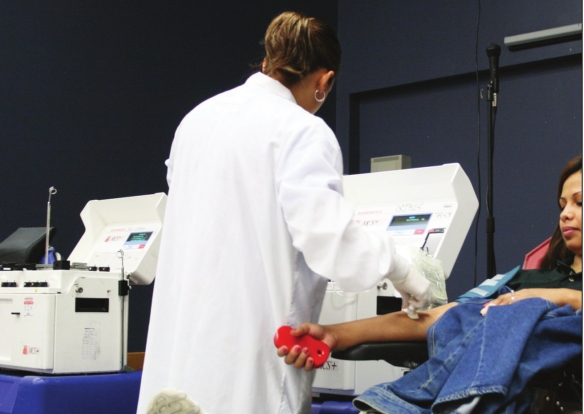
Volunteer donating platelets For Taina Maitre, sickle cell disease has meant frequent pain and missed opportunities.
Last winter, she was in the hospital for Thanksgiving. And for Christmas. And again, for New Years.
And when Maitre, a 36-yearold nurse from Woburn, goes to the beach with friends, as the rest go in the ocean, she stays behind, worried the cold water will cause a sickle cell crisis.
“I can go to the beach,” she said, “but when everyone’s swimming, I’m back on the sand.”
Those crises, she said, have been getting worse over the past decade. In her four years of high school, Maitre said she was hospitalized for a sickle cell crisis maybe once. Now she’s admitted to the hospital for three- or four-week stints at a time, every month or two.
So, when she got the opportunity to get one of the two gene therapies designed to treat the disease, which were approved by the U.S. Food and Drug Administration at the end of 2023, she knew it was something she wanted to try.
“It’s just been hard, and it seems like it’s just getting harder with my crises,” she said. “So, the second it was offered to me, I was ready to just jump all in.”
Now,
as Maitre prepares to start the lengthy treatment process, she said she
is “really excited” for the relief she expects the treatment to bring.
At
the end of July, she will have the first procedure to remove the stem
cells that will be edited to treat her sickle cell disease, kicking off a
process that can take up to about a year.
Gone,
she expects, will be the days of missing family events, or hoping a
sickle cell crisis won’t pull her away from a friend’s wedding or
planning trips based on where the nearest hospital is.
“There’s
just lots of things, mental capacity that sickle cell takes that I
won’t have to do anymore,” Maitre said. “And of course, just feeling
better — I’m going to feel better all the time, and not just some of the
time.”
At the end of
2023, the FDA announced its approval of the two new gene therapies, the
first two ever approved in the United States to treat sickle cell, from
Vertex Pharmaceuticals and Bluebird Bio, both Boston area companies.
The
disease overwhelmingly affects patients of color — especially in the
Black community. According to the U.S. Centers for Disease Control,
sickle cell disease impacts an estimated 100,000 people in the United
States. More than 90% are Black.
At
the time of their approval, there were 32 gene therapies already
approved by the FDA, with the first approved in 2017. In the
year-and-a-half since, another 11 have been added.
Bluebird
Bio’s Lyfgenia works by adding working copies of the gene that produces
hemoglobin — the protein in red blood cells that can clump together to
cause sickling — to the removed blood stem cells. Those cells are then
infused back into the body to make it produce functional adult
hemoglobin.
Vertex’s
Casgevy, the treatment Maitre is slated to receive at Mass General
Hospital, was the first treatment approved by the FDA to use CRISPR
technology, a gene editing technique. Through the treatment, doctors
remove blood stem cells from a patient. Those cells are treated using
CRISPR-Cas9 to make the body produce more fetal hemoglobin, which
carries oxygen when a baby is growing in the womb and which generally
isn’t affected by the sickling that can clog blood vessels.
At
the time, experts hailed it as a major step forward in treating the
disease, though some expressed questions and potential concerns around
the cost and lengthy process that the treatments would require.
Now
advocates say barriers around the procedure and the perception of it
has slowed uptake of the two gene therapy treatments, but that they are
“still excited” about getting them on the market, said Jacqueline Haley,
executive director of the Massachusetts Sickle Cell Association.
Those
concerns include the price point for the treatment. Vertex’s Casgevy
treatment was initially priced at $2.2 million per patient and Bluebird
Bio’s Lyfgenia was initially listed at $3.1 million; meanwhile half of
the patients the Massachusetts Sickle Cell Association works with are on
Medicaid, Haley said.
According
to Vertex Pharmaceuticals in an earnings call from the first quarter of
2025, nationwide, Medicaid represents 45% of patients for its sickle
cell gene therapy treatments. Vertex shared
the transcript in response to a request for comment. Bluebird Bio didn’t
respond to a request for comment.
Also
of concern was fertility preservation for patients. The chemotherapy
treatments involved in the procedure can affect patients’ ability to
have children later.
Haley said that there have been some steps forward to reducing those barriers to uptake.
Last
year, the State House passed a law that requires commercial insurance
providers to offer wider coverage of fertility preservation measures,
including for patients with sickle cell disease.
“It
will allow for patients who have commercial insurance to be able to at
least have the option to be able to plan for a family while they pursue
getting these treatments,” Haley said.
This year, the group is lobbying for a similar measure for MassHealth patients, she said.
Maitre,
who doesn’t have kids but wants them, said that fertility preservation
had been on her mind for a while. Pursuing gene therapy has added a
timeline to that.
But
her pending treatment has also meant new hope for what that family could
look like. As her sickle cell crises have gotten worse, Maitre said she
realized that’s not how she wanted to have a family.
“They
say takes a village — and I have a great village; my friends and family
are the most amazing people, and if I had kids, it would be totally
fine — but with that emotional toll that it takes on you, I know if I
was in the hospital for months at a time, I wouldn’t be okay with that
and then having kids at home,” she said.
When
it comes to cost, many insurance providers offer some level of coverage
for the treatments, though they may require doctors to submit a request
for the treatment before it’s administered. Currently, MassHealth
covers both treatments with prior authorization.
Maitre said that, for her, the “stars aligned” and her insurance will cover most if not all of her treatment.
But
still, Haley said, those concerns, alongside general trepidation about a
brand-new treatment, have led to some hesitation among the
Massachusetts sickle cell community.
“While they are interested to know more about it, there’s also the delay or hesitation in seeking out this treatment,” Haley said. “We don’t know what the long-term effects are.”
In
the earnings call, Stuart Arbuckle, chief operating officer at Vertex,
said the rollout of the treatment is “progressing as we expected and
gathering momentum across all regions.” As of that call, there were 65
hospitals “activated” to provide the treatment — locally, those centers
comprise Boston Medical Center, Mass General Hospital, Boston Children’s
Hospital and the Dana-Farber Brigham Cancer Center.
BMC and Boston Children’s Hospital are also qualified to provide Bluebird Bio’s treatment.
At
the recommendation of the FDA, both Vertex and Bluebird Bio have agreed
to report a 15-year follow-up of patients to track long-term effects of
the treatment.
And Maitre said that, for her, the benefits of the treatment outweigh any potential for long-term effects.
“I
always joke, if in 40 years something weird happens and I grow a tail
or something crazy, that’s okay,” she said. “I got 40 years of my life
that I got to experience life to the 100% fullest.”
Having that sense of “full freedom” on the horizon is important for her, Maitre said.
“Sickle
cell has taken a lot from us,” she said. “Memories and all these events
and all the things you’re missing — just regular life stuff on a
Tuesday that you’re admitted for or at home not feeling good. If you got
this treatment, and you got 20, 30, 40 years of your life back where
every day you got to experience life and not be in the hospital? I would
take that.”


