
Hundreds of thousands take part in No kings protest marches in Cities around the country. Protesters marching to the Minnesota State Capitol. Despite warnings from the law enforcement not to attend a No Kings rally after the Saturday morning shootings of Minnesota lawmakers with the killer on the lose, the No Kings Rally occurred at the Minnesota State Capitol in St. Paul.
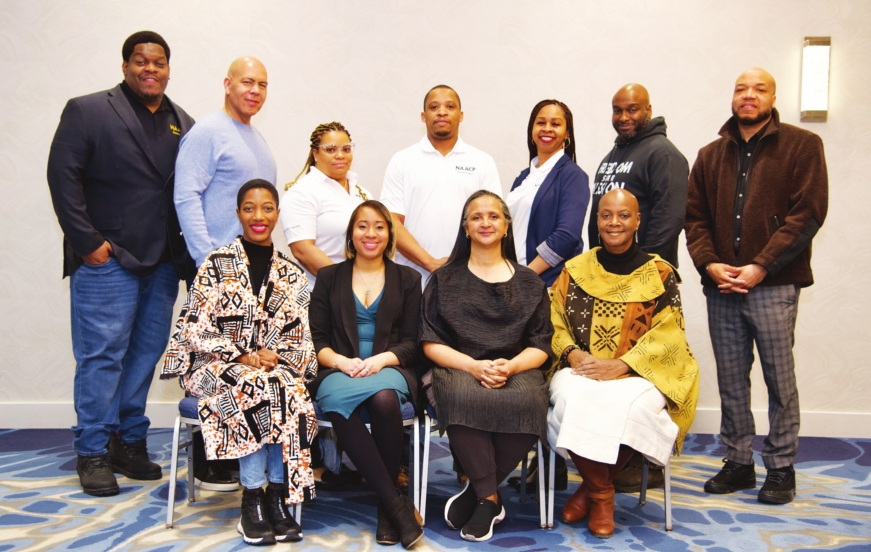
NAACP Boston branch executive committeeIn January, the federal administration was not the only one that shifted.
Locally, the Boston branch of the NAACP saw a changing of the guard, as it welcomed new members to its executive committee.
Now, as that executive committee stares down a shifting federal landscape under the Trump administration, and in the midst of persistent local disparities, they have identified three central priorities, said Royal Smith, the branch’s new president: health equity, Black homeownership and a continued push to return Boston Public Schools to an elected school committee.
“This is what we were kind of highlighting, because these are the issues of right now,” Smith said.
They’re also the issues that will keep the branch — the oldest local charted group in the NAACP — moving forward.
“We’re going on 115 years. How do we last another 100?” he asked.
Specifics around those goals largely remain to be determined. First, the branch plans to connect with community members and put together a “report card” focused on equity and opportunity in the city. He pointed to previous reports produced by the branch in the last 10 years.
One, published in 2017, covered economic development, education, public safety and staffing diversity, particularly in the mayoral administration of Marty Walsh, over the course of almost 170 pages.
“It all starts with that assessment, right?” Smith asked. “Getting the folks together, seeing what’s going on, hearing from the people — really hearing from the people.”
Elected school committee
Whether
or not to have an elected school committee has been a debate in the
city for years. Currently, all members of the committee are appointed by
the city’s mayor. Boston previously had an elected school committee; it
was replaced by an appointed one in 1992.
In
2021, the question went to voters across the city in a nonbinding
ballot question. At the time about 79% of voters said they would like to
see the city return to electing the members of Boston Public Schools’
governing body.
Smith
said that switch would bring more “real-life lived experience” to the
body, which is tasked with defining the district’s goals and operating
budget, reviewing policies, and hiring the superintendent.
The
current school committee was appointed by Mayor Michelle Wu — a
structure some critics say could introduce a level of sway from mayoral
priorities to the committee, if members feel beholden to the city’s
leader to keep their position on the body.
Supporters
of an appointed school committee have said that the model better
supports stability and a focus on long-term goals, and have suggested
that an elected committee might be more beholden to political pressure
and efforts to be reelected than to actual improvement.
During
her run for mayor, Wu offered support for a hybrid model — with a
majority of members of the committee elected while others would be
appointed by the city’s top executive. She has opposed a fully elected
body.
In 2023, when
the Boston City Council voted 7-5 to pass a proposal that would have
switched the school committee’s membership to a fully-elected model, Wu
vetoed the measure. At the time, she said in a letter to the council
that she thought the switch would “compromise our ability to stabilize
and support the Boston Public Schools in this critical period.”
The
district has, in recent years, faced transportation issues and poor
MCAS test scores that triggered fears of a receivership for the district
— a possibility that was ultimately averted.
Six
of the Boston City Councilors submitted a new measure seeking to switch
the committee’s make-up to an elected body in January.
In its support for the elected committee, Smith pointed to the broad support the measure received on the 2021 ballot.
“The
people wanted this,” Smith said. “When you’re going through something,
you feel a little better if you know that the persons or person making
decisions for you, can relate to you.”
Rufus
Faulk, the branch’s new vice president, said as the branch looks to
advocate an elected committee, he wants to make sure that the branch
considers historical lessons and other factors, like a record of low
voter turnout from Boston’s Black community, so that the committee is
“inclusive to all of the voices within the city of Boston.”
“We want to make sure that there’s enough education going around where residents are as enthusiastic about the elected school board as we are,” Faulk said.
Health Equity
When
it comes to the branch’s priority around health equity, Lucy Lomas, the
branch’s new health committee chair, said she anticipates addressing
the branch’s goals through a handful of efforts.
Those
initiatives will include steps like educating community members about
health disparities, providing connections to resources that exist around
health and health care access, and providing information about general
health information.
Lomas
also said the group will promote efforts from the national NAACP, like
its Ace Your Health survey, which is largely focused on trends around
social determinants of health — outside-of-hospital factors like access
to healthy food, quality health care, housing transportation and
greenspace.
For a
branch agenda that has such a strong focus on education, growing trends
of health misinformation at the federal level are “definitely focusing
into my lens and how I see it being a really important priority,” Lomas
said.
Last week, U.S.
Health and Human Services Secretary Robert F. Kennedy Jr. sent
congressional lawmakers a document explaining his recent changes in the
country’s COVID-19 vaccine policy. According to reporting by NPR, health
experts have called that document, which relies on scientific studies
that are unpublished or under dispute, “medical disinformation.”
Last
month, Kennedy’s “Make America Healthy Again Commission” released a
report that was found to contain citations to studies that don’t exist.
Smith
said the group plans to focus on issues specifically around mental
health and life expectancy — both issues that have been on the radar of
equity-focused efforts in recent years.
Last year, the Boston
Public Health Commission launched its Live Long and Well Agenda, an
effort aimed at closing life expectancy gaps in the city, like a 23-
year gap the commission identified between one census tract in Back Bay
and another two miles away in Roxbury. That effort is focused on
targeting cardiometabolic diseases, opioid overdoses and preventable
cancers by addressing things like social, economic and environmental
factors.
At a state
level, the Executive Office of Health and Human Services launched its
Advancing Health Equity in Massachusetts plan, announced in January
2024. That effort also aims to decrease disparities in life expectancy,
with targeted efforts around maternal health and, like the Boston
effort, cardiometabolic diseases.
Lomas
said she’s thinking about both of those initiatives, and how they can
intersect with the work that the NAACP branch is doing. Ongoing city and
state efforts make her hopeful, she said.
“It’s
our job as the branch to figure out how we fit in and how we can help
our branch members just amplify their work so that they know what’s
being done,” Lomas said.
The
work, broadly, is a “really challenging truth,” she said, and leaves
the branch and its health committee with a hefty workload.
Housing access
When
it comes to the branch’s housing goals, Smith said addressing Black
homeownership and housing costs is an important step to keep communities
of color strong and to avoid the negative impacts that gentrification
could cause on businesses.
It’s a need that he said is especially true given the high cost of housing in the state.
“Home
ownership, that’s a big indicator, but the lower-hanging fruit in that
is housing,” Smith said. “This is one of the most expensive places, if
not the most expensive place in the United States.”
According
to data from Zillow, earlier this year, Massachusetts clocked in with
the third highest median home value, after only Hawaii and California,
at $635,252.
Faulk said those efforts are tied, as well, to economic
development measures to make sure Black residents can afford to be
homeowners, a push he said is centered in connecting communities of
color to booming industries in the region.
“I
think, oftentimes, when we think about housing, we think about it
strictly around this lens of affordable housing,” said Faulk. “But a
portion of this also has to be, how are we making sure that Boston’s
Black residents,
Black population, are able to earn a living wage or be able to increase
their earning potential so that they can withstand any rises or dips in
the housing market?”
That
work, he said, will include connecting residents to existing programs
aimed at bringing in more residents of color into some of those
industries, like a push in recent years to diversify the life science
industry of the climate tech space. Or supporting residents in being a
part of the hospitality industry as it bounces back from the COVID-19
pandemic.
“We’re not
going to be able to be all things, but we want to make sure in our
partnership spaces, we are partnering with organizations and individuals
who are in the space of doing this work,” Faulk said.
Community connection
Beyond
its three main focus areas, Smith said he has a goal of engaging with
more people faceto-face, something he said is especially important to
him as the group begins its outreach and research on the report card it
intends to create.
Smith
said that the group is looking to use this summer to “talk with people —
not through Facebook, not through any of these mediums, but really
listen to the stories of what’s going on and what’s really affecting our
neighbors, our brothers, our sisters.”
Connecting
with community members was a priority Lomas and Faulk also listed, with
intentions of making sure that residents know about the various
programs around those focus areas — like equitable access to health or
home ownership — that the branch is focused on.
Smith
said he sees that kind of community connection as a longstanding piece
of how the NAACP works, which has allowed the group to do “unbelievable
things.”
“When you
convene, when you’re building your community, you’re knowing what your
neighbor’s doing; you’re being one in the same fight,” Smith said.


