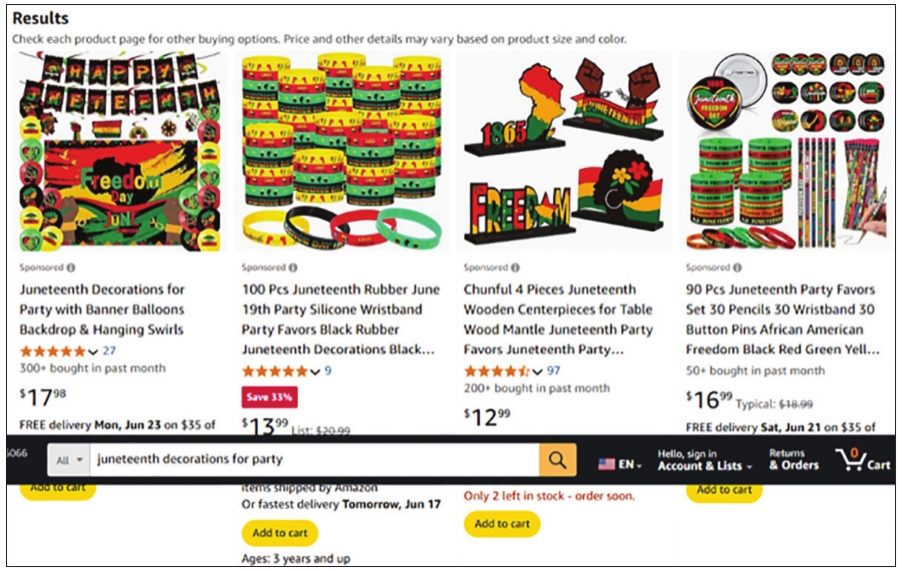
A sample page of Amazon Juneteenth wares
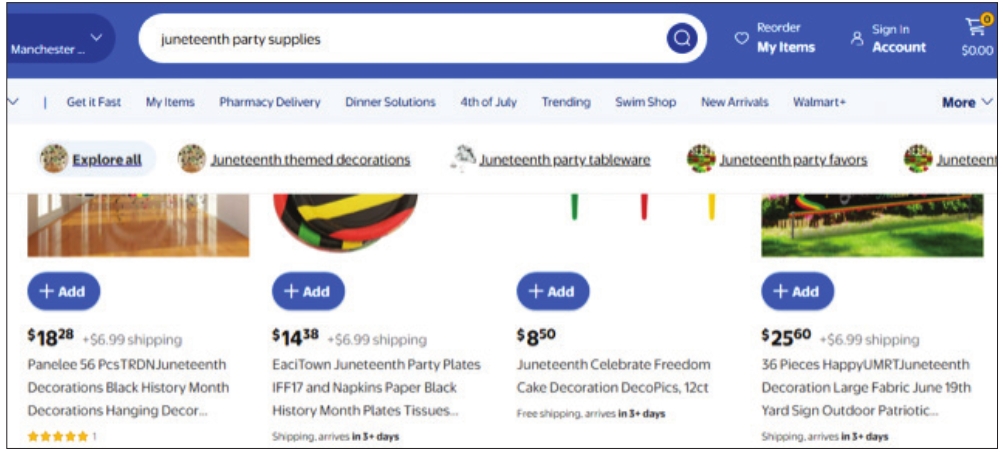
Juneteenth party supplies from Walmart Juneteenth, celebrated on June 19, marks the day in 1865 when enslaved African Americans in Texas were finally informed of their freedom — two and a half years after the Emancipation Proclamation. On that day, Union General Gordon Granger arrived in Galveston and issued the historic order declaring all enslaved people in the state free, making Juneteenth a powerful symbol of delayed liberation and enduring resilience.
After the police murder of George Floyd in 2020, many companies made pledges and promises to embrace diversity, equity and inclusion — which included the acknowledgment of Juneteenth.
However, when President Donald J. Trump was voted back into the White House, he issued an executive order to “coordinate the termination” of what he calls “discriminatory programs,” which include “illegal DEI” and “diversity, equity, inclusion, and accessibility mandates, policies, programs, preferences, and activities.”
After this order, some companies began to withdraw their support and pledges from many DEI initiatives.
Target formally acknowledged Juneteenth in 2020 as an official annual company holiday and called it part of their “commitment to advancing racial equity and social justice” by giving their employees “space to celebrate and honor the day in their own way.”
Yet in 2025, Target said it would phase out its DEI initiatives, such as ending their Racial Equity Action and Change committee, which was created to accelerate their ongoing diversity, equity and inclusion strategy, with a focus on advancing racial equity for Black employees and guests.
Recognizing Juneteenth as an annual holiday was one of their first actions from this committee.
PBS
News reported that it had already had plans to wrap up the program this
year and will move forward with ending the DEI goals “it previously set
in three-year cycles, which included “hiring and promoting more women
and members of racial minority groups, and recruiting more diverse
suppliers, including businesses owned by people of color, women, LGBTQ+
people, veterans and people with disabilities.”
Walmart
has also chosen to wrap up their DEI initiatives, which include not
renewing a five-year commitment for an equity racial center set up in
2020, pulling out of a prominent gay rights index, and no longer giving priority treatment to suppliers based on race or gender, according to The Associated Press.
Amazon
joined this list, as CNBC News reported that they have decided to stop
some of their diversity and inclusion initiatives, as they obtained an
internal note to staff by their vice president of inclusive experiences
and technology, Candi Castleberry, who said that “the company was in the
process of “winding down outdated programs and materials” as part of a
broader review of hundreds of initiatives.
Yet
in 2021, Amazon sponsored the inaugural Juneteenth Unityfest, a
national livestream event conceived by Grammy-nominated African American
artist Robert Randolph, which brought “together people of all
backgrounds in a day of unity to commemorate and celebrate Juneteenth
and Black culture with musical performances, inspiring remarks, films,
comedy, storytelling, and appearances by civic leaders and influencers.”
They also launched their Black Business Accelerator.
Amazon
was also a promotional sponsor of Blk Freedom’s 2021 Virtual Museum
Experience, which included a selection of books highlighting the history
of Juneteenth. The company announced that it was donating $1 million to
be distributed to 13 community-based organizations that support
communities of color in Seattle.
Mark
Zuckerberg’s Meta also made the decision to terminate their major DEI
programs “for hiring, training, and picking suppliers,” stating that the
“legal and policy landscape surrounding diversity, equity and inclusion
efforts in the United States is changing,” per a memo by Janelle Gale,
vice president of human resources, according to Axios.
Yet
in 2021, Meta Elevate dedicated Juneteenth “to the Black business
owners and leaders who have created their own opportunities and continue
to serve as the lifeblood of their local communities.” In their
Instagram Stories they featured
businesses from the birthplace of Juneteenth, and teamed up with the
#BuyBlack initiative to bring their audience a duo of Reels hosted by
celebrity and talk show host Karamo that offered up commerce tips for
small business owners.
The
changes and shifts away from important DEI initiatives seem to suggest
that supporting Black people and our sacred holiday of Juneteenth were
only relevant when it was “in vogue” to provide funding to racial equity
causes while making a profit from our collective pain. While some of us
have chosen to participate in boycotts, we also must acknowledge that
some of us cannot, as some of these businesses provide essential goods
that could be inaccessible elsewhere, due to financial constraints or
lack of transportation options.
These
changes also show us that DEI initiatives, including Juneteenth, were
just a business strategy. It can be extremely disheartening and could
bring about questioning about whether we will truly overcome someday, as
our ancestors sang during the Civil Rights Movement.
There
are also so many attacks on equity in this political climate, from DEI
initiatives being shut down, new deportation laws that are unjust, and
the fight to preserve our history and our stories. It seems as if safe
spaces for us are dwindling and there’s an intentional roll back of many
of the civil rights, for which we have fought so hard over the years.
However,
as sad as this can be, I want to encourage us, as we prepare for
Juneteenth and celebrate the freedom that those same ancestors fought
for us to have with unbridled love and joy towards our families and our
communities — using it to fuel and strengthen us for the battles we face
as a community.
One
of my favorite Black journalists is Roland Martin. Three months ago, he
ran a counter episode on his news show, Roland Martin Unfiltered,
called, “State of Our Union,” specifically to talk about the issues most
important to Black people in contrast to Trump’s joint address to
Congress.
As my mother
and I watched this six-hour episode where he featured Black
politicians, activists and experts, it was his sign-off where he issued a
call to action to the Black community.
“There
are people who say, ‘Well, where do I start? Where do I call? Who do I
call? Is somebody going to allow me to do it?’ And the reality is, you
don’t have to ask anybody’s permission … you have to start exactly where
you are … you must stop waiting for other people to show up. Too many
of us are so fixated on the problem and the issues and what can’t be
done, as opposed to what actually can be done. Tomorrow is an
opportunity for you to decide, what are you going to do and what are you
prepared to do to be a change agent for our community,” he said.
So,
I issue the same clarion call to you. On Juneteenth, let us celebrate
our resilience and freedom that our ancestors valiantly fought for.
Let’s support one another, pray for one another and encourage one
another. Yet, let us also reflect and decide how we will engage in this
fight to keep our individual and collective freedom and become change
makers for good in our city, our state, and our nation — as Juneteenth
is not a business to us, it’s a celebration for us and by us.