Wendel
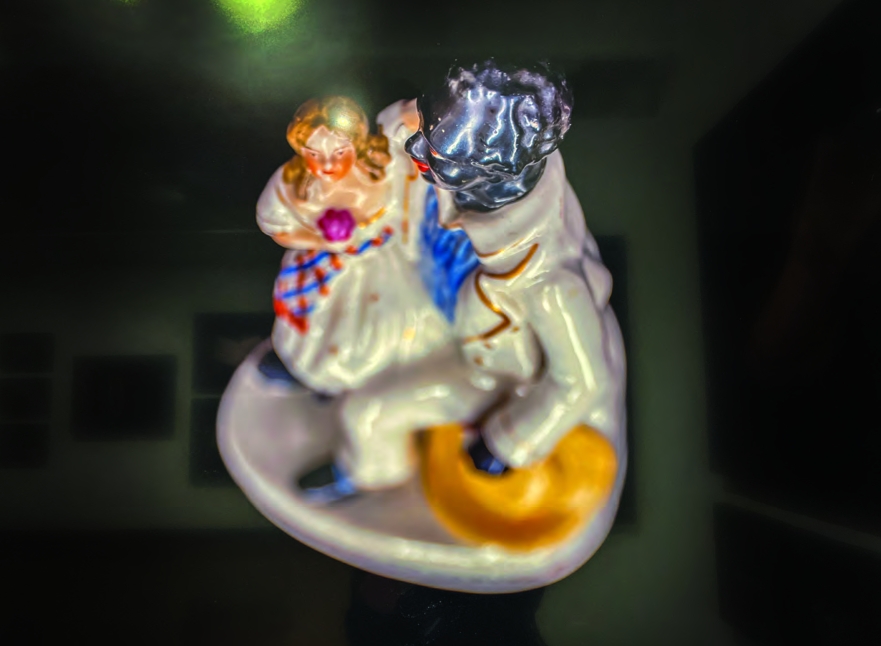
White photograph of Staffordshire Ceramic, Uncle Tom and Eva from the
Harriet Beecher Stowe Center in Hartford Connecticut.James Baldwin’s inkwell, Malcolm X’s tape recorder, a lock of Frederick Douglass’s hair. These are some of the physical manifestations of Black history, oppression and transcendence that artist Wendel White photographed for his book “Manifest: Thirteen Colonies” and the eponymous exhibition the Peabody Museum of Archaeology & Ethnology at Harvard University.
The items White photographed paint a vivid portrait of Black history in the United States. One photograph shows a piece of intestine from a man of African descent used to understand and identify one of the first strains of cholera, a reference to the torturous history of nonconsensual medical testing on Black bodies. Other objects showcase the talents of cultural titans like Zora Neale Hurston, James Baldwin and W. E. B. Du Bois.
“The historical record has not been in place for African Americans in the way that it has been in place for the broader American population,” said White during a public discussion with historian Brenda Tindal and collaborators Cheryl Finley, Leigh Raiford and Deborah Willis about his book. “What we have passed on in memory has not often existed in the collections, has not often existed in the archives.”
The exhibition is aptly hosted at Harvard, the home of extensive, and often exclusionary, archives acquired at times through morally dubious means. White
contained the project to objects found within the territory of the
original 13 British colonies, some from the Peabody Museum itself.
But
White is not merely documenting the objects for the record; he’s
interpreting them through a specific point of view. Photographed with a
very shallow depth of field, the images are often focused on one piece
of the object. In some cases, nearly the entire object is blurred.
An
image of a ceramic Uncle Tom and Eva figure from the Harriet Beecher
Stowe Center in Hartford, Connecticut, is focused on the face of the
Black Uncle Tom figure, blurring out the white child on his lap and the
rest of the figure composition. In this way, White returns personhood to
a depiction created as a caricature, rather than an homage to the
character of Uncle Tom created by Stowe.
Each
of the objects is photographed on a plain black backdrop, completely
removing it from all historical and cultural contexts. In that way, the
viewer sees the artifacts as White did, individually, out of chronology
and without an immediate sense of how they relate to one another. By
presenting these objects, literally through his own lens, White creates a
new perspective of African American history in the United States.
“Manifest: Thirteen Colonies” is on view through April 13
at the Peabody Museum, located at 11 Divinity Ave. in Cambridge. The
museum is free to Massachusetts residents on Sundays from 9 a.m. to 12
p.m. and Wednesdays from 3 p.m to 5 p.m.
White
says his book “is about tremendous pain and terror that has occurred to
the African-American communities in this country for a long period of
time, but then, also a transcendence which has taken place within the
community, a sense of agency and a sense of accomplishment in spite of
obstacles placed in the way.”
ON THE WEB
Learn more at peabody.harvard.edu/manifest-thirteen-colonies