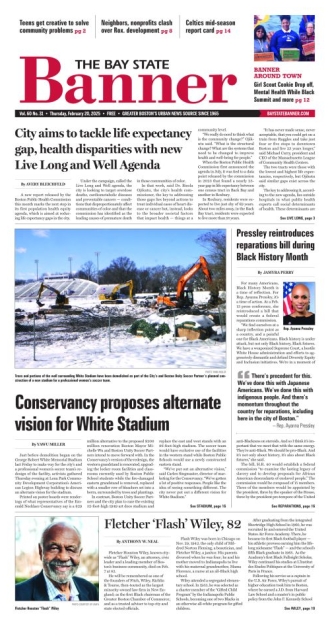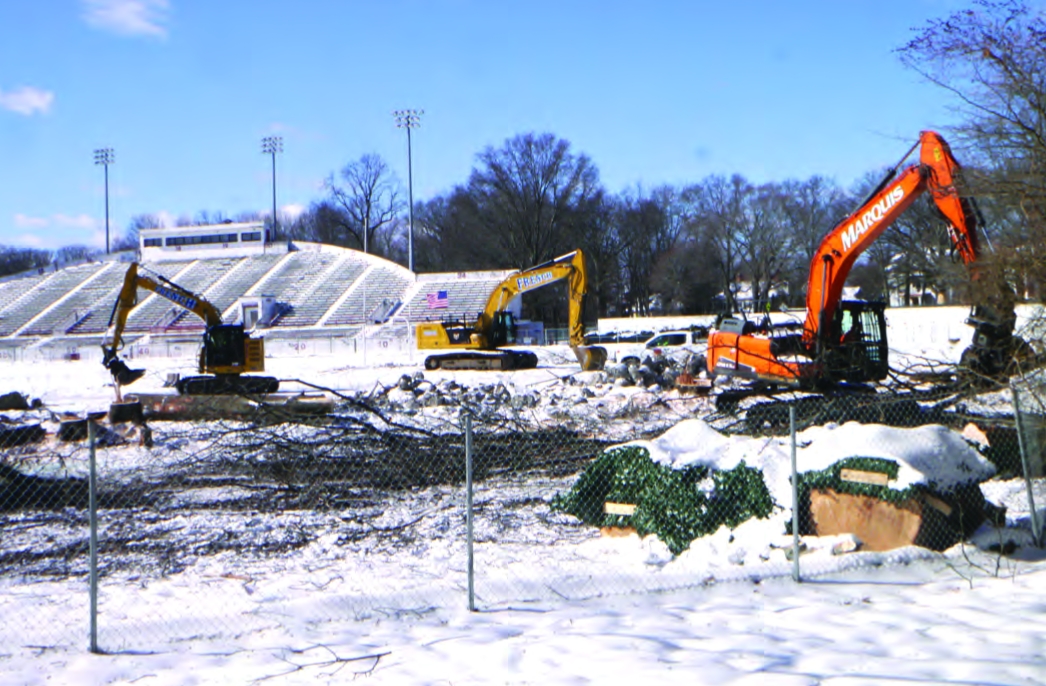
Trees and portions of the wall surrounding White Stadium have been demolished as part of the City’s and Boston Unity Soccer Partner’s planned construction of a new stadium for a professional women’s soccer team.Just before demolition began on the George Robert White Memorial Stadium last Friday to make way for the city’s and a professional women’s soccer team’s redesign of the facility, activists gathered Thursday evening at Lena Park Community Development Corporation’s American Legion Highway building to discuss an alternate vision for the stadium.
Printed on poster boards were renderings of what representatives of the Emerald Necklace Conservancy say is a $29 million alternative to the proposed $200 million renovation Boston Mayor Michelle Wu and Boston Unity Soccer Partners intend to move forward with. In the Conservancy’s version of the redesign, the western grandstand is renovated, upgrading the locker room facilities and classrooms currently used by Boston Public School students while the fire-damaged eastern grandstand is removed, replaced with a smaller row of bleachers set into a berm, surrounded by trees and plantings.
In contrast, Boston Unity Soccer Partners and the city plan to raze the existing 52-foot-high 1949 art deco stadium and replace the east and west stands with an 86-foot-high stadium. The soccer team would have exclusive use of the facilities in the western stand while Boston Public Schools would use a newly constructed eastern stand.
“We’ve put out an alternative vision,” said Carlen Singmaster, director of marketing for the Conservancy. “We’ve gotten a lot of positive responses. People like the idea of seeing something different. The city never put out a different vision for White Stadium.”
Beyond
the design differences, the Conservancy’s vision reflects the
organization’s orientation as a steward of the city’s network of public
parks. There’s no professional women’s soccer team in the conservancy’s
plans, which assume the stadium would remain under the exclusive control
of the Boston Public Schools. The design also preserves what’s
currently sited around the stadium — the tennis and basketball courts
and trees, 147 of which are currently being removed under the Boston
Unity Soccer Partners’ plan for a new stadium.
The
presentation of the alternative plan to the community, coming as the
city begins demolition, is unlikely to stop city officials from moving
forward with their project. But the Conservancy has also filed a lawsuit
against the project on the grounds that it violates the Public Lands
Protection Act, a law meant to prevent public parklands from being
converted to private use.
“The
displacement of the public from public spaces is something we care
about,” said Conservancy President Karen Mauney-Brodek, who argues the
soccer group and city are taking space in and around the stadium for
private use.
The
Conservancy’s lawsuit also alleges the Wu administration leapfrogged
over proper environmental reviews in its rush to move the project
forward.
“We do not believe the proper reviews have taken place,” Mauney-Brodek said.
While
a judge denied the Conservancy’s motion to block the project from
moving forward before the March 18 trial date, the judge advised city
officials and Boston Unity Soccer Partners that their decision to
proceed with the project would be at their own risk.
Activists
who turned out to the Conservancy’s Thursday meeting expressed concerns
about aspects of the city and soccer team’s plans for White Stadium.
Will
Onuoha, a Dorchester resident and candidate for an at-large seat on the
Boston City Council, said he is concerned about what many see as a lack
of process around the decision to lease the stadium to a professional
soccer team.
“I don’t
think the city should move on this until they listen to how the
community feels,” said Onouha, who played football in the stadium while
in high school. “Together, we can come up with a different plan. What
the community wants should matter.”
Philanthropist Josh Kraft, a candidate for mayor, said the city needs to pause on the project.
“There have been consistent concerns from a majority of those most impacted by the project,” he said.
Kraft’s family owns the New England Revolution, a men’s soccer team that is seeking to build a new stadium in Everett.
Others
cited a proposed game-day parking ban that would extend nearly a mile
from the park, potentially shutting down festivals, concerts, and other
outdoor events in the park and surrounding area; abutters have
complained about potential noise from the games.
“They’re
telling us we have to ask permission to park where we live,” said Jean
McGuire, a retired former director of METCO and former Boston School
Committee member. “How are they going to restrict parking in our
neighborhood?”