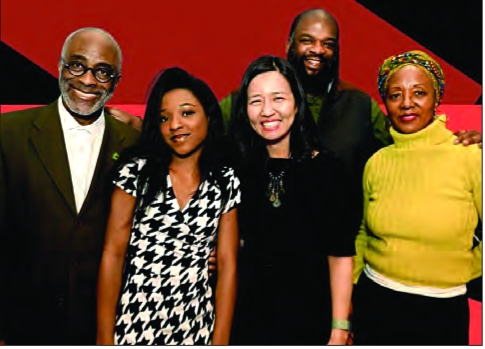
Some
members of Boston’s Task Force on Reparations: (from left) Joseph
Feaster, Carrie Mays, Mayor Michelle Wu, George (Chip) Greenidge, Jr.
and Dorothea Jones
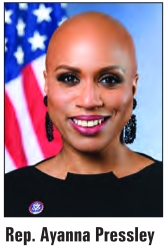
For many Americans, Black History Month is a time of reflection. For Rep. Ayanna Pressley, it’s a time of action. At a Feb. 13 press conference, she reintroduced a bill that would create a federal reparations commission.
“We find ourselves at a sharp inflection point as a country, and a painful one for Black Americans. Black history is under attack, but not only Black history, Black futures. We have a weaponized Supreme Court, a hostile White House administration and efforts to aggressively dismantle and defund Diversity Equity and Inclusion initiatives. We’re in a moment of anti-Blackness on steroids. And so I think it’s important that we meet that with the same energy.
They’re anti-Black. We should be pro-Black. And it’s not only about history, it’s also about Black futures,” she said.
The bill, H.R. 40 would establish a federal commission “to examine the lasting legacy of slavery and to develop proposals for African American descendants of enslaved people.” The commission would be composed of 15 members. Three of the members would be appointed by the president, three by the speaker of the House, three by the president pro tempore of the United States
Senate and the remaining six would be subject matter experts in racial
justice, economics, civil rights, reparative justice and other related
fields.
Pressley
said now is the time to really dig into what reparations could look
like on the federal level, thanks to the work previously done in
Congress.
“H.R. 40 has
tremendous momentum thanks to this incredible and resilient movement of
justice seekers and liberators led by our beloved and recently departed
Congresswoman Sheila Jackson Lee, and before her Congressman John
Conyers, who took up this mantle respectively in the last Congress. This
was marked up and reported on in the Judiciary Committee. We have more
co-sponsors than ever before,” said the representative for
Massachusetts’s 7th congressional district.
She said history is on the side of the reparation commission thanks to the historical blueprint laid out before them.
“There’s
precedent for this. We’ve done this with Japanese Americans. We’ve done
this with indigenous people. And there’s momentum throughout the
country for reparations, including here in the city of Boston,” Pressley
said.
Here in Boston,
the City’s Task Force on Reparations works with the Mayor and the City
of Boston for solutions to heal racial inequities for descendants of
slavery. The task force was established in 2022 through a City Council
ordinance and appointed by Mayor Wu. The task force is made up of 10
members, including two youth appointees.
Both
the Federal Commission and the Boston Task Force have their work cut
out for them when it comes to finding ways to mitigate centuries of
trauma.
“The
harms done to Black Americans didn’t just happen in the ether. It
wasn’t just some organic cultural phenomenon. These were legislated hurt
and harms. And so if the federal government, codified the harm to Black
Americans through law, I think the federal government also has a
responsibility to legislate equity, legislate healing, to legislate
justice,” she said.
For
the Japanese Americans interred in camps, reparations included an
official apology, a small fund for public education, and cash payments
to survivors. For indigenous people, reparations looked a little
different. Native American tribes endured historical injustices and land
seizures. To address that widespread mistreatment the United States
government offered monetary payments or the return of land.
Pressley
said merely cutting a check just won’t cut it when it comes to
reparations for African Americans and that’s why the work of the Federal
Commission will be so vital.
“A
lot of people try to define the work of reparations as simply about a
check. When you think about the systemic ways in which the vestiges of
slavery show up in our day-to-day lives or even the fact that this
country is still benefiting from an economy, including sugar, rice,
cotton and tobacco, that was built on the brutality and the backs of
Black people. This is timely. It is relevant, and it is about so much
more than just a check because the harm is systemic, and that’s why this
commission is so needed so that we can fully examine the systemic
implications of channel slavery on our society, and then deliberate and
invent comprehensive, holistic operations proposals,” said the
congresswoman.
Tackling such a ubiquitous topic could take years but the Federal Commission has a tight deadline.
It
has 18 months to do its work. With an end date in sight, it remains to
be seen what it will accomplish but Pressley is hopeful. She views H.R.
40 and the creation of the commission as a bright spot in the future of
Black Americans.
“I
see H.R. 40 as our North Star. As a mom to a 16-year-old, when I
transition and I’m an ancestor, what I don’t want to pass on to my
daughter is generational trauma, a legacy of hurt and harm. My daughter
deserves to inherit a legacy of generational black wealth, generational
black health, generational Black joy, and generational black freedom, to
live in a country where her joy is a birthright and not a privilege. I
do believe another world is possible,” she shared.