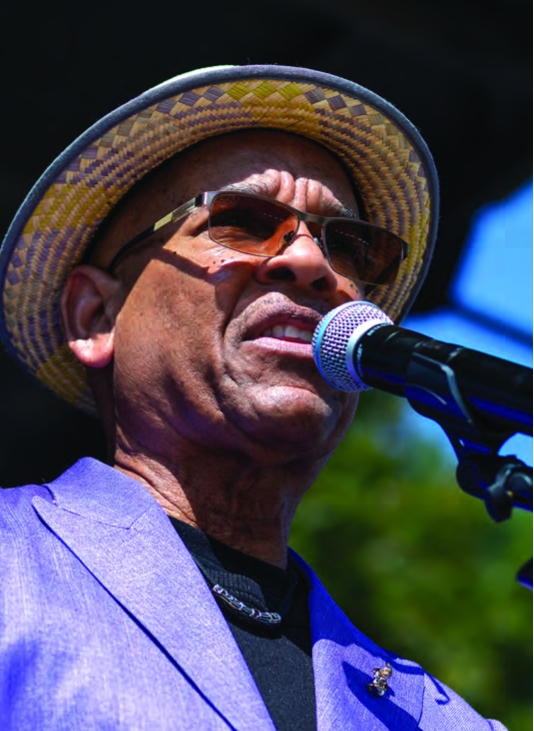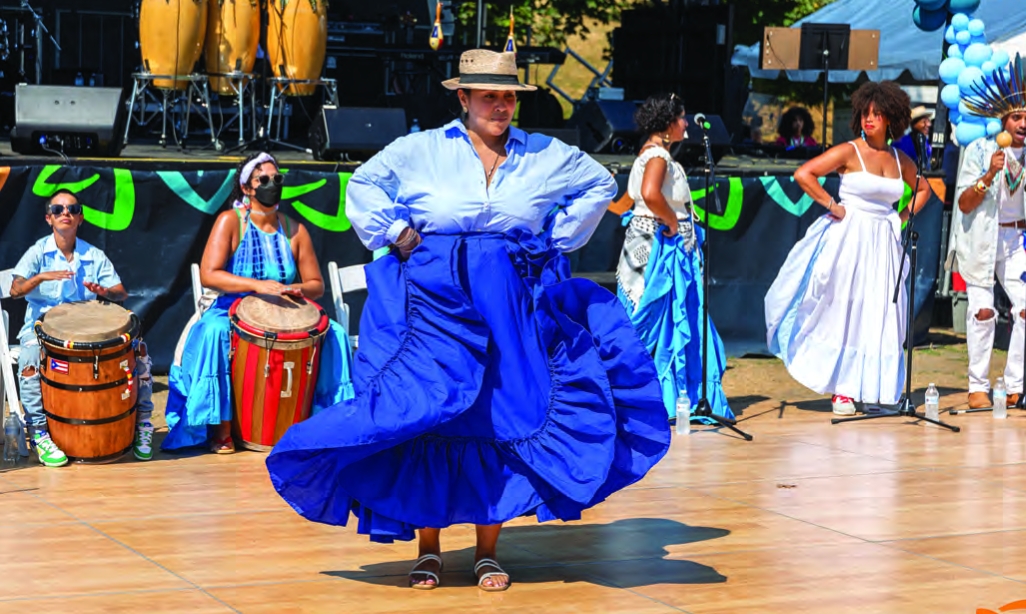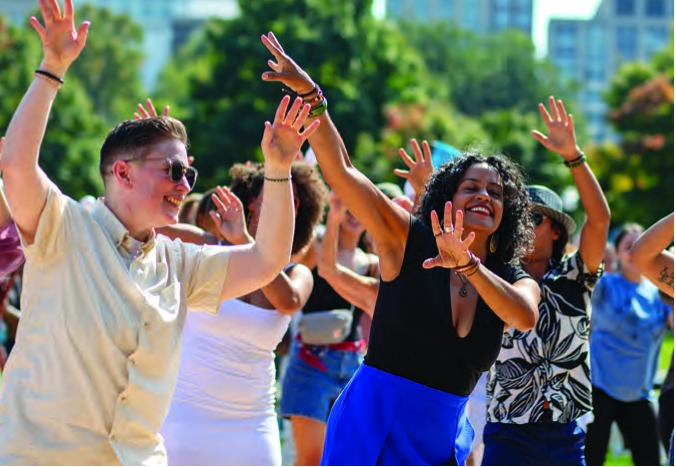
Scenes
from last year’s festival: (top) Jose Massó III speaks to the crowd;
(middle) a performance of traditional dance; (bottom) Attendees enjoy a
community dance lesson.The Embrace Massó ¡Con Salsa! International Music Festival, sponsored by Embrace Boston, is less than two weeks away. The free, daylong event celebrates Latin music and culture as well as social justice efforts.
The festival is named in honor of Jose Massó III, host of WBUR’s “¡Con Salsa!” a radio program celebrating its 50th anniversary.
“Mr. Massó has been a longtime supporter, mentor and guiding light to all of us at Embrace,” Imari K. Paris Jeffries, president and CEO of Embrace Boston, told the Banner.
According to the City of Boston Planning Department statistic released in April, “Spanish is the most prevalent second language in the city with 104,259 speakers, concentrated in East Boston.” The U.S. Census Bureau in 2025 noted that Dominicans make up the largest group of these speakers, followed by Puerto Ricans and then Salvadorans.
“It’s not just a music festival,” Jeffries said. “It’s public policy in motion. It’s a space where Afro-Latinx culture takes center stage in a city that too often overlooks it.”
The celebration takes place on Sept. 13 from noon to 7 p.m. The festival segues to National Hispanic Heritage Month, which takes place Sept. 15 to Oct. 15.
Performers include Manuela Sánchez-Goubert, a vocalist and composer who moved to New York City at age nine from Columbia and is currently a student at Berklee College of Music. Sánchez-Goubert describes her music on her website as a mix of “elements of traditional Latin American folk acts like Violeta Parra and Susana Baca with the sophistication of modern jazz greats like Cécile McLorin Salvant.”
Later
in the day, saxophonist and composer Jonathan Suazo plays tunes that
are enriched by knowledge and love of his heritage in the Dominican
Republic and Puerto Rico.
Aja
Monet, nominated for a Grammy in 2024 in the Best Spoken Word Poetry
Album category, for her album “when the poems do what they do,” takes to
the stage in late afternoon. Monet, was brought up in East New York,
Brooklyn, is a 2009 graduate of Sarah Lawrence College and is currently
based in Los Angeles, describes, “Florida Water,” her most recent book,
as “a collection of poems that, like the cleansing waters of spiritual
baths, rinse, reflect, and reveal the raw truths that lie within us.”
The
importance of music and poetry as political forces is exemplified by
José Massó III, whose work can be seen as the inspiration for this
festival honoring him.
“We
are living in a time when a kakistocracy, backed by oligarchic
interests, is dismantling six decades of civil rights progress and
steering our nation toward authoritarianism,” Massó told the Banner.
“This regression threatens to restore an era defined by white male
privilege, entitlement and the resurgence of white supremacy. ...We
don’t need to agree on every issue, but we must commit to dismantling
tribalism and outdated traditions that hinder progress toward equity and
fully embrace diversity and inclusion.”
Educating
audiences about the nuances and complexities of varied Afro-Latin
communities in Boston is part of the day’s activities. As such, festival
organizers are including the Hyde Square Task Force to present its
work.
Massó explained
that the Jamaica Plain-based Hyde Square Task Force “is a dynamic
organization unapologetically committed to nurturing and amplifying the
voices,
creativity and power of youth by grounding them in Afro-Latin culture so
they can advance justice in their communities.”
BOMBAntillana is also in the mix.
The
drums, dance and vocals of Bomba, rooted in Africa and Puerto Rico, can
make history so contemporary and vibrant that its artistic lessons
enter hearts. Then, too, audiences can tune into music spun by DJ
Armando.
The festival
closes out with the Spanish Harlem Orchestra, also known as SHO. Founded
25 years ago by Oscar Hernández and Aaron Levinson, the three-time
Grammy Award-winning band describes itself as being “dedicated to the
sounds of the barrio (Spanish Harlem, NYC),” and “on a mission to keep
the musical legacy of salsa dura (hard salsa) alive and expand its
audience to those who love great music, not just Latin music.”
This festival is all about art as activism.
“These
past five decades I have employed pedagogy on my show that fosters
integrity, social justice and liberation that I hope will inspire
listeners for civic action, sustainability and community building,”
Massó said.
ON THE WEB
Learn more at embraceboston.org/embracemasso-con-salsa