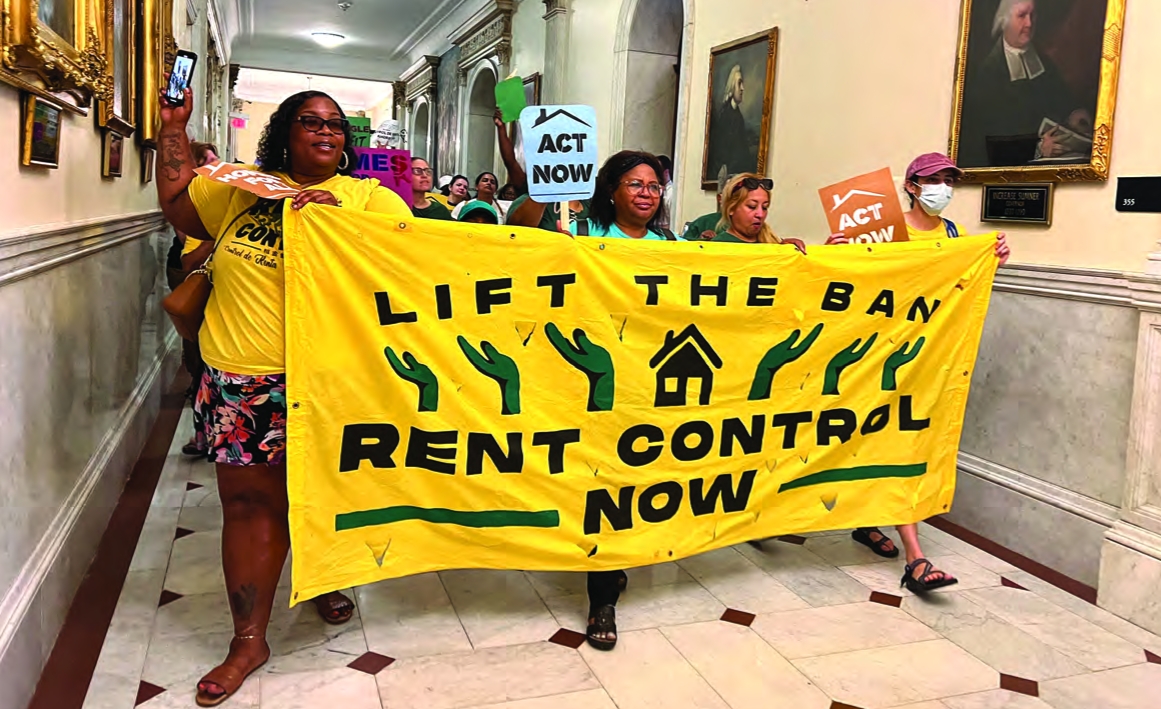
Advocates
march through the State House before a legislative hearing before the
Joint Committee on Municipalities and Regional Government, July 29.

A
state housing needs assessment, published by the Executive Office of
Housing and Livable Communities, found that approximately 115,600 homes
will be needed over the next 10 years to solve the existing shortage.Rent control advocates, opponents state their case during State House hearing
Advocates flocked to the State House, July 29, amid a renewed push to eliminate the statewide ban that prohibits cities and towns in Massachusetts from creating local rent control measures.
In a five-hour-long hearing before the Joint Committee on Municipalities and Regional Government, legislators heard from advocates speaking in support and opposition to the rent control bill, as well as other pieces of proposed legislation that would shift municipal approaches to housing, including proposed changes to the long-contentious MBTA Communities Act.
A new push to bring back rent control
Since the mid-1990s, rent control has been prohibited in Massachusetts.
The proposed legislation, if passed, would not directly implement rent control across Massachusetts, but would remove a 1994 ban for the measures, allowing municipalities to adopt rent control or rent stabilization measures.
“Lifting the statewide ban on rent control and stabilization would allow municipalities who are most impacted by the rising cost of housing and displacement to create their own path toward housing security for all families,” said Sen. Liz Miranda, during the hearing.
Under the bill, rent increases would be allowed at the rate of inflation, with a cap of 5% increases. The limit would continue across leases, so rents would not be able to be dramatically raised between tenants.
And
the legislation includes other proposed tenant protections in the form
of a ban on no-fault evictions, which would require landlords to provide
“just cause” when trying to evict a tenant.
The bill bakes certain exemptions into its structure.
Under
the legislation, owner-occupied buildings with four units or less would
be exempted, as would new housing for five years after its
construction. Public and subsidized housing, college and university
dorms and facilities for elder care would also fall outside of the law.
Rent
control was banned in Massachusetts following a statewide ballot
measure in 1994. At the time, three municipalities — Boston, Cambridge
and Brookline — had rent control systems in place.
At
the time, voters in those municipalities voted to uphold rent control,
but statewide, pressures leaned the opposite direction and, overall, the
state narrowly voted to eliminate and prohibit rent control in a
decision that differed by less than three percentage points.
Locally
the concept still seems to hold some appeal. In a July poll from
Suffolk University and the Boston Globe, 65% of respondents said they
favored a cap on rents or other forms of rent control.
And
in 2021, when Boston voters last elected their mayor, Mayor Michelle Wu
ran on a platform that included pushing the state to re-allow rent
control.
Supporters
of the bill framed the legislation, and the municipal policies it would
allow, as one of multiple measures needed to address housing shortages
in the state. A state housing needs assessment, published by the
Executive Office of Housing and Livable Communities in February, found
that between families in the state’s shelter system, a low vacancy rate
for homes and apartments across Massachusetts and overcrowded homes,
approximately 115,600 homes will be needed over the next 10 years to
solve the existing shortage.
With a forecasted growing need, the state could require an estimated 222,000 homes total by 2035.
“Building
new housing won’t keep rents from rising faster than people’s incomes,”
said Sen. Pat Jehlen, lead sponsor of the bill in the Senate. “It won’t
keep people from being evicted.”
Supporters
also sought to draw a contrast between corporate landlords, who they
framed as the culprits behind the large rent increases that rent control
measures would seek to cap, and smaller landlords, some of whom would
be exempted unto the local rent control measures allowed under the bill.
“We
know that most landlords are able to not raise the rent more than the
cost of living and they’re able to continue to pay what they need to,”
said Carolyn Chou, executive director of Homes for All Massachusetts, a
local organization that advocates housing and tenants’ rights. “This is
really about corporate interests who are coming into cities and towns.”
The
state’s housing need assessment identified larger landlords with
profit-driven investors as more likely to maximize rents, take quick
action to evict renters falling behind on payments and make quick
investments to “flip” properties for shortterm gains.
And
some smaller landlords who spoke during the hearing said they believe
rent stabilization policies can improve trust between landlords and
tenants, and rent control can result in more stability with less abuse.
“I
believe the landlord-tenant relationship should be good. This ensures
better care for our properties, and it leads to better stabilities for
our families,” said one small landlord with five units in Lynn through a
translator. “That helps both parties equally.”
Opponents of the bill said they worry that rent stabilization policies will drive good landlords out of the market.
“We
need more conscientious housing providers, not fewer, but this policy
drives them out of the market,” said one small landlord who spoke during
the hearing.
Opponents
also cited other arguments against the policy, like concerns that it
could drive prices higher in the long-term or lead to disinvestment in
properties.
But
supporters argued it was just one tool in the toolbox, and one that
could be brought into play more quickly than growing the state’s housing
stock.
“This is truly a crisis, and we have to do something now,” Miranda said.
Seeking change on the MBTA Communities Act
During
the legislative hearing, advocates and lawmakers also turned their
focus to proposed legislation focused on making adjustments to the MBTA
Communities Act.
That
2021 law requires municipalities that touch the MBTA system, or the
communities adjacent to them, to establish an area where multifamily
housing is allowed by default or zoned by right.
Overall, it impacts 177 cities and towns across eastern Massachusetts.
Supporters
of that law, including Gov. Maura Healey, have said the act makes it
possible for more residents to find a home that’s accessible by transit,
but it has proved contentious.
Municipalities
have opted not to create the zoning plan required under the law —
making them ineligible for certain kinds of state funding — and pushed
back in other ways. Following the town of Milton’s refusal to adopt the
zoning requirements under the law, in 2024, the attorney general’s
office sued the town, which is bordered on its northern end by the
Mattapan Trolley. Milton argued the attorney general’s office couldn’t
enforce the law and lodged allegations that the MBTA Communities Act was
unconstitutional.
In
January, the Massachusetts Supreme Judicial Court ruled that the state
had to redo its guidelines around the law, but that the measure was both
constitutional and enforceable.
The
Joint Committee on Municipalities and Regional Government heard
testimony about a handful of bills that would make changes to the MBTA
Communities Act, largely to restrict its reach, taking steps from
creating exemptions based on size or existing housing stock to repealing
the law altogether.
Another
proposed bill would move in the opposite direction, expanding the
requirements for multi-family zoning to all communities across
Massachusetts.
Advocates
for changes to the MBTA Communities Act largely hung their arguments in
opposition to what they described as a “onesize-fits-all” mandate.
“The
one-size-fits-all approach really doesn’t work and hasn’t worked in the
history of the state,” said Sen. Patrick O’Connor, speaking on a bill
that would allow for exemptions for adjacent communities, and another
that would create an appeals process that would allow municipalities to
object based on factors around drinking water supply, wastewater
treatment, transportation impacts and environmental or historical
impacts.
“I think we need to give more options to our communities who are struggling to meet the MBTA Communities Law,” O’Connor said.


