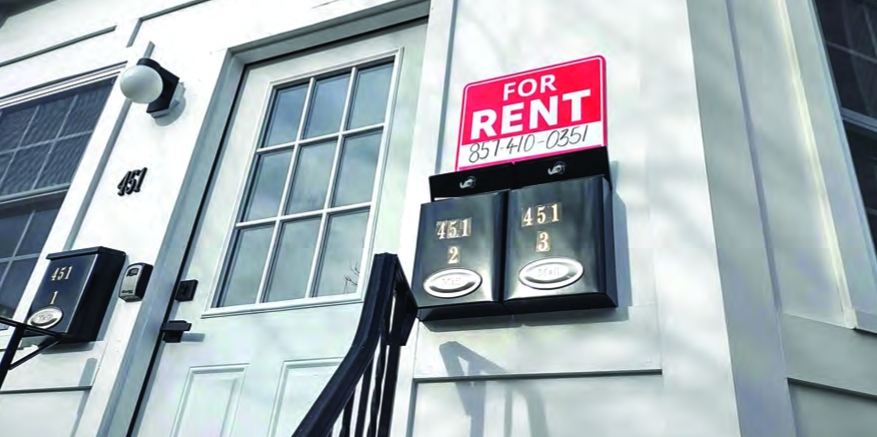
A sign hangs on the front of a rental unit in Somerville on Feb. 8, 2025. Effective August 1, renters looking to secure housing in Massachusetts no longer have to pay a mandatory broker’s fee unless they choose to hire one acting on their behalf. For brokers, leasing agents and landlords, it means a new way of doing business.
The change comes as part of a clarifying law that was added to the state budget bill passed in June. Before, many landlords in Massachusetts who hired a broker passed the fee on to the tenant, adding it to the required upfront move-in costs. The broker’s fee typically amounted to one month’s rent. When added to the other usual fees — first month’s rent, last month’s and security deposit — it amounted to four months’ worth of rent due in order to sign a lease.
In a housing market where monthly rent for a one-bedroom averages over $3,500, according to the apartment listing website Apartments.com, that fee requirement could cost prospective tenants well over $10,000 to secure a place.
On the flip side, brokers and the agents who work with them may struggle to find work because of the new law requires them to get paid directly from the landlords who hire them rather than securing payment as part of a lease signing.
“It’ll be interesting to see how it affects the market next year,” said Sophia Bruno, a leasing agent with the New York-based Prestige Property Solutions. Despite its New York contact address, the firm advertises as specializing in apartment rentals throughout Boston and its surrounding towns.
Bruno predicted that small landlords will opt to take it upon themselves to secure tenants, making less work for leasing agents and brokers.
“It’s
definitely not going to make it worth driving into Boston every day,”
Bruno said, pointing to her work expenses. “I mean, I have to pay tolls,
I have to pay gas, I have to pay for my car, I have to pay for
[advertising] these apartments online,” she said, adding that if an
apartment hunter doesn’t rent a unit she shows them, that also costs her
time.
Bruno, who also
owns a gym in Canton, said she plans to respond to the new law by being
more strategic about screening potential tenants and matching them to
apartments when she’s working on behalf of a landlord.
Asked whether she could foresee an increase in renters hiring brokers directly for help, Bruno said, “That’s very unheard of.”
“I
have never in my experience as an agent been contracted out to do that,
and I don’t think anybody in my office has either,” she said pointing
to high housing costs in the Boston market. “People don’t have all that
money.”
In
an advisory earlier this month, the Massachusetts Association of
Realtors told members that one broker working on behalf of both a
landlord and a prospective tenant will no longer be legal.
The
advisory also cautioned members that they may no longer advertise
apartments with a notation that the broker’s fee is to be paid by the
tenant, and that “it will no longer be possible for the licensee to
accept half of its fee from the landlord and then collect the balance
from the tenant.”
Doug
Quattrochi, executive director of the nonprofit trade association Mass
Landlords, said that for lawful landlords who have avoided charging
broker’s fees, the new law should not be disruptive.
“Since
1970, we’ve had 186 15B, which is a law that says a landlord can’t
require or collect anything other than first month’s rent, last month’s
rent, a security deposit equal to the first month rent, and the actual
costs of changing the locks and issuing new keys,” he said. “So, the
whole thing that was happening, where lots of [renters], especially in
Boston, were paying for broker’s fees, was noncompliant, and it was a
question of lack of enforcement.”
Quattrochi
warned that the new law may mean higher rental prices. “If a landlord
was having a renter pay for the broker fee, they are absolutely within
their rights under the new law to raise the rent, divide the broker fees
by 12, and that’s your new monthly rent amount increase,” he said.
Mark
Martinez, a housing attorney with the Mass Law Reform Institute, agreed
that many interpreted the earlier law as a ban on charging a broker’s
fee.
“It was a thing
that ultimately would have needed to be litigated,” he told GBH News,
describing the new law as one that “clarifies” what was already on the
books. “So now, it is crystal clear, it is in the law. There’s really no
ambiguity anymore.”
Martinez
added that for tenants facing landlords who improperly require a
broker’s fee, “this is a thing you can go to the Attorney General’s
Office about and you can file a complaint.”
An
official with Attorney General Andrea Campbell’s office confirmed that
tenants can file a consumer complaint with the Consumer Advocacy and
Response Division. Campbell’s office has also issued an advisory about
the changes.
“For
tenants in Massachusetts, the only reason you should ever be paying a
broker fee after August 1st is if you went and specifically hired the
broker to work on your behalf. Other than that, tenants should not be
paying a broker’s fee, whether it be directly to the broker or to
landlord anymore,” Martinez said.
Saraya Wintersmith covers Boston City Hall for GBH News and is the host of the “What Is Owed?” podcast.