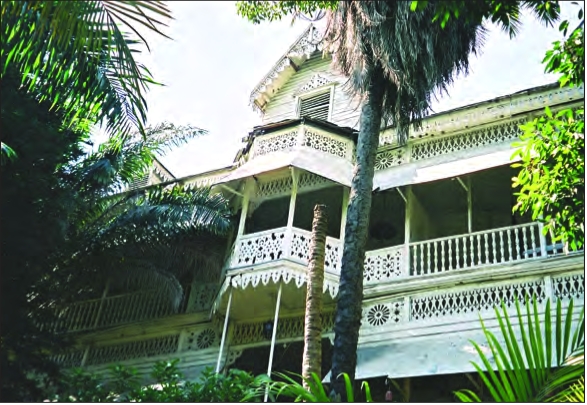
The landmark Hotel Oloffson in Port au Prince, Haiti was destroyed by fire earlier this month. Throughout the political unrest that has long gripped Haiti, one of the few islands of relative calm was the Hotel Oloffson, an ornate gingerbread mansion that hosted generations of tourists, journalists, celebrities, foreign-aid workers and diplomats.
The gang-affiliated arsonists who burned the hillside Port-au-Prince landmark to the ground earlier this month destroyed more than a unique hostelry. They set the torch to a place where, for better or worse, Haitian culture and political life converged with world travelers, artists and globalists seeking to make sense of a nation nearly opaque to outsiders.
The complete collapse of Haiti’s government — no elections in years and its president assassinated in 2021 — and the disappearance of civil society institutions in the face of increasing gang rule in the country forced the closing of the Oloffson over a year ago, leaving it vulnerable to the fire next time.
My first visit to the hotel, with its filigree latticework, tall doors and lush vegetation, came during the brief first administration of President
Jean-Bertrand Aristide in 1991. The Oloffson, named for a Swedish sea
captain who took it over from the occupying U.S. Marines in 1934, then
beckoned like a verandah of possibilities. The hotel’s famous rum punch
and slow-moving ceiling fans cooled the guests meeting with government
ministers and United Nations functionaries to discuss and plot the
nation’s promising future.
The
Aristide government, the first democratically elected power in the
country’s history, had been swept into office by an overwhelming turnout
among poor “Lavalas” followers. “Titid,” as Aristide was known, became
the world’s first priest-president, who ministered to impoverished slum
dwellers and escaped numerous assassins to become leader of a nation
founded by the slaves who kicked out the First French Empire.
No
one knew it then, but Aristide’s stay in the Palais National would last
only seven months, ending with a military coup fueled by remnants of
the Tontons Macoutes, the dreaded paramilitary force loyal to the
murderous dictatorship of the ousted Duvalier family.
Aristide’s
devotion to liberation theology stirred distrust among the Haitian
elite as well as their foreign sponsors who sensed more socialism than
sanctity in the Salesian cleric. I had followed his rise through news
reports as well as his disciples among Haitian exiles who met at St.
Leo’s Church in Dorchester, Boston’s center of Creole worship and social
services.
One of them
had a cousin working as a barman at the Oloffson who had served guests
like Mick Jagger back in the hotel’s heyday in the 1970s as a
globe-trotter’s destination. By 1991, the hotel was run — and later
owned — by Richard Morse, a Haitian American musician whose band RAM
performed a unique fusion sound for packed audiences on Thursday nights.
It
was a hopeful time. The renowned Partners in Health nonprofit, founded
in Boston by my friend the late Dr. Paul Farmer, had been operating a
clinic in the provinces for four years and was already drawing global
attention. Aristide had put forth ambitious plans for land reclamation,
education, health care, industrial development, new roads, an improved
port and water and sewer projects.
The
polyglot universe of private contractors, global aid specialists and
government workers met at the Oloffson to chat in French, English,
Spanish, Russian and Haitian Creole to translate that vision into
reality. The hotel’s role as neutral ground did not diminish its
association with wealth and foreign intrigue in a country split by the
vast gulf between the Creole-speaking rural and urban poor and the
cosmopolitan elite who had second homes in Miami or Paris, studied
abroad and owned most everything.
One
sweltering afternoon, I set out from the Oloffson for the Palais de
Justice to report on a crowd of demonstrators calling for the conviction
of the hated Tontons Macoutes police chief of Portau-Prince, Roger
Lafontant, who was on trial for his role in staging a failed coup d’etat
a month before Aristide’s inauguration.
Out
of the swelling mob on the plaza came a crazed, half-clothed stick
figure of a man carrying a gas-soaked tire above his head. Confronting
me, he threw it down at my feet and shouted, “Tuez les blancs! Pe
Lebrun!” — a lethal reference to the name of a local tire dealer who had
become synonymous with the practice of placing a burning tire around
the neck of enemies.
This was no idle threat. The streets of the capital were singed with the remains of summary executions.
The
crowd parted and grew silent. The man’s eyes blazed. Then a teenager I
had been speaking with stepped out of the crowd and stood in front of
me. The tension broke. The mad vigilante picked up his tire and moved
on.
When I got back to the Oloffson, I walked unsteadily up the stairs to the bar and collapsed in a seat.
That’s
when a small, elegantly dressed figure carrying a goldtipped cane got
up from his rattan chair and walked toward me. It was Aubelin Jolicoeur,
rendered as the unctuous Petit Pierre in Graham Greene’s 1966
despairing novel “The Comedians,” set in the Hotel Trianon, a stand-in
for the Oloffson. For over 25 years Jolicoeur had been reporting on the
comings-and-goings at the hotel for Le Nouvelliste newspaper while
feeding meatier details of his conversations to the shadowy leaders of
Haitian society.
I was
not about to provide fodder for his column. The conversation, brief and
courtly, ended with the journalist rising from the seat facing me,
bowing slightly and moving toward other prey.
A well-known Creole proverb crossed my mind: “Tout sa ou we, se pa sa” — “Nothing you see is what it seems to be.”
There
were later visits to the Oloffson but none as memorable. Something may
rise from its charred remains, but it won’t be the same. Maybe for the
better.
Despite my
Oloffson nostalgia, it’s preferable that Haiti, long battered by outside
economic and political interests, interpret its own future and not
filter its aspirations through the poolside deliberations of rum-soaked
planners, plotters and scribes with return air tickets.


