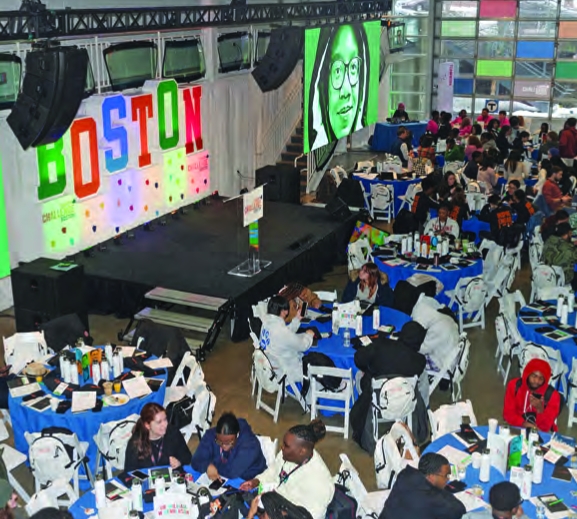
BPS
students gather at the Artists for Humanity space in South Boston, Feb.
12, for the launch of the Aspen Challenge. The 10-week program tasks
high schoolers with developing solutions to community issues like gun
violence, affordable housing and access to green space.Under bright, colorful lights, to the beat of music, high schoolers across Boston gathered to kick off a new opportunity to make their voices heard.
The launch event, held Feb. 13 at the Artists for Humanity building in South Boston, marked the start of a 10-week process in which student teams from 20 Boston high schools will have the chance to develop their own solutions to one of five major challenges facing the city today.
Brian Hodge, a junior at Tech- Boston Academy in Dorchester, said he sees the challenge as a new set of resources to make the changes he and other high schoolers like him want to see better their communities.
“[The Aspen Challenge] gives us the bass in our voice to actually make that change happen and to push forward and to move our community forward,” he said.
Throughout the course of the program, a team from each of the schools will choose one of the challenges — aimed at tackling a list of issues including gun violence, access to green space, affordable housing, post-secondary pathways for young people, and the link between substance use and social media — putting together and implementing a solution in their communities.
The Aspen Challenge is run by the Aspen Institute, a Colorado-based nonprofit that hosts events and conferences around global issues. Each year a new city is selected to participate in the challenge.
Mary Skipper, superintendent of Boston Public Schools, said she sees the program as a “life-changing experience” for students — one she hopes they will use to help discover what they can do and how they can help solve challenges.
“When
you see a challenge, you can step back from it, or you can step to it,
and leaders step to challenges,” Skipper said. “Every one of those
students has taken that first step in being here today.”
Cities
participate in a two-year, overlapping sequence, so when the selected
teams from Boston attend the Aspen Ideas Festival in June, a week-long
program hosted by the Aspen Institute in Colorado, they’ll be going up
against one team from San Diego, which had its first year of the program
in 2024 (next year one Boston team will go, in addition to whichever
city is selected next).
Brett
Howley, Associate Director at the Aspen Challengez, said she thinks
it’s important to give high school students the chance to have a
platform. Often, she said, she’s heard participants come up and say, “No
one’s ever asked us before.”
Each
of the challenges was posed to the students by an expert in the field,
with a specific directive — things like reimagining an empty space into
green space or developing an intergenerational initiative to increase
access for young people to post-secondary resources and opportunities.
That model, Howley said, is key to helping them get started as they aim
to tackle enormous issues.
“These
topics are big and they’re daunting, and sometimes it’s hard to wrap
your head around them,” she said. “You do need to kind of give a little
bit of direction for them to start.”
But
even with a slightly narrower prompt, once the students get going, the
Aspen Challenge team said they hope the impact will be big too.
Each high school team will
not only have to plan a solution in the next 10 weeks but put it into
practice and get a sense of how it fares in the world so that when they
come back to the program’s solutions showcase in April, they can present
outcomes.
That
timeline is condensed — Howley said that the program doesn’t “give them
all the time in the world to change the world” — but students said they
felt up to the challenge.
“I
feel like my group will be able to come together and easily find these
solutions,” said Sinai Phillips-Thompson, a junior at TechBoston
Academy. “And the 10 weeks are just to get the foot in the door. Nothing
is saying that after these 10 weeks, we can’t just keep trying to make
our solution be available.”
Hodge said the timeline felt appropriate for the real-world issues they’re challenged to tackle.
“I feel like it’s real life,” he said.
“Time
doesn’t stop for anybody, so you’re going to have to crunch, you’re
going to have to make a solution. I feel like it prepares us for that.”
Its organizers said the Aspen Challenge is a program that is unique by putting young people in the driver’s seat of solutions.
During
remarks welcoming students to the kick-off, Katie Fitzgerald, managing
director of the Aspen Challenge, said that they were gathered because we
need the voice of the next generation.
“We
need your voices. We need your creativity. We need your leadership,”
Fitzgerald said to students. “We’re talking about some of the most
serious issues that we face in society. You have the answers, and in the
next 10 weeks, you are going to show us how to do things that we as
adults, we as a society, have not figured out how to do yet.”
Howley
said she thinks it’s important to give high school students the chance
to have a platform. Often, she said, she’s heard participants come up
and say, “No one’s ever asked us before.”
“This
is an untapped resource that we have — our young people in the world,”
Howley said. “We think they’re the leaders of tomorrow. They really can
be the leaders today, and we need them.”
Even
the challenge issues stemmed from student input. Throughout the fall,
the Aspen Challenge team held focus groups with Boston high school
students with the open-ended question of what the most pressing issues
were that they saw in the city.
From
those gatherings, the Challenge team took what students said they felt,
distilled the responses to five solutions and tracked down experts to
issue the specific challenge prompts. Largely, they tried to keep the
experts local, Howley said.
For
example, Brandy Brooks, who issued the affordable housing challenge, is
executive director at Higher Ground, a Roxbury-based nonprofit focused
on housing and education, and the challenge focused on green space was
issued by Gretchen Rabinkin, executive director of Boston Society of
Landscape Architects.
“I
think they’re right on the mark with what they’ve picked,” said
Skipper, who is looking forward to seeing which issues students
gravitate towards.
They are also issues that can impact students’ day-to-day lives.
“These are the things our students and their families have experienced, or they see,” Skipper said.
“I
think it’s wonderful that they’ve identified them as the challenges
that they want to put their effort, their time, their thinking into.”
Students also said they feel close to and interact with the issues regularly.
Phillips-Thompson
said she was interested in the gun violence and housing issues — both
of which she said she sees as needing attention in her community or in
the city at large.
Hodge, too, pointed to housing as one that resonates with him.
“You
go down [Massachusetts Avenue], [Dorchester Avenue], and you see these
rows and lines of homeless people,” Hodge said. “It’s disheartening,
it’s hard.”
Some
of the issues also impact students directly. Oliver, who posed the
challenge for students to develop a campaign tackling gun violence,
pointed to lockdown drills that students regularly participate in to
prepare for shooter situations.
“They
have to go to school and learn how to protect themselves in an active
shooter situation and they are sick of that,” Oliver said. “It’s not
fair that they need to train how to survive.”
While
the Aspen Challenge may be specifically centering the perspectives of
high schoolers in a way that is unique for many of them, Skipper said
that she views Boston, especially under the administration of Mayor
Michelle Wu, as a place where students are more often brought into the
conversation.
She said that highlighting student voices in this way elevates their agency in a way the city wants.
“Our
mayor is so about our students being solutions and coming to the table
and being part, with their voice, of the real issues our city faces,”
she said. “This just elevates that in so many ways.”
Skipper
said specifically, she’s interested in seeing if student solutions
around post-secondary education can help inform how the district
approaches early college and career programming in Boston’s public high
schools. And she said that she imagines Wu might be interested in
hearing what students come up with around things like access to green
space.
Students from the district, too, described a unique environment in the city.
“I
feel like, living in Boston, I have had so many opportunities to try to
put my input or get people thinking about my ideas so I can make things
happen,” Phillips-Thompson said.