
Like most states, Illinois is struggling with a severe teacher shortage. And, also like most states, that shortage is felt most profoundly in the area of special education. There is, however, an army of teacher assistants already on the job. Could they help relieve this shortage?
Decades ago, when these assistants were known as teachers’ aides, they Xeroxed worksheets or ran them through the mimeograph machine, and they could be hired with only a high school diploma or a G.E.D. Nowadays, they need 60 hours of college credit or a certain score on a certification test, and their work is harder than clearing jams from the copy machine. Most administrators refer to them as paraprofessionals.
MaryFran Wessler has worked as a parapro at Peoria High School since 2003.
“Many kids in my district are dealing with very tough situations – trauma, stress, addiction, family instability, food insecurity. They’re coming into our classrooms and very often, the para is the main contact,” she says. “We have to have the strategies to get them to the place where they can feel safe and learn.”
Terry Kays works for the Kaskaskia Special Education District, which serves a threecounty area in southern Illinois. She’s been a parapro since 2004, and this year works with high school students who have autism. Her colleagues help students who are diagnosed with attention deficit hyperactivity disorder, oppositional defiant disorder or intermittent explosive disorder. Like Wessler, she says she’s learned to deal with her district’s most challenging students. “Yes, absolutely. Believe me, we’ve been through some,” Kays says.
Yolanda Harrington works as a parapro in a Champaign elementary school.
“I don’t think they realize the wear and tear that our job has on us physically and mentally,” she says. “I mean, there are kids that get aggressive with us, there are kids we have to pick up, there’s diapering, there’s feeding, there’s kids running away from us. We do the whole gamut.
“I don’t think they realize how much we really do, and how much we really, really care about the kids.”
Illinois Issues is
in-depth reporting and analysis that takes you beyond the headlines to
provide a deeper understanding of our state. Illinois Issues is produced
by NPR Illinois 91.9 WUIS in Springfield.
Harrington, Wessler, Kays – and other parapros I talked to – aren’t complaining about those students; they say the kids are the best part of their job.
Because in many districts, paraprofessionals have another, unspoken
duty: They’re the workers school districts use to balance the budget.
Paraprofessionals
are paid anywhere from $8.25 to about $33 per hour. But on average,
even parapros with more than eight years of experience generally make
around $14 an hour. Their benefits vary from district to district. Some
offer health insurance, and maybe even cover vision. Others offer health
insurance, but at a price so high that a parapro’s entire paycheck goes
to cover that cost.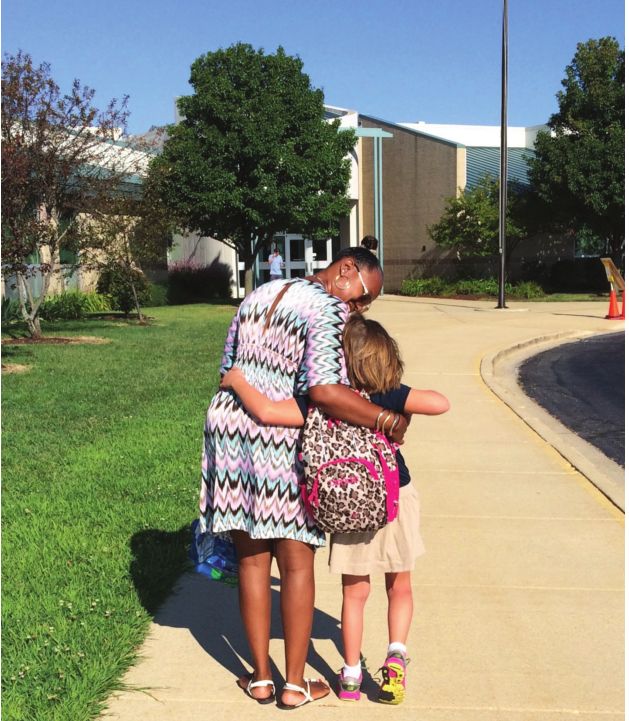
Some districts limit parapros to 30 hours a week – specifically to avoid having to provide health insurance.
And
it’s not uncommon for school districts to lay off (or “RIF”) parapros
every June, then rehire them when school starts a few months later.
After
one such layoff, in 2012, Kaskaskia Special Ed re-called parapros under
a new contract that wiped out seniority and past pay raises. Kays, who
had been making $26,000 a year, saw her salary cut in half. Most of her
paraprofessional colleagues were able to find other work and rejected
the district’s offer. But Kays, who was in her late 40s, couldn’t find
another job, and was told she was to lose unemployment benefits if she
turned it down.
“So
all the extras went out the window,” she says. “Since 2012, there’s been
no internet service, no TV service, none of that, in my home.”
She
drives a 1996 Jeep Cherokee without a functioning A/C. “I just say,
‘Keep running, baby.’” Superintendents say the reason paraprofessionals
tend to get cut is because many of their positions rely on grants that
have to be renewed every year (the Individuals with Disabilities Act
provides funds for special ed staff; Title I and Preschool For All fund
support services for at-risk learners). Over the past decade, as state
funding for schools declined, administrators felt it was safer to cut
staff loose before the annual RIF (reduction in force) deadline than risk having to squeeze money out of their tight budget if a grant fell through.
For
the paraprofessionals like Wessler – who says annual layoffs were a way
of life in her Peoria district – this strategy meant summers spent in
purgatory.
“You would
get RIFfed every spring and hired back, hopefully, before school started
in the fall, but every year you had to deal with that uncertainty. And I
will tell you, as someone who came very close to being pinkslipped
several years when I first started, that it was nerve-wracking to think
that you might not have a job the next year,” she says. “It shows a lack
of respect and a lack of understanding to the value a good para brings
to the team.”
The line
between duties that require a certified teacher and tasks that can be
handled by parapros may be clear on paper, but in the classroom, things
get a little fuzzier. As a rule of thumb, teachers present lessons, or
“new information.” Then paraprofessionals meet in smaller groups with
the students who are struggling, and “reteach” content the teacher has
presented.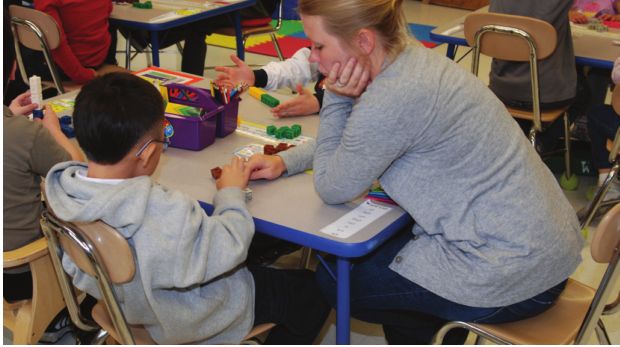
Some parapros assist students who have behavioral disorders stay focused on learning, rather than disrupting the classroom.
Harrington,
for example, currently acts as the rescue squad for one child who has
oppositional defiant disorder “The minute I hear it on the walkietalkie,
I immediately leave the class that I’m in and go to see what’s up,” she
says. “If it’s something that I can fix really quickly and he can stay
in there, great. But if it’s something that I’ve got to talk him off the
ledge, that takes a little more time.”
These
intense, intimate and even crisis interactions give paraprofessionals a
special role in students’ lives that teachers – who have to worry about
test scores, report cards and getting through curriculum – may not
always have the bandwidth to manage. But is their role a lesser
skillset? Or do parapros have abilities that could be turned into
teaching?
Bob Chikos, a
special ed teacher in Crystal Lake, calls the paraprofessionals he
works with “my eyes, ears and arms in a classroom,” saying they do
everything from helping physically disabled students use the toilet to
simply noticing when a student doesn’t have a pencil. “There always has
to be a teacher present, by state law, but a paraprofessional can do a
lot of the duties just as a teacher.”
Chikos
has done extensive research on the teacher shortage, and he suggests
that districts could use parapros like a farm team, cultivating the best
ones to become certified teachers. But there’s one major problem: Even
if paraprofessionals could take courses to earn an advanced degree in
their spare time, they’d still be required to serve one semester as a
student teacher – for free.
“But
we’re talking about people who didn’t get paid a whole lot to begin
with, and then expect them to take four months off from a job, unpaid,
to student teach, like, that’s going to eliminate a lot of people from
moving up,” Chikos says.
Meanwhile, whatever experience they’ve acquired while working as a parapro earns zero credit toward a teaching certificate.
Dan Cox, superintendent of
Staunton schools, says that doesn’t make sense. In his district, one of
the services paraprofessionals provide is “Tier 3 interventions,”
working in small groups with the students who are furthest behind
academically. “That’s important, intensive stuff that we have these
people doing, and we spend a lot of time training them to help provide
these services to the kids. It’s something that translates well to the
classroom,” Cox says.
Tony
Sanders, the CEO of the state’s second largest school district, U-46 in
Elgin, agrees there should be some way to harness the experience of
those workers.
“It
would really help school districts across the state if there was a way
of utilizing our current talent, investing in them and having them then
transition from a paraeducator into a teaching role,” Sanders says.
Chikos believes finding a way to make that happen could help Illinois start to solve its teacher shortage on multiple levels.
“Then
you have maybe a lot of people who don’t go into being a
paraprofessional because they think it’s a dead-end job, they’re worried
that it doesn’t lead anywhere,” he says. “So I think it would really
help both our special ed (teacher) shortage, and our paraprofessional
shortage.”
Of course,
not all parapros want to be teachers. After all, unlike teachers,
parapros don’t have to make lesson plans or take stacks of essays home
to grade. But some, like Yolanda Harrington, have given it a shot. While
working as a parapro in Champaign, she enrolled in Eastern Illinois
University, taking education courses with the goal of becoming a
certified teacher. But upper level education classes are off-limits to
students who haven’t passed the Pearson Test of Academic Proficiency,
known as TAP. Harrington took the five-hour test – twice – and says both
times she fell a few points short.
“And
so since I had been going part-time for so long, I just got burnt out.”
She graduated with a bachelor’s degree in general studies.
Now,
with almost 20 years of experience as a parapro, Harrington earns $18
per hour. She supplements that salary with a second job, working nights
at the Champaign YMCA.
The
State Board of Education recently released a 27-page report meant to
address the teacher shortage. It includes several ideas for lowering
licensure requirements, including eliminating that TAP test that
discouraged Harrington. But none of the recommendations specifically
addressed smoothing the path for paraprofessionals to become teachers.
The board is accepting public comments via email at
[email protected] through Oct. 2.
Dusty Rhodes is education desk reporter for NPR Illinois and Illinois Issues, where this article first appeared. It is reprinted with permission.


