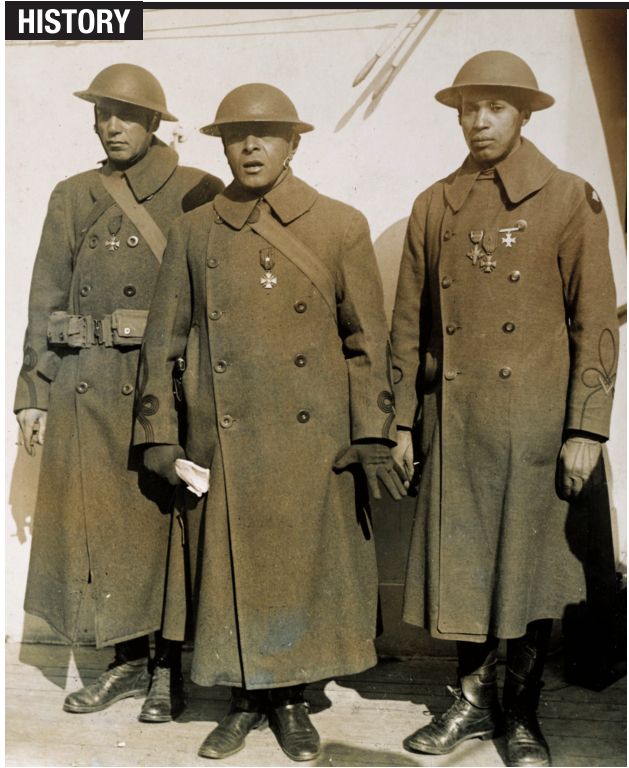
One hundred years ago, after four long and brutal years, the end of the Great War was finally in sight. By late summer of 1918, Allies had pushed the German forces into retreat. Among the American forces in pursuit of the fleeing German army was the Third Battalion of the 370 th Infantry Regiment. Its commander, Otis B. Duncan of Springfield, was the highest-ranking African-American officer to serve in the American Expeditionary Forces in that war.
Duncan was born in Springfield in 1873.
His father, Clark, was a grocer who had been born into slavery and fought in the Civil War as a sergeant. His mother, Julia, was a granddaughter of William Florville, Abraham Lincoln’s Haitian barber.
After attending Springfield public schools, Duncan worked for a time as the business manager of a Springfield African-American newspaper called the State Capitol. In 1897 he took a position as a clerk in the office of the state Superintendent of Public Instruction and remained employed by that department for the rest of his life.
Duncan
was active in Springfield’s civic and political life. He was a member
of the Young Men’s Society Club, the Colored Voter’s League, the
Protective Order of the Elks, the Afro-American Equal Rights League and
the Stalwart Republican Club. A lifelong Republican, Duncan ran for
alderman of Springfield’s First Ward in 1898 and again in 1906. In both
elections he won his primaries against a white challenger but was
defeated in the general election.
In
1902, Duncan joined the Eighth Infantry Regiment, an all-black unit of
the Illinois National Guard, as a first lieutenant. By 1904, he had been
promoted to the rank of major and placed in command of the Third
Battalion.
Perhaps it
was Duncan’s political aspirations and high-profile military career that
made him a particular target during the Springfield Race Riot of 1908.
On the night of Friday, Aug. 14, the mob ransacked the two-story frame
Duncan home at 312 N. 13th St. while other houses on the block were left
undisturbed. Rioters broke the front door off its hinges, smashed
windows and fired shots into the house before charging inside to destroy
Duncan’s piano, break all his furniture, and loot the place of its
valuables, including Duncan’s uniform and sabre. The sabre was
eventually returned to Duncan, and the thief was arrested, convicted and
sentenced to 30 days in jail for the crime.
In
August 1917, the Eighth Illinois Infantry Regiment was mustered into
federal service and drafted into World War I. In December, the unit was
redesignated as the 370 th Infantry. One of only a few African- American
regiments in the war and the only one commanded by all black officers,
it came to be known as the “Black Devils” by German soldiers after
fierce fighting at the Argonne Forest.
Duncan,
newly promoted to the rank of lieutenant colonel, arrived in France
with the 370 th Infantry in May 2018, and was soon engaged in training
new African-American recruits for battle near the front lines.
Even
as they fought for freedom and democracy oversees, African-American
troops were subjected to discrimination and disrespect by their own
army. The commander of the American Expeditionary Force, John J.
Pershing, followed the racist policies of President Woodrow Wilson and
Secretary of War Newton D. Baker which did not allow black soldiers to
fight alongside white troops. Because the French were much more relaxed
in their racial attitudes, the 370 th fought with the 10 th French Army
using French equipment and rations.
Duncan’s
battalion saw some of the most bitter combat of any of the American
troops in France. On the front lines, they pushed the German forces back
and were among the first allied troops to enter occupied Belgium. The
battalion’s pursuit of the German army continued until Armistice was
signed on Nov. 11.
Duncan
was one of 60 officers of the 370 th Infantry awarded the Croix de
Guerre, an elite French commendation for valor. In a letter home, he
told his parents he was “very proud” of the honor and wanted his friends
at home to know that “we have given our full contributions to this war,
that we have fought, bled, and died for the grand and noble principles
of the war.”
On Feb.
17, 1919, Duncan and his division returned stateside to Chicago and were
met by a welcoming parade, which many Springfield African-Americans
traveled north to attend. When company I, composed of Springfield
soldiers, returned to Springfield on Feb. 26, they were welcomed by
Governor Frank O. Lowden and a celebratory banquet was held in their
honor at the Leland Hotel.
After
the war, Duncan was promoted to colonel and tasked with reorganizing
the Eighth Illinois Infantry of the Illinois National Guard, and also
resumed his “day job” in the office of the Illinois Superintendent of
Public Instruction.
Duncan
died in 1937 after a long illness and was buried in Oak Ridge Cemetery.
Shortly after his passing, the American Legion organized a local post
(#809) composed of African-American veterans of World War I and named it
in Duncan’s honor.
Erika Holst is a Springfi eld writer and historian. Her latest book is Historic Houses of Lincoln’s Illinois.


