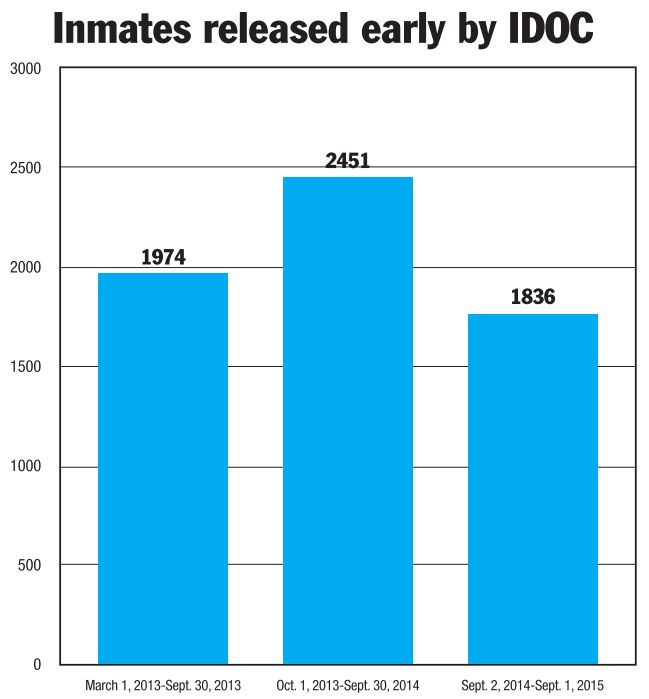
Release rate appears to slow
Illinois’ early prisoner
release program saved the state more than $11 million in the past two
years, according to data from the Illinois Department of Corrections.
These savings come as a state panel works to reduce Illinois’ prison costs by reforming the correctional system.
During
the state’s 2015 fiscal year, which ended on June 30, 2,303 inmates
convicted of nonviolent crimes received credit for a total of 314,634
days off of their prison sentences through the Supplemental Sentence
Credit program. An IDOC spokeswoman says that amounts to more than $5
million in savings versus continuing to house the inmates. For the 2014
fiscal year, 2,844 inmates were awarded 372,251 days of credit, saving
an estimated $6 million.
Illinois
has long offered early release to inmates who consistently follow the
rules, complete rehabilitation courses or earn a degree. However, the
parameters of early release have changed over time. An Associated Press
report in 2009 revealed that, in order to accelerate releases, IDOC had
done away with an informal tradition of waiting until an inmate had
served 60 days in prison before awarding “supplemental” sentence
credits. While some inmates were released from prison after only serving
a few days or weeks, IDOC’s policy change took into account that many
inmates had spent months or even years in county jails awaiting trial.
Additionally, IDOC had no legal authority to revoke sentence credits
once they were awarded.
The
resulting flap saw former Gov. Pat Quinn suspend supplemental sentence
credits in late 2009 until the legislature authorized the Supplemental
Sentence Credit program in June 2012. IDOC began awarding sentence
credits under the new program in Feb. 2013.
From
March 2013 to September 2013, IDOC released 1,974 inmates through the
program. That brings the total number of inmates released to 7,121 from
March 2013 until the start of July 2015.
It
appears that the rate of release has slowed since the program began,
with an average of 282 inmates released each month from March to Sept.
2013. On average, 204 inmates were released each month during Fiscal
Year 2014, and that number sank to an average of 152 per month during
Fiscal Year 2015.
Under
the program, the director of IDOC has sole discretion in awarding or
revoking sentence credits, and inmates are not entitled to receive
credits. Inmates convicted of a violent crime like murder
or rape are not eligible, and they can be disqualified for other
reasons, such as having criminal charges pending against them or
committing further crimes while incarcerated. Many of the people
released were originally incarcerated for nonviolent drug charges or
property offenses like credit card fraud.
Inmates
in Illinois prisons can also work off part of their sentences through
Illinois Correctional Industries, a work program that teaches inmates
job skills. IDOC says 1,351 inmates cut a total of 24,597 days from
their sentences by working at ICI shops, where they make everything from
furniture to clothing to cleaning supplies.
During
the past 12 months spanning Sept. 2014 to Sept. 2015, IDOC released
1,836 inmates, an average of five per day and about 150 per month. On
some days, such as Christmas Day 2014, no inmates were released, but
other days saw as many as 24 inmates freed. With almost 47,000 people in Illinois
prisons, the 1,836 inmates released over the past 12 months represents
about 4 percent of the state’s prison population.
Fifteen
of the inmates released in the past 12 months committed their crimes in
Sangamon County, but 24 people were released to Sangamon County.
Although
the rate of inmates being released early seems to be slowing year over
year, the state is looking for ways to reduce the prison population and
save more money on corrections. In February, Gov. Bruce Rauner created
the Illinois State Commission on Criminal Justice and Sentencing Reform,
a bipartisan panel of lawmakers and experts tasked with reducing
Illinois’ prison population 25 percent by 2025 without negatively
affecting public safety. The panel is due to issue its final report
before January 1. For more information, visit www.icjia.org/ cjreform2015.
Contact Patrick Yeagle at [email protected].


