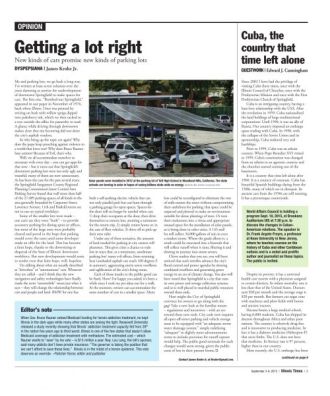
New kinds of cars promise new kinds of parking lots
Me and parking lots, we go back a long way. I’ve written at least seven columns over the years damning as unwise the undevelopment of downtown Springfield to make spaces for cars. The first one, “Bombed-out Springfield,” appeared in our paper in November of 1976, back when Illinois Times was printed by writing on bark with willow sprigs dipped into pokeberry ink, which we then tacked to a tree outside the office for passersby to read. A glance while driving through downtown makes clear that my hectoring did not deter the city’s asphalt vendors.
So why bring up the topic yet again? Why does the pope keep preaching against violence to a world that loves war? Why does Bruce Rauner hate unions? Because of Evil, that’s why.
Well, we all accommodate ourselves to necessary evils every day – you can get apps for that now – but it turns out that Springfield’s downtown parking lots were not only ugly and wasteful, many of them are now unnecessary. As has been the case for the past several years, the Springfield-Sangamon County Regional Planning Commission’s latest Central Area Parking Survey found that well more than half of the 27,489 parking spaces of all kinds in the area generally bounded by Carpenter Street, Lawrence Avenue, 11th and Pasfield streets are not in use on typical weekdays.
Some of the smaller lots were made – one can’t say they were “built” – to provide accessory parking for dining spots or offices, but most of the large ones were probably cleared and paved in the hope that parking would cover the taxes until some developer made an offer for the land. That has become a faint hope, thanks to the downsizing or dispersal of the State of Illinois’ downtown workforce. But new developments would seem to render even that faint hope, well, hopeless.
I’m talking about what are usually described as “driverless” or “autonomous” cars. Whatever they are called – and I think that the new navigation and safety technologies have finally made the term “automobile” mean just what it says – they will change the relationship between cars and people and land. BMW for one has built a self-parking electric vehicle that can not only parallel park but can hunt through a parking garage for open spaces. Spaces-bythe-door will no longer be needed when cars 1) drop their occupants at the door, then drive themselves to remote lots, awaiting a summons for the return trip, 2) simply return home or, in the case of fleet vehicles, 3) drive off to pick up their next rider.
Under any of these scenarios, the amount of land needed for parking in city centers will plummet. This gives cities a chance to redo lots in ways that, at a minimum, ameliorate parking lots’ many evil effects, from retaining heat (unshaded asphalt can reach 160 degrees F. in summer), aggravating storm sewer overflows and uglification of the city’s living room.
Each of those insults to the public good can be fixed. How? I’m happy you asked; it’s been a while since I took my pet ideas out for a walk. At the moment, owners can accommodate the same number of cars in a smaller space. Many lots could be reconfigured to eliminate the row of stalls nearest the street without compromising their usefulness for parking; that space could be unpaved and plowed to make an environment suitable for dense plantings of trees. Or turn their treelessness into a virtue and appropriate unused space for the installation of solar panels, as is being done in other cities. A 145-stall lot will collect 34,000 gallons of rain in even a modest storm. Where the grade allows it, a swath could be excavated into a bioswale that will collect runoff when it rains, filtering it and slowing its journey into storm sewers.
Clever readers that you are, you will have noticed that such retrofits advance the city’s flood control and power agendas by slowing combined overflows and generating green energy in an era of climate change. You also will have noted that Springfield is a city that runs its own power and sewage collection systems, and so is well-placed to marshal public resources toward these ends.
How might the City of Springfield convince lot owners to go along with the gag? Take a new look at the familiar means – regulations and incentives – with an eye toward these new ends. City code now requires all open off-street parking and vehicle storage areas to be equipped with “an adequate storm water drainage system;” simply redefining “adequate” in slightly more adventuresome terms to include provision for runoff capture would help. The public good rationale for such changes would seem strong, given the public costs of lots in their present forms.
Contact James Krohe Jr. at [email protected].
Editor’s noteWhen Gov. Bruce Rauner vetoed Medicaid funding for heroin addiction
treatment, he kept Illinois in the dark ages while many other states are
seeing the light. Roosevelt University released a study recently
showing that Illinois’ addiction treatment capacity fell from 28 th in
the nation fi ve years ago to third worst. Illinois is one of the few
states that doesn’t allow Medicaid coverage of addiction treatment with
methadone. The estimated cost – which Rauner wants to “save” by his veto
– is $15 million a year. Rep. Lou Lang, the bill’s sponsor, said many
addicts don’t have private insurance. “The governor is taking the
position that we can’t afford to save these lives.” Illinois is in the
midst of a heroin epidemic. This veto deserves an override. –Fletcher
Farrar, editor and publisher