Fifteen minutes with Andy
FOOD | Julianne Glatz
“In the future, everyone will be world-famous for 15 minutes.” –Andy Warhol, 1968 My kids still think I should have accepted his invitation. But they weren’t there. More than 40 years later, thinking about his hands still gives me the creeps.
It was the summer of 1972, and I was in Venice, having finished my freshman year at the University of Illinois (Urbana-Champaign) and having just become engaged. And I’d traveled to Europe, something I’d always longed to do.
I’d come to Europe with the Concert Choir, crown jewel of the U of I’s undergraduate choral ensembles. Freshmen were rarely accepted into CC; my having joined its exalted ranks was more luck than talent. The previous fall there’d been some conflict; several CC choristers had quit or been thrown out. I never discovered why, and didn’t really care. I was in. And the “icing on the cake” was the the CC heading that summer to Vienna and Venice as participants in a Renaissance Choral Symposium.
Prior to Venice, we’d spent a week in Vienna, attending lectures at the Mozartium, and rehearsing for the symposium’s climax: a concert in Venice’s Basilica San Marcos, the many-domed edifice most familiar as background in films depicting its immense public square and innumerable pigeons.
Other international college choirs participated. All singers were regrouped into antiphonal choirs (call and response), scattered precisely throughout the space to sing Renaissance music especially written for the Basilica San Marcos. Distances between the separate-but-equal choirs caused minute time delays which had to be taken into account.
The experience was educational and exhilarating, and judging by the concert audience’s response, well-received. Afterwards we regrouped into our own choirs, and the approximately 30 U of I CC’ers were led to a smaller square where we waited while the room for our post-performance celebration was readied.
A middle-aged man and woman approached. Both were deeply tanned and both stylishly outfitted entirely in white: white hair, white linen suit with open-neck white shirt and white fedora for the man; platinum hair, a white pantsuit, and heavy gold jewelry for the woman. They were British, cheerful and curious and for some reason focused on me. “Where were we from? What were we doing in Venice? Why were we dressed like that ?” (black concert gowns and tuxedoes) After a few minutes, they said, “We’re with Andy Warhol; he’s right over there.” They gestured to a restaurant’s outdoor seating area on the far side of the square. “Would you like to meet him?” “Sure,” I responded. I knew who Warhol was, of course, but wasn’t exactly a devotée. Still, why not?
Exceptionally courteous, Warhol stood and extended a hand. It’s still the strangest handshake I’ve ever experienced: his hand felt as if it had no bones. I didn’t register what he was wearing, but he was as white as his British buddies: hair bleached platinum and the palest skin – truly pasty – I’d ever seen. His eyes seemed glazed, his voice almost a monotone. Was he stoned or just a space-head?
Warhol ordered me a glass of wine and we chatted, mostly covering the same ground as I had with the Brits, now talking to other people at the table. But Warhol asked more about me personally. I don’t remember asking him anything.
As I reached for my wine glass, Warhol put his hand over mine: “I’d like it if you’d have dinner with me.” He
wasn’t trying to be intimate or intimidating. But his flaccid fleshy
hand was creepy – there’s really no other word that fits. I mumbled
something about having to get back to my friends, who were by now filing
into the restaurant, thanked Warhol, and left. My 15 minutes were over.
The
Italian food I had during that trip was dreadful; certainly I’d have
had a much better meal with Warhol. Our early supper before the concert
consisted of canned peas and truly repulsive “hot dogs,” presumably what
was thought appropriate for American students. It would be years before
I discovered risottos, rice preparations made with grains especially
developed to absorb maximum flavor, Venice’s signature dishes that are
far different and far more delicate than Italian-American red-sauced
pastas.
Contact Julianne Glatz at [email protected].
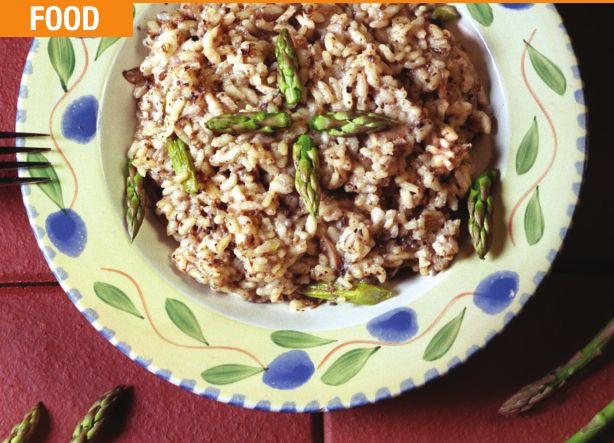
RISOTTO WITH ASPARAGUS AND LEMON
• 1 1/2 lbs. asparagus 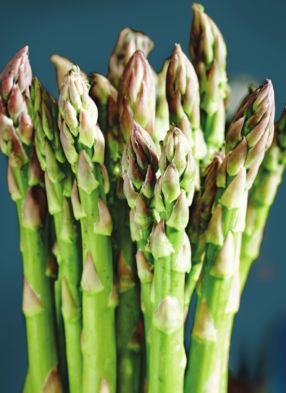
• 6 tablespoons unsalted butter
• 1 1/2 c. Arborio or other Italian short-grain rice suitable for risotto, such as Carnaroli, preferred
• 4 cups unsalted or low-sodium chicken or vegetable stock, plus additional if needed
• 1 medium lemon, preferably a Meyer lemon
1 teaspoon kosher or sea salt
• 1/3 cup finely diced onion (bulbous spring onions or young green garlic are especially delicious and appropriate)
• 1/2 cup dry white wine or dry vermouth
• 1 cup freshly grated Parmeggiano Reggiano
or a good American equivalent, such as Wisconsin’s Sartori Parmesan
• Freshly ground pepper to taste Break off the tough ends of the asparagus by holding the bottom of each stalk with one hand
•
and gently but firmly bending the top over with the other hand until
the bottom breaks off. Discard the bottoms. Cut the asparagus into
approximately 2-inch pieces, reserving the tips separately from the
stems.
In a large
heavy pot, sauté the asparagus stem pieces in the butter until the
asparagus is just tender. A knife should be able to easily pierce them,
but they should still be bright green. Remove the asparagus pieces with a
slotted spoon, draining off as much of the butter as possible. Spread
them in a single layer to cool.
Sauté
the asparagus tips in the same pot until just barely crisp-tender.
Remove the tips with a slotted spoon as above. Set them aside in a
single layer to cool; remove the pot from the stove.
Purée
the asparagus stem pieces and 1-2 cups of stock in an electric blender
or food processor. Put into a saucepan (not the pot in which they
cooked), and whisk in the remaining stock and the salt. Warm over lowest
possible heat; keep warm throughout the cooking process.
Finely grate the lemon peel, then juice the lemon. Add the peel to the asparagus/stock; reserve the juice separately.
Return
the pot to the stove over medium heat. Add the onion. Sauté, stirring
frequently, until the onion is softened and translucent but not browned,
3-5 minutes. Add the rice to the pan and cook a few minutes more until
the rice has absorbed most of the butter and has become somewhat
translucent. Increase the heat to high and add the wine or vermouth.
Continue stirring until the wine is almost completely absorbed.
Reduce
the heat to medium low and add enough stock mixture to cover the rice
by about an inch. Cook at the lowest possible simmer, stirring
frequently. As the liquid is absorbed, add additional stock to keep the
rice covered. When the stock mixture has been absorbed, check the rice.
It should be cooked through, but still slightly firm, though not at all
crunchy in the centers. If they’re still somewhat crunchy, add more
stock a bit at a time until the appropriate consistency is achieved.
Total cooking time should be about 30 minutes, but can be longer or
shorter depending on the weather, humidity levels and the rice’s
freshness.
Risotto can
be served relatively “dry” but most traditionally it’s served just
slightly runny. The next step is to stir in the cheese. That will
tighten the risotto (make it less liquid), so make allowances if you’re
going for a soupier consistency. (Don’t worry, the risotto will be
delicious regardless.)
Stir
in the cheese, warming the asparagus tips gently in a microwave or
skillet as you do so. Add lemon juice and pepper – and salt, if needed;
it will depend on the saltiness of the stock and the cheese – to taste.
Ladle
the risotto into shallow soup bowls or rimmed plates and top with the
warmed asparagus tips. Serve immediately; pass extra cheese at the table
if desired. Serves 4-6.