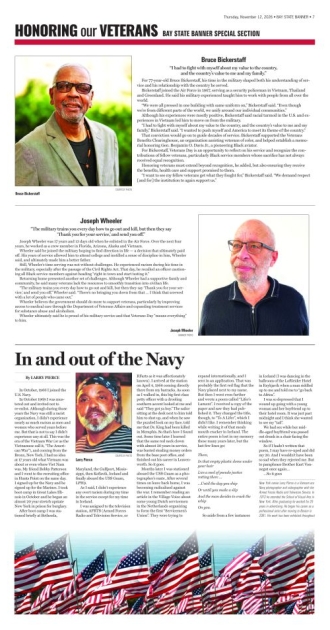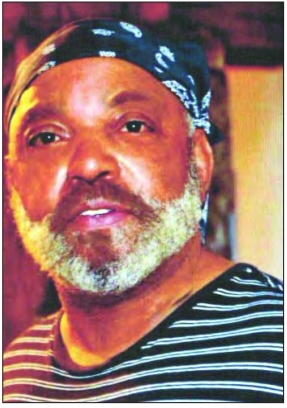
Larry Pierce In October, 1966 I joined the U.S. Navy.
In October 1969 I was mustered out and invited not to re-enlist. Although during those years the Navy was still a racist organization, I didn’t experience nearly as much racism as men and women who served years before me. But that is not to say I didn’t experience any at all. This was the era of the Vietnam War (or as the Vietnamese call it, “The American War”), and coming from the Bronx, New York, I had no idea at 17 years old what Vietnam was about or even where Viet Nam was. My friend Bobby Patterson and I went to the recruiting office in Hunts Point on the same day. I signed up for the Navy and he signed up for the Marines. I took boot camp in Great Lakes Illinois in October and he began an almost 20 year stretch upstate New York in prison for burglary.
After boot camp I was stationed briefly at Bethesda, Maryland, the Gulfport, Mississippi, then Keflavik, Iceland and finally aboard the USS Guam, LPH9.
As I said, I didn’t experience any overt racism during my time in the service except for my time in Iceland.
I was assigned to the television station, AFRTS (Armed Forces Radio and Television Service, or RFarts as it was
affectionately known). I arrived at the station on April 4, 1968 coming
directly there from my barracks. As soon as I walked in, this big first
class petty officer with a drooling southern accent looked at me and
said “They got ya boy.” The sailor sitting at the desk next to him told
him to shut up, and when he saw the puzzled look on my face, told me
that Dr. King had been killed in Memphis. So that’s how I found out.
Some time later I learned that the same red neck clown with almost 20
years in service, was busted stealing money orders from the base post
office, and finished out his career in Leavenworth. So it goes.
Months
later I was stationed aboard the USS Guam as a photographer’s mate.
After several times on leave back home, I was becoming radicalized
against the war. I remember reading an article in the Village Voice
about some young Dutch servicemen in the Netherlands organizing to form
the first “Servicemen’s Union”. They were trying to expand
internationally, and I sent in an application. That was probably the
first red flag that the Navy placed next to my name. But then I went
even further and wrote a poem called “Lifer’s Lament”. I received a copy
of the paper and saw they had published it. They changed the title,
though, to “To A Lifer”, which I didn’t like. I remember thinking while
writing it of that mealy mouth cracker in Iceland. The entire poem is
lost in my memory these many years later, but the last few lines go:
There,
In that empty plastic dome under your hair
Lies a seed of pseudo justice rotting there …
…Until the day you ship
Or until you make a slip
And the man decides to crack the whip
On you.
So
aside from a few instances in Iceland (I was dancing in the ballroom of
the Loftleider Hotel in Reykjavik when a man siddled up to me and told
me to “go back to Africa”.
I
was so depressed that I wound up going with a young woman and her
boyfriend up to their hotel room. It was just past midnight and I think
she wanted to see my “tail”.
We had sex while her middle-aged boyfriend was passed out drunk in a chair facing the window.
So
if I hadn’t written that poem, I may have re-uped and did my 20. And I
wouldn’t have been so sad when they rejected me. But to paraphrase
Brother Kurt Vonnegut once again… …So it goes
New York native
Larry Pierce is a Vietnam era Navy photographer and videographer with
the Armed Forces Radio and Television Service. In 1973 he attended the
School of Visual Arts in New York. After graduating he worked for 25
years in advertising. He began his career as a professional artist after
moving to Boston in 2001. His work has been exhibited throughout