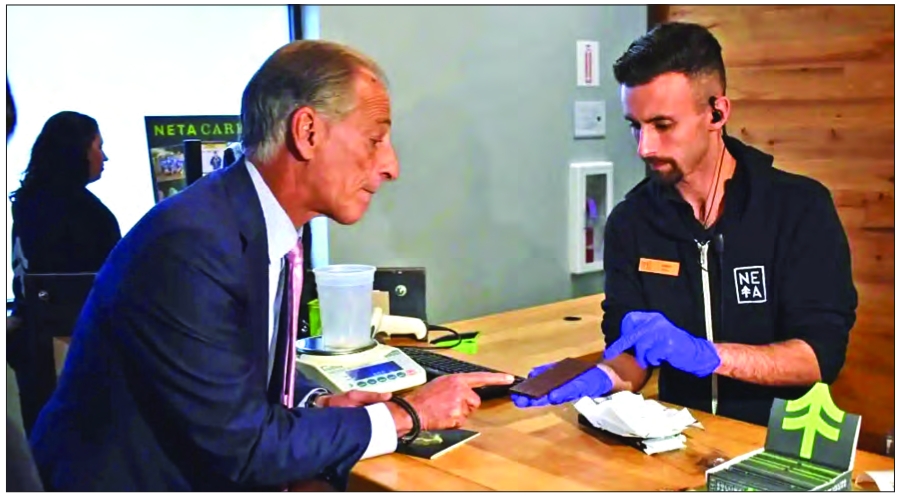
The
state’s first chairman of the Cannabis Control Commission, Steven
Hoffman, emphasized regulatory thoroughness over speed in introducing
retail sales. He is shown in 2018 inspecting operations at New England
Treatment Access in Northampton on the eve of the marijuana shop’s
opening to non-medical customers.
GBH NEWS
When Massachusetts voters decided whether to legalize recreational marijuana sales for adults 10 years ago, they were nearly split on the issue. Most public leaders stood firmly in opposition.
Today, the reverse is true — on both fronts. Voters like weed, and politicians are not vocal opponents. In last week’s election, a ballot measure seeking to repeal all laws allowing for legal pot sales in the commonwealth flopped, with 75.6% of Massachusetts voters checking “no” on Question 8 and 24.4% voting “yes.”
To understand how Massachusetts has gone from marijuana battleground to fertile weed country, GBH News looked into the dynamics surrounding the original fight over legal cannabis 10 years ago — what was promised and what was feared in 2016 — and found that over the past decade, the commonwealth has fundamentally shifted its views on legal pot.
The 2016 cannabis showdown
The original campaign for legalization was something of a David and Goliath story, with then-Gov. Charlie Baker leading the charge against 2016’s Ballot Question 4 alongside a wall of powerful political leaders.
“The corporatization of complete legalization of marijuana makes me extremely nervous,” Baker said during a November 2016 press conference with Massachusetts faith leaders urging a “no” vote on Question 8.
Jim Borghesani, a communications specialist who helped lead the campaign to legalize recreational marijuana sales in Massachusetts, remembered the opposition from some of the state’s top politicians.
“We had the governor and the speaker of the House and the mayor of Boston not only opposing but literally forming the opposition campaign,” he said.
Borghesani currently works as the head of communications for the Suffolk County District Attorney’s Office. In 2016, he hesitated to take on the legalization campaign because he worried it could tarnish his career.
“There was a stigma attached to this.
There still is, but it’s not nearly as prevalent as it was back then,” he said.
But Borghesani was ardent in his belief that legalizing cannabis made sense.
“I’m not a user, but I’ve always felt that cannabis should be legalized, simply because prohibition, in my view, had failed,” he
said. “And all it had done was set up a marketplace that was completely
dominated by drug dealers and didn’t sell tested products.”
Borghesani
and his team’s argument in favor of legalization went something like
this: A legal market would be better regulated and prevent underage
consumption. It would help address racial disparities in law
enforcement, since drug laws disproportionately affected communities of
color. And it would generate a boatload of new tax revenue for the state
and local municipalities.
The
opposition’s arguments ran the gamut from fears of impaired driving to
concerns about the disconnect between state and federal policy, since
marijuana sales were — and remain — illegal under federal law.
But the biggest force unifying the opposition to Question 4 in 2016 was children.
Experts, politicians and religious leaders argued that legalizing recreational
marijuana would create a new industry, similar to the 20th century
tobacco market, that would target kids and put profits over safety.
“Big
tobacco, of course, was an industry that lied to the American people
for a century, that said tobacco wasn’t addictive, it didn’t cause harm,
it didn’t cause cancer,” said Dr. Kevin Sabet, who co-founded the
anti-legalization group Smart Approaches to Marijuana during a debate
over Question 4 hosted by GBH in 2016.
“All the while, just simply trying to profit off of other people’s addiction.”
“This is no different with
marijuana,” he said. “I don’t really care if you’re an adult in
Massachusetts and you want to smoke in the privacy of your home. This is
about commercialization. This is about pot candies targeting kids. This
is about advertisements. This is about money. Not marijuana. And this
is why I’m opposed to it.”
Despite
those claims — and the high-profile figures standing in opposition to
Question 4 — the measure passed, with more than 53% of Massachusetts
voters in favor and 46% against.
A new industry
After legalization came the hard part.
“We had a lot of work to do.
And
we had no staff, no office, no money,” said Steve Hoffman, the first
chair of the Cannabis Control Commission, the new state agency
established by the ballot measure to set up and regulate the
Commonwealth’s recreational cannabis market.
This story was first published
- GBH News.