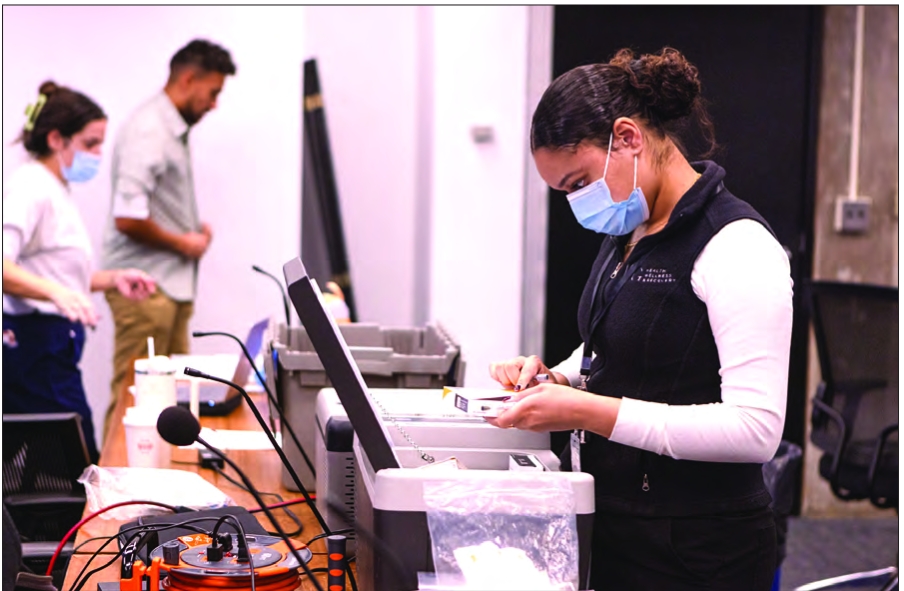
A nurse prepares vaccinations at a recent City Hall vaccine clinic.A decade ago when California legislators eliminated non-medical exemptions for childhood vaccines, Katie Blair thought the decision marked a successful move for public health in that state. So, when legislation was filed at the Massachusetts State House a few years later to do the same thing, she started volunteering to advocate for it.
That was in 2019. Now the director of Massachusetts Families for Vaccines, the grassroots organization pushing for the bill, the fight for her became personal last year when her daughter was born.
Her daughter, who is now almost nine months old, hasn’t been vaccinated against some diseases that come later in the standard childhood vaccine schedule. For example, Blair is concerned about measles, the first shot for which is recommended after 12 months, amid dwindling vaccination rates for the disease and a growing number of cases around the country.
“She really depends on community protection from people around her,” Blair said.
Blair is also concerned about the gaps in Massachusetts’ immunization rates. According to state data released in April, the rates of childhood vaccinations as a whole are high across Massachusetts but pockets of lower coverage exist. Statewide, 95% of children entering kindergarten have received their full schedule of vaccines, but in some counties that percentage drops to close to 90%.
For Blair, the bill is a valuable tool to try to close those gaps and increase protection for residents like her daughter who don’t have all their shots because of their age, or other residents who can’t be vaccinated for medical reasons.
“I think it’s important for all of us to do our part to make the state as safe as we can,” Blair said.
The bill, if passed, would remove text from the state’s laws that allow for parents or guardians to opt their children out of vaccination when the shots would conflict with “sincere religious beliefs.” It would also require schools to annually report the total number of children who are immunized to the state Department of Public Health, which in turn would be required to annually publish immunizations and exemptions data for each school and district.
Rick Moriarty, a retired pediatric infectious disease specialist and advocate with Massachusetts Families for Vaccines, said restricting non-medical vaccine exemptions would build on a long history of vaccine regulation in Massachusetts. The state was the first in the United States to implement a vaccine mandate in 1809, requiring students be vaccinated against smallpox.
“Massachusetts has this opportunity now to help protect the people of our state and keep the long track record we have of good immunization rates and less of these diseases than other states see,” Moriarty said.
Statewide, only 1.8% of kindergarten students have a medical or religious exemption. On the more granular community level, gaps exist. In Franklin County in western Massachusetts, the percentage of kindergarten students with an exemption rises to 5.1%. In Dukes County on Martha’s Vineyard, it’s 9.6%.
And more students are simply not in compliance with state school requirements for vaccinations. That number sat at 3.2% statewide, as of April, with higher county-level rates in Franklin and Suffolk counties, at 7.9%, Berkshire County in western Massachusetts at 8.6% and Nantucket County on Nantucket Island at 9.2%.
Broadly, for highly contagious diseases like measles, public health experts suggest that a 95% vaccination rate is necessary for a community to develop herd immunity — the point at which a disease is less likely to spread because enough people have immunity. That number for Massachusetts currently stands at 96.5% among children entering kindergarten.
Other diseases that are less contagious have a lower threshold.
Supporters of the legislation say the bill would help close those gaps, which could open communities to the spread of infection.
“It’s very easy [in] our interconnected world for a case to come in and end up in a more vulnerable area that might not have very strong community protection because of the rising exemptions,” Blair said.
A 2025 poll, conducted for Massachusetts Families for Vaccines by Beacon Research, a local market and opinion research firm, found that 70% of more than 1,000 voters polled supported the legislation. Three-quarters of parents of school-age children who were among the respondents said they support the proposal in the bill.
It has been endorsed by medical associations, such as the Massachusetts chapter of the American Academy of Pediatrics and the Massachusetts Medical Society; public health organizations, including the Massachusetts Public Health Association; and both major teachers unions in the state.
For opponents of the legislation, a ban on religious exemptions isn’t the way to fix the problem. In an emailed statement, a spokesperson for Health Action Massachusetts, a nonprofit that has been advocating against the legislation, said they believe the focus should instead be on reaching out to families who are not in compliance.
“Public health policy should continue to focus on proven strategies — supporting school nurses, improving follow-up and expanding education and access — while prioritizing outreach to the larger group of students who are not in compliance, rather than permanently excluding a small number of families of faith who have been following the law,” the group said in a statement.
The Health Action Massachusetts spokesperson said the group worries that prohibiting religious exemptions would force families who are opposed to the vaccinations on religious grounds into an “impossible situation,” choosing between getting the shots or finding education outside of the school system.
Moriarty objected to that kind of framing and said that no religion preaches against vaccines.
Instead, he said he believes that many of the religious exemptions are used as a placeholder for other types of exemptions.
A 2022 opinion article in the journal Frontiers in Public Health may back him up: The authors of that piece also argued that few major religious affiliations reject vaccines for the sake of immunization but that some express concerns about non-halal ingredients or ethical objections to vaccines that use cells from aborted fetuses.
In the meantime, the bill is making its way through the Legislature. In April, the Joint Committee on Health Care Financing recommended the bill pass and it was referred to the House Committee on Ways and Means, which must approve it before it would be able to move on to a full vote for passage.
Blair, who first got involved with advocacy for the bill before the COVID-19 pandemic and the recent shifts in conversations about vaccination as a whole, said she hoped that, if nothing else, the pandemic would show residents across the state the importance of vaccination. Instead, she said it seemed to prompt a wider spread of vaccine misinformation.
A 2024 paper in the BMJ (British Medical Journal) found that vaccine misinformation has spread more widely since the start of the COVID-19 pandemic, often at a faster rate than interventions addressing it.
More recently, federal guidelines on childhood vaccines have also shifted as the Trump administration, led by vaccine skeptic Health and Human Services Secretary Robert F. Kennedy Jr., replaced all the members of the Advisory Council on Immunization Practices and modified the government’s recommended vaccine schedule, largely reducing the number of shots recommended for children in the United States.
These shifts, however, underscore the need for the bill, Blair said.
“I think it’s unfortunate how politicized it’s gotten, but the science has not changed,” she said.
“Vaccines are safe and effective, and having that herd immunity or community immunity protection is really important.”


