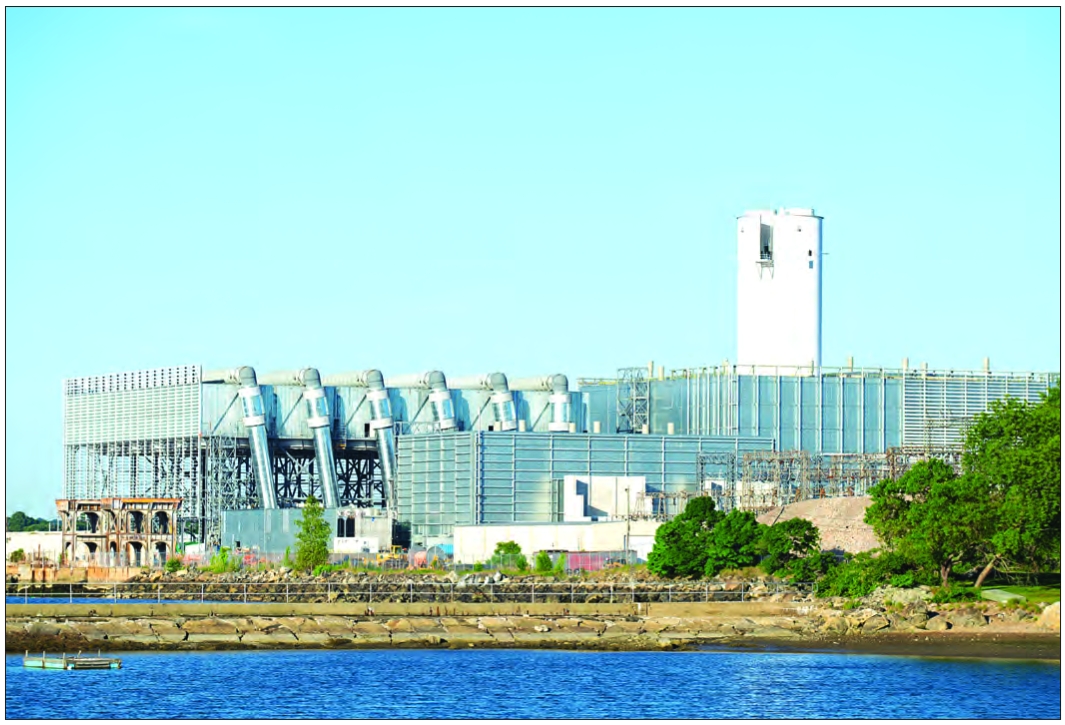
The Salem Harbor Power Station is a natural gas-fired power plant located in Salem, Mass.

Tristan ThomasMost fossil fuel power plants in the Northeast are located near environmental justice communities, a new report has found.
The report, released May 19 by the Roxbury-based environmental justice group Alternatives for Community and Environment (ACE) and eight other advocacy organizations, found that over 90% of the power plant units included in its report were located within 3 miles of an environmental justice community — about the distance from Nubian Square to Ashmont. That distance was chosen because it is in line with how much of the existing scientific literature looks at exposure to fossil fuel power plants.
Within the 11 states considered in the report, which was prepared by Cambridge-based environmental consultant Synapse Energy Economics, 30% of environmental justice communities were within 3 miles of a power plant, compared to 16% of nonenvironmental justice communities.
In five of the 11 states — one of which was Massachusetts — all the greenhouse-gas-emitting power plants were located within 3 miles of an environmental justice community. That spread means the proximity impacts 8.9 million people across 11 states in New England and along the East Coast.
The findings, while concerning, didn’t come as a shock to advocates and experts working in the field.
Tristan Thomas, director of policy at ACE, said the report “confirms information that we’ve already known or experienced as front line communities, which is that we bear the disproportionate burden of polluting infrastructure.”
Exposure to the pollutants emitted from such power plants can have significant health impacts for the communities near them, according to Mary Willis, an environmental epidemiologist at Boston University. When power plants burn fossil fuels, they release air pollutants that have been associated with higher risk for conditions like cardiac arrest, asthma attacks, low infant birth rate and mortality.
A 2024 report from the American Lung Association identified fine particulate matter as responsible for nearly 48,000 premature deaths nationally each year.
Those pollutants can compound existing health impacts, what experts call the “double jeopardy hypothesis.”
For the report, the definition of “environmental justice” communities varied based on how each state assessed those populations. For Delaware and New Hampshire, which have no state-level definition, they relied on a federal definition based on burdens of climate change, the environment, health and economic opportunity. Across the 11 states, the report identified 49% of the population as living in an environmental justice community.
The report found that environmental justice communities located near the power plants also tended to be communities with higher proportions of people of color, lower-income residents, higher unemployment, lower levels of education attainment and fewer English-speaking households, findings that align with Massachusetts’ definition of environmental justice communities.
“Communities that already have an increased burden of chronic disease are also burdened with an environmental exposure, which makes these conditions even worse,” Willis said.
For ACE, air pollution has been a priority for decades. The group has pushed for expanded air quality monitoring in Roxbury, including around Nubian Square, which long bore the brunt of pollution from diesel-fueled MBTA buses. More recently, the nonprofit has been helping to lead advocacy work for a pair of bills at the State House that would create new guidelines and monitoring for indoor and outdoor air quality.
The 11 states included in the report were those that participated in the Regional Greenhouse Gas Initiative, a cooperative effort among Connecticut, Delaware, Maine, Maryland, Massachusetts, New Hampshire, New Jersey, New York, Rhode Island and Vermont to reduce carbon dioxide emissions from the power sector. The initiative also included Virginia from 2021 through 2024, when the state opted to suspend participation, which being challenged in court.
The initiative uses a cap-and-invest system — formerly known as cap-and-trade — to reduce greenhouse gas emissions. Under that style of initiative, each state sets a cap on carbon dioxide emissions; then, any power plant facilities above a certain size must pay for credits that represent the amount of carbon dioxide they will emit. If they emit less than the credits they purchased, the remaining allowances can be resold on a secondary market. If they emit more carbon dioxide than they pay for, they must pay for credits equivalent to three times the excess emissions. The hope is that having to pay those penalties incentivizes companies to stay below their cap and that over time, the cap decreases, and with that the fossil fuel emissions.
The funds generated by the sale of the credits by the state are invested in energy efficiency improvements, clean energy infrastructure, energy bill assistance and other community benefit programs.
Since being implemented in 2009, the program has reduced emissions by 50% compared to 2005 levels and has generated over $10 billion in community investments.
The power plants included in the report made up 87% of the generating capacity across the 11 states. The remaining 13% came from smaller plants that aren’t required to comply with the emissions reductions. Of those unregulated units, 86% are located near an environmental justice community.
Advocates said the Regional Greenhouse Gas Initiative could offer an opportunity to address the same gaps the report found.
Thomas said he believes the report’s findings should be a call to action. As the states that participate in the Regional Greenhouse Gas Initiative consider how to spend the dollars directed through the program, he’d like to see an increased share go to the frontline communities that have been impacted the greatest.
“Whatever the slice of that pie, our communities need to have our equitable slice, because we’re bearing the burden,” Thomas said.
What that looks like: If 90% of the facilities are near environmental justice communities, Thomas said he believes 90% of the funds should be directed to those communities.
Some policy efforts have aimed to address the disparities of where energy infrastructure is located. Two years ago, the Massachusetts Legislature passed the 2024 Climate Act, which implemented new regulations regarding the siting and permitting of energy infrastructure.
That legislation also includes a more intensive community review process and requires a cumulative impact analysis — consideration of not just what impacts the new infrastructure would have on a community, but also what burdens that community already faces.
“We think that this new process hopefully will produce some better outcomes for communities, but it all comes down to practice,” Thomas said. ACE, he said, was involved in advocacy around the bill.
“But we’re very happy that Massachusetts has taken some concrete steps to address the siting of polluting infrastructure in front line communities.”
The focus on infrastructure may be well placed as the report found that the bulk of new infrastructure continues to be sited in environmental justice communities; from the Regional Greenhouse Gas Initiative’s start in 2009 to 2022, 90% of new emitting units were built near environmental justice communities.
At the same time, legislation that governs new infrastructure comes with its own limitations. “I think the key here is that we have a lot of legislation and regulatory measures that imply that we are getting better at putting infrastructure near environmental justice communities, but they’re usually regulating new infrastructure,” Willis, who in 2024 co-led a project to better track and report the locations of exposure to energy infrastructure, said. “It’s not the stuff that’s already there.”
Any restrictions in existing legislation might also not line up with the scope of the real-world impacts. The findings of the new report looked at a 3-mile radius around power plants, but zoning and legal requirements may focus on smaller distances, Willis said.
Instead, Willis said solutions could look like increasing renewable energy infrastructure or revamping existing power plants to reduce harmful emissions.
“I think at this point it’s a lot more mitigation than removal of a hazard,” she said.


