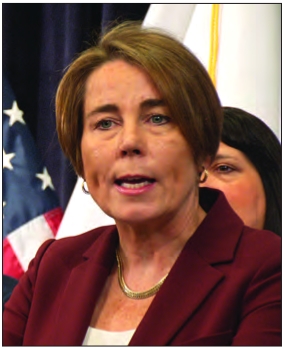
Gov. Maura Healey Since the start of the second administration of President Donald Trump in January 2025, increased immigration enforcement has spilled over into spaces where community members have generally felt safe. It’s a shift that has left many immigrants afraid to attend school and church or to seek medical or legal support.
As the state sees an influx of enforcement efforts by U.S. Immigrations and Customs Enforcement (ICE), Gov. Maura Healey announced new guidance for how people at some of these public spaces can interact with immigration agents.
Under a policy instituted during the administration of President Joe Biden, federal agents were generally limited from pursuing immigration enforcement in those spaces. Within days of retaking office the Trump administration announced it would no longer follow that policy.
“People should be able to go to church, to drop their kids off at school, to go get health care, to go report crimes,” Healey said at a May 28 event announcing the guidelines. “Unfortunately, ICE is making that very difficult.”
The creation of the guidance was required by an executive order Healey signed in January prohibiting any state office or agency from agreeing to use prisons to house ICE detainees without a public safety need. It also created the initial guidelines prohibiting the use of state facilities for ICE use.
Central to the new guidance is the idea of preparation, like identifying which areas are considered public spaces and which are nonpublic spaces, broadly restricted only to those with permission to be there. Notably, the guidance advises that restrictions can’t prohibit federal agents in particular but can restrict access generally for individuals who aren’t affiliated with the organization.
Broadly, the guidance recommends identifying nonpublic spaces in written documentation and by signage. It also encourages a chain of command, establishing someone at the facility as the point person to whom federal officials can be directed.
Also at the heart of the guidance is the difference between judicial and administrative warrants. Judicial warrants are orders issued by a court and signed by a judge or magistrate based on probable cause. In contrast, administrative warrants are issued by an immigration enforcement agency such as the Department of Homeland Security, which oversees ICE, and are signed by an immigration agent, without necessarily being based on probable cause. Agents who present a judicial warrant must be given access to nonpublic spaces, but those with an administrative warrant can be turned away.
It also outlines the rights of individuals being arrested by immigration officials (to remain silent, to consult an attorney and to refuse to sign documents) and the rights of bystanders (to observe and openly record, to remain silent and to assist detained individuals if it doesn’t interfere with the officers).
At the press conference, many faith leaders joined Healey to endorse the guidelines.
Rev. Mariamma White-Hammond, who leads New Roots AME Church in Dorchester, said the guidelines give practical guidance to help houses of worship balance their spiritual and religious priorities with the law.
“We will not let any political agenda of the moment draw us away from those higher principles,” White-Hammond said.
In the state’s press release announcing the guidelines, health and education leaders also voiced support for the new resources.
“At a time of uncertainty, this direction helps school leaders protect students, families and staff while ensuring schools remain safe, supportive environments focused on teaching and learning and grounded in respect for the legal rights and dignity of all,” said Mary Bourque, executive director of the Massachusetts Association of School Superintendents.
Jennifer Lemmerman, executive director of Health Care for All, a health equity nonprofit, said that a fear of immigration enforcement shouldn’t limit access to health care.
“Access means very little if people are afraid to use it,” she said. “Gov. Healey’s guidance sends a clear message that hospitals, community health centers, and doctors’ offices should be safe places where people understand their rights and can seek needed health care with confidence.”
The new guidelines also aim to protect access to buildings owned or controlled by state executive agencies, which Healey said will not be used for immigration enforcement staging. It also prohibits arrests without a judicial warrant in private areas of state property.
The state would continue to support law enforcement doing “legitimate law enforcement work,” Healey said, adding “that’s not what we’re seeing from ICE.”
The new guidelines come as the Healey-Driscoll administration faces other challenges from the federal government stemming from dueling approaches to immigration enforcement.
On May 27, the day before the guidance was announced, the U.S. Department of Justice filed a lawsuit against officials at the Massachusetts Registry of Motor Vehicles (RMV) in federal court over the state agency’s refusal to issue confidential and undercover license plates to immigration authorities for administrative warrants. The Massachusetts RMV stopped issuing the license plates to ICE agents two weeks ago. The Justice Department is challenging similar policies in Maine, Oregon and Washington, alleging in court that the restrictions are illegal and discriminatory.
In a statement released the day of the event, Healey said the state’s policy extends not just to ICE, but to any law enforcement agency — local, state or federal — that primarily engages in civil enforcement efforts aren’t qualified to receive the confidential plates.
“We’re not going to help them operate in secret as they take people off our street without cause,” Healey said at the press conference. “We’re going to protect public safety and we’re not going to back down on that.”
Healey emphasized that Massachusetts would continue to push back on what state officials view as oversteps of the authority of immigration agents and will continue to stand up for the rule of law.
“I have a responsibility to stand up and explain to the public what’s really going on and to take action to protect the rule of law and protect citizens here in Massachusetts,” Healey said.


