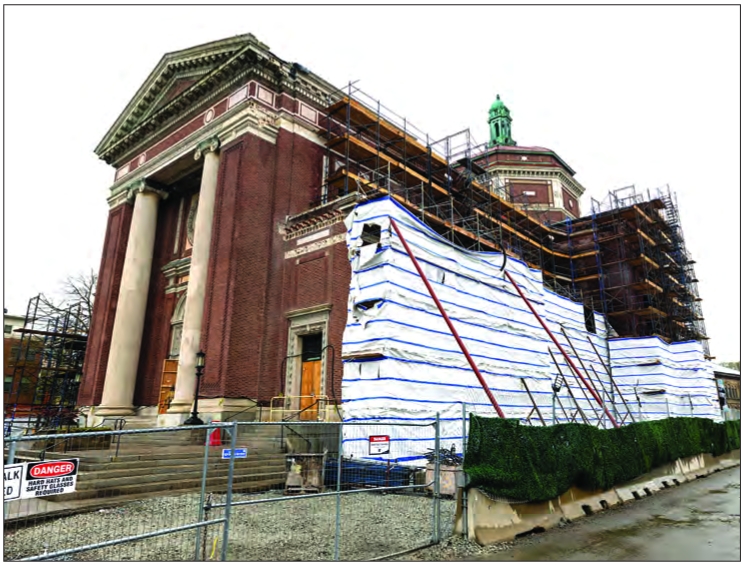
The groundbreaking for the redevelopment of Blessed Sacrament Church in Jamaica Plain was held April 30.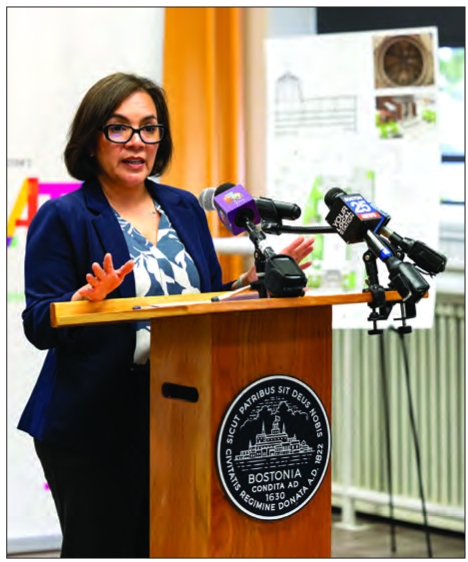
HSTF Executive Director Celina E. Miranda speaks at a press conference on the Blessed Sacrament Church redevelopment project.
Hyde Square Task Force, Pennrose break ground on JP develpment
For many Bostonians, community can be found in art classes, youth programs or even within the walls of a church. For the Hyde Square Task Force (HSTF), a nonprofit based in Boston’s Latin Quarter, community means cultural inclusivity.
HSTF was founded in the 1980s by a neighborhood consortium in response to widespread racial and economic prejudice. Under the leadership of Executive Director Celina E.
Miranda, it has grown to uplift Afro-Latin creatives seeking higher education. With the support of philanthropic and private backing, Miranda has spearheaded the introduction of new programming that centers the organization’s core values of creativity, justice and love.
Miranda feels a personal connection to HSTF’s work. “As an immigrant and transplant to the city many years ago, [specifically] Jamaica Plain, Boston’s Latin Quarter was a home away from home and a place where I felt a strong sense of belonging,” she said. “As a Salvadoran immigrant and a mother of an Afro-Latina, I feel honored to be leading this project. It is an opportunity to ensure Boston’s Latin Quarter retains the cultural richness that has made it a unique place in Boston’s diverse ecosystem for decades.”
Miranda
has been able to maintain a foundation of kinship through Hyde Park
Task Force’s key programs. One of them, Jóvenes en Acción, or Youth in
Action, centers immigrant and first-generation students who are applying
to college. With her perspec`stive as a Latina first-generation college
graduate, Miranda helps students overcome the intersectional challenges
in the private and public education systems.
Another
program, Caminos College and Careers, helps prepare high school
juniors, seniors and graduates as they enter college, trade school or
the job market. Through mentorship and workshops, students receive
education in financial literacy, career counseling, access to
professionals, therapy resources and a $500 scholarship.
The third key program, Creative Development and Community Engagement, focuses on marketing as well as social entrepreneurship.
According
to HSTF’s mission statement, the purpose of these programs is to
“nurture and amplify the voices, creativity, and power of youth” through
their Afro-Latin roots.
“When
young people see their culture centered in what they are learning and
creating, they gain a deeper understanding of the richness, history and
contributions of their communities,” said Nicolas J. Perez, HSTF arts
manager.
While
HSTF’s mission has always been rooted in advocacy and accessibility,
the current physical space has its limitations, which also affects the
accessibility of its programmig.
Perez
said that staff members “often have to make the difficult decision to
record performances and share them afterward… simply because our
building cannot accommodate larger audiences.”
HSTF
has partnered with Pennrose, a development company that is transforming
the abandoned Blessed Sacrament Church at 361 Centre St. in Jamaica
Plain, into a community space. HSTF bought the church more than a decade
ago and has used it as a center of worship, belonging and service to
BIPOC youth.
“When
HSTF purchased the church in 2014, we did it with a clear purpose: to
preserve it for community use,” said Miranda. “And when the time came to
redevelop it, we held on to that idea as we engaged in a community
process that led us to select Pennrose as our development partner.”
As
a Philadelphia-based affordable housing developer, Pennrose maintains
projects throughout the Northeast. HSTF selected it through a
community-decision process based on an alignment with value and vision.
The
redevelopment will include 55 affordable apartments for families with a
range of incomes. There will also be a community arts space built in
the nave of the former church.
On
the housing side, Pennrose is leveraging government grants, tax credits
and private investors to generate the funds for the project. The
performing arts and creative spaces are relying on fundraising and
charitable donations to support “lighting, sound, a stage and other
components,” said Miranda.
Those
contributions will not only help current youth participants, but also
those who grew up with HSTF as their second home. One of them is Anais
Disla Soto, a sophomore at Lesley University who started taking classes
at HSTF when she was 16, before becoming a HSTF ambassador — a
representative from Jóvenes en Acción (Youth in Action) — and dance
associate. Through both roles, Soto has performed at the Museum of Fine
Arts, Boston and Wake Up The Earth, a grassroots-driven annual festival
grounded in the fight against gentrification.
“Being
part of HSTF has changed my life in many ways,” she said. “The
Caminantes Program reassures me that I can continue working hard in
school and that resources are always available if I need support.”
For
students like Soto, the redevelopment project is “groundbreaking” and
“represents more than just a building or a performance space,” she said.
“It is an investment in youth voices, creativity and the future of the
community as a whole.”