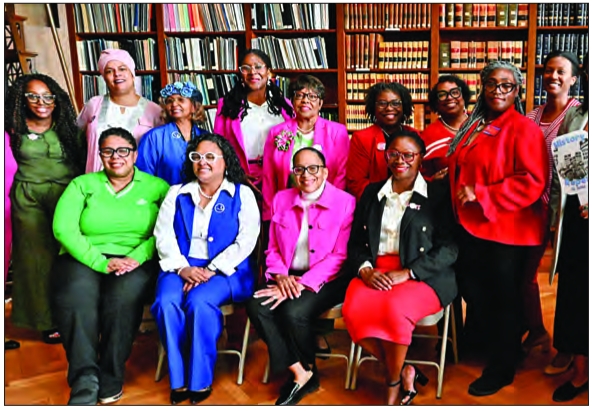
The local leadership of some Black Pan-Hellenic Council members hosted AKA Day at the Rhode Island State House to protest the erosion of voting rights. 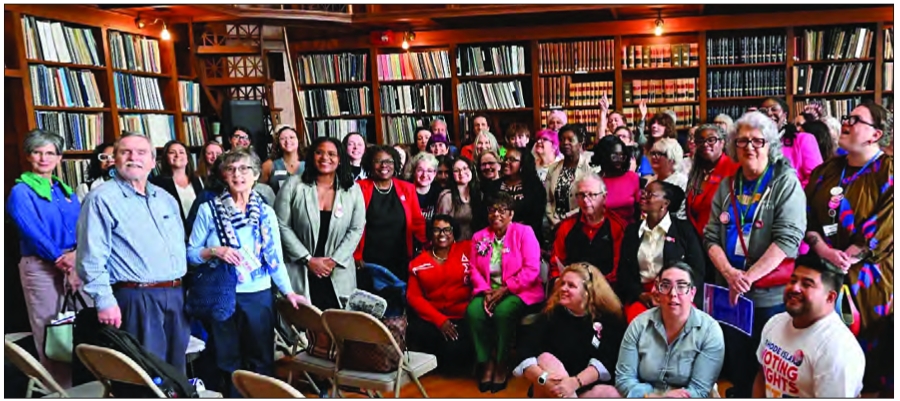
Members of COMMON CAUSE joined Black sorority members in Rhode Island to protest the erosion of voting rights.
Voting rights and the rollback of several other civil rights are front of mind for many in the country, especially those who belong to groups that had to fight hard to win those rights. There have been many actions on the part of the federal government to chip away at the rights of minority groups, including a recent decision by the
U.S. Supreme Court. The court struck down Louisiana’s congressional map and, in doing so, also struck down Section 2 of the Voting Rights Act that helped prevent discrimination based on race.
It’s against this backdrop that historically Black organizations and members of the National Pan-Hellenic Council — often known as the “Divine Nine”— have encouraged voter outreach and turnout. In partnership with the Rhode Island Voting Rights Act Coalition, the Theta Psi Omega chapter of Alpha Kappa Alpha (AKA) Sorority hosted AKA Day at the State House Library on May 21. Theta Psi Omega represents the Rhode Island alumni chapter of AKA. The event, part of AKA’s 2026 Advocate for Social Justice initiative, was an effort to show support for a proposed Voting Rights Act in Rhode Island and included invited public speakers, legislators, as well as members of the public.
The roughly 50 participants were divided into small groups, each with a captain who directed them to various floors. The aim of each team was to speak directly with state representatives and senators before the legislators headed off to their afternoon sessions.
“We had a speaking session for about 10 to 15 minutes. …You would go onto Senate floors and each team would speak to the senators about the voting rights,” said Susan Pires, connection and social action chair and state coordinator for Theta Psi Omega.
Other organizations in the National Pan-Hellenic Council, including Delta Sigma Theta, Zeta Phi Beta and Omega Psi Phi attended as well.
At the forefront of last Thursday’s activism was the proposed Rhode Island Voting Rights law, a bill supported by Common Cause — a lobbying group that monitors government activity nationwide — and a growing coalition of social justice organizations. For Pires and her colleagues, the conversation has moved beyond registration.
“We can’t focus on voter registration,” Pires said. “We need to push for this bill to be passed. We’ve been working on it for years.”
The legislation includes 10 proposed amendments that would secure voter protections across the state. Among them, expanding the protected class of Rhode Islanders to include all backgrounds, disabilities and languages; holding elected officials accountable for lack of responsiveness to constituents; and opposing exemptions that would strip communities of color of their right to representation on regional school district governing bodies.
Although Rhode Island is politically “blue” and viewed as progressive by locals and outsiders, organizers described a “false sense of security” associated with voting rights in the state, according to Chapter President Roxann Johnson-Nance.
“We don’t always think about what other people have gone through,” she said, referring to the recent Supreme Court decision. The ruling not only underscored the instability of voting rights, but the division amid the Rhode Island Senate floor. Some officials were receptive to feedback regarding the Rhode Island Voting Rights Act but others were not, Johnson-Nance said.
Black women were at the forefront of action, a reflection of a legacy that stretches back generations. One of the members and featured speakers was Shahidah Ali, executive assistant of RI Housing and Political Action Committee chair of the nonprofit Rhode Island Coalition of Black Women (RICBW), a nonprofit that works to uplift Black women and girls through access to education, health resources and economic growth. State Sen. Tiara Mack, the only Black woman currently serving in the Rhode Island Senate, helped ensure the organizers of AKA Day had direct access to legislators to have conversations, emphasized Johnson-Nance. “As Black women, we are taking the issue seriously,” she said. “We were there to say that this matters.”
While the event at the State House only lasted a few hours, organizers encouraged Rhode Islanders to continue the work by starting where they are — voting for local council members, school boards and juvenile hearing boards — and building civic engagement from the ground up. Johnson-Nance framed voting not as a privilege but as a responsibility.
“If you don’t vote, do you really have a right to complain about what we have or where we end up?” she said. “You’re not even standing in the gym to exercise.”


