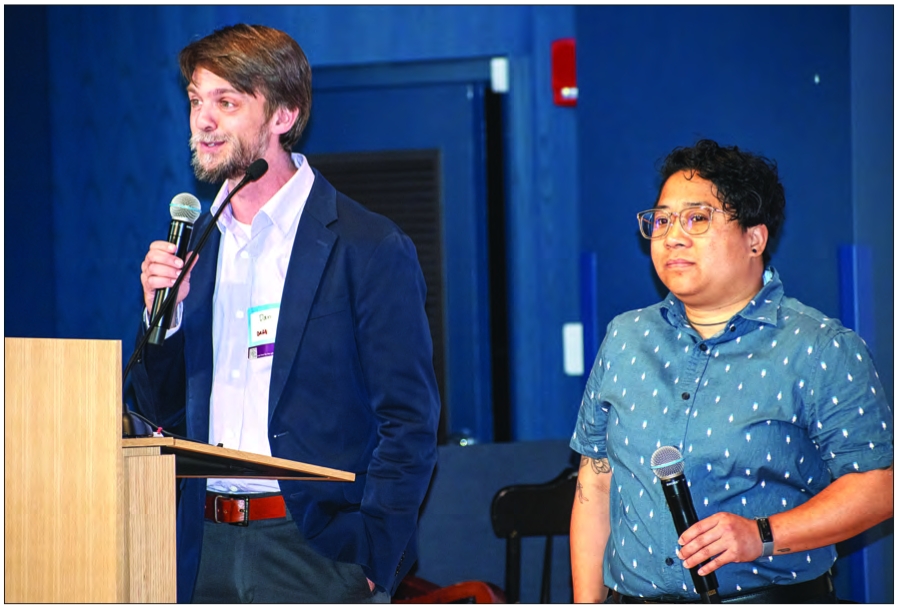
Dan O’Brien (left), director of the Boston Area Research Initiative, and Kim Lucas, associate director of civic research at BARI, deliver opening remarks at the research initiative’s annual conference, May 8. The conference, which covered topics like extreme urban heat, housing access and transportation and mobility, focused on research and data through its ability to work with and serve communities.Transportation, climate change and health care among topics
When Kim Lucas went to the first annual conference of the Boston Area Research Initiative in 2017, the event’s 40 attendees posed for a photo together in Northeastern University’s Curry Student Center ballroom.
Ten years later, the same ballroom was packed — standing-room only. More than 400 participants attended this year’s conference on May 8, which covered research on topics including local housing, transportation and climate change challenges.
Lucas, who is now BARI’s associate director for civic research, said the event has grown into a “valuable container” and a “labor of love.” It brings together experts with diverse backgrounds who leverage research and data to improve the lives of residents in the Greater Boston area.
The event focuses — like the group that runs it — on “civic research,” a field where anyone from academics, research firms, governments or community members collect and use data to solve local challenges.
Luc Schuster, executive director of Boston Indicators, The Boston Foundation’s research arm, said that kind of community-engaged research can ensure that the information gathered is useful to the population it aims to serve.
He said academic research can easily become detached from the community movement and priorities it should inform.
“You’re going to do better research if it’s regularly informed by the questions on real people’s minds,” said Schuster, who attended the conference. “And on the back end, you still could do the best research in the world, but if you aren’t engaged with people who might actually use it to create change, that’s not going to matter anyway.”
The questions and issues that research can support can be big, said Dan O’Brien, director of BARI, during opening remarks at the conference. He pointed to topics like housing access, transportation and climate change that were all in focus at the event. Tackling them, he said, requires collaboration across sectors.
“Everyone has a stake, right?
But also, we’re going to need all of us to pitch in if we’re going to make any progress,” he said. “In a world where the volume on disagreements is too often turned up to 11, we’re just hoping that we can be an exemplar for what those conversations can look like.”
At the conference, that looked like regional planning organizations working with nonprofits to understand how extreme heat is felt by pedestrians and how to address those hotspots. Researchers discussed artificial intelligence tools created with neighborhood groups to develop informational tools to help residents access real-time information about their communities.
Lucas described the umbrella of civic research as a broad one.
“You start to realize that beyond universities and research firms and people who do it formally, there are many people who do it in their day-to-day work,” she said. The conference, too, considered a similarly wide scope.
Some sessions discussed science topics such as artificial intelligence or extreme urban heat, while others tackled social and community issues like rising housing prices and access to social safety net programs. Still others were aimed at the nitty-gritty of city and institutional functions like procurement and public health services.
Broadly, researchers at the conference said that the community focus and engagement of civic research can help expand the work researchers can do.
Sometimes, developing the most effective research means reconsidering what questions to ask, said Beverly Ge, a PhD candidate at Boston University’s School of Public Health, who presented during a session about extreme heat.
“I think again, there’s a little bit of this tension between, like, what would make like the coolest ever research study, and like, what would actually cool people right here, right now?”
It also means centering people in the work, said Rose McCorran, manager of project analysis and applications at the Boston Region Metropolitan Planning Organization. Over the past year-and-a-half, the organization has run an initiative called Neutralizing Onerous Heat Effects on Active Transportation, or NO-HEAT, which aimed to collect and track more precise data about where pedestrians and cyclists are facing higher temperatures and developing solutions to address those areas.
“I’m a data person — I’m really proud of the data we created for this study — but really, it doesn’t matter until you’re thinking about it at a human scale,” she said.
The NO-HEAT project included factors like humidity and wind speed, which impact how people experience heat, as they measured local temperatures. The team worked with local organizations to identify areas of particular concern to install new shade shelters.
The event also showcased how developing technologies and research efforts can support community needs.
During a panel on the ways teams in the Greater Boston area are using artificial intelligence in community settings, researchers presented about an AI tool designed to provide up-to-date information particularly about Dorchester. The AI tool, called “On the Porch,” sources its information from local news like the Dorchester Reporter, as well as local community newsletters and municipal sources like 311 and 911 databases.
“The issue was not so much, ‘How can this neighborhood in Dorchester represent itself to the city?’ The issue was more, ‘How can this neighborhood in Dorchester represent itself to itself, so that it can communicate effectively with the city?’” said Eric Gordon, director of the Boston University Center for Media Innovation & Social Impact, who was involved in developing the AI tool.
Aryana Blake, who has worked with the project from the community side, said the tool has been developed with community voices and preferences in mind to optimize its effectiveness in the neighborhood.
“It gives the community a voice in a way that really shapes us culturally,” Blake said. Community feedback helped shape what kind of information was included in the tool, like making sure there was good news, not just bad, and identifying ways to source information that might not be included in local news.
At a separate panel on research efforts around the impacts of and solutions to extreme heat, Ge described her team’s efforts to identify extreme temperatures at Boston area family childcare centers — residential-based, early childhood education and care facilities. That research helped providers identify where young children, particularly vulnerable to extreme heat, were most at risk.
The partnership between the Boston University team and Boston’s Office of Early Childhood enabled the research team to more effectively communicate results back to the providers, Ge said. While members of the research team were outsiders, staff from the city were a trusted voice who were able to provide constructive feedback and support to providers facing the highest temperatures.
“Data alone doesn’t equal change,” Ge said during her presentation. “Partnerships like the one between my team at Boston University and the city of Boston’s Office of Early Childhood are needed to turn these findings into action and to ensure that Boston’s youngest children and the providers who care for them have what they need to weather a warming planet.”
At the conference, members of the BARI team and others in the local civic research community also celebrated the annual event’s 10th year. During opening remarks attendees shared stories of their favorite moments from BARI conferences, and an interactive timeline, set up in a common area, allowed attendees to write down highlights from the past decade.
The impact of that civic research community was on the mind of individuals like Schuster of Boston Indicators.
“We have a lot of challenges in Greater Boston, but we’re really fortunate to have such a strong civic research ecosystem,” Schuster said. “The fact that this conference has been going for 10 years is a real testament to the strength of that network.”


