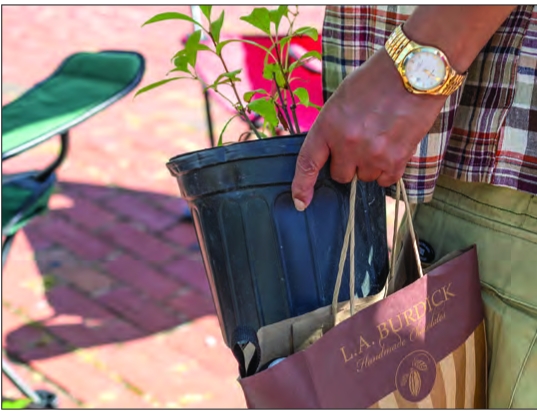
Mission Hill resident Roderick Kersey holds a free plant at a tree and shrub giveaway hosted by Zoo New England during the Roxbury Crossing Farmers Market, Sept. 19. The giveaway was part of a zoo-run partnership aimed at increasing tree canopy in Dorchester and Roxbury.
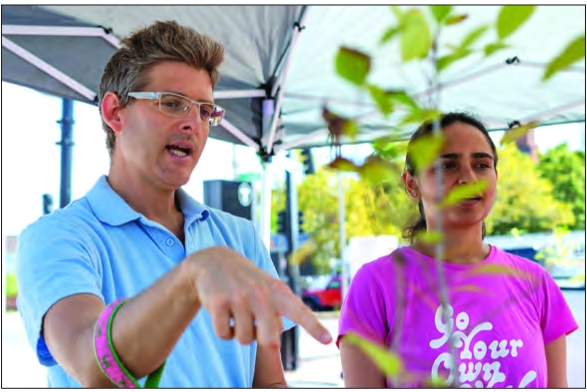
Josh
Meyer (left), Zoo New England’s curator of horticulture and
sustainability, talks plants with a community member during a free tree
and shrub giveaway hosted by Zoo New England during the Roxbury
Crossing Farmers Market, Sept. 19.
One Friday morning, warm with the last vestiges of summer, Josh Meyer stood in his pale blue polo shirt emblazoned with the Zoo New England logo, excited to let the patrons of the Roxbury Crossing farmers market in on something special: “We’re giving away free plants.”
Those plants surrounded Meyer — little saplings of witch-hazel, American sweetgum, silky dogwood, winterberry holly, black chokeberry — all urban-tolerant, native trees and shrubs to be distributed to Roxbury and Dorchester residents.
And people responded to his call, picking up plants — alongside fresh vegetables and other hauls from the market — to plant in their yards or pot in their homes. Meyer said he hopes that excitement can help bring a better tree canopy — and reduced summer temperatures — to the neighborhoods.
“There’s just a lot of interest.
People want to know, ‘What trees are those, what shrubs are those?’” said Meyer, Zoo New England’s curator of horticulture and sustainability. “I think everybody is interested in trees and shrubs, but they’re always interested to know how this can help.”
Through the initiative, Zoo New England and five partner organizations — the Harvard Street Neighborhood Health Center, Boston PowerCorps, Greater Grove Hall Main Street, Neighborhood Forest and the Price Center — hope to plant 2,000 trees over the next three years across Dorchester and Roxbury.
Bringing community groups into the work is “really critical” to efforts like this, said David Meshoulam, executive director at Speak for the Trees, a Dorchester-based nonprofit focused on tree canopy equity that is not affiliated with the zoo’s program.
He said the program sounds great, but the goal of 600 to 700 trees per year is “ambitious,” though still doable. Speak for the Trees plants about 200 per year, he said, with a goal to raise that to 400 or 500 annually. The organization also distributes between 500 and 1,000 seedlings per year, but Meshoulam said those have a lower rate of viability.
The zoo’s effort is largely based in getting more trees or shrubs into the hands of residents and businesses in Dorchester and Roxbury through giveaways like the one at the Roxbury Crossing farmers market or health fairs. In mid- April, the program — with partner Neighborhood Forest, a Minnesota-based nonprofit that distributes free trees to young people every Earth Day — held an event to distribute trees to kids in Roxbury and Dorchester and educate them about planting.
The partnership started following a separate tree planting effort at and around Franklin Park Zoo, where they planted a couple hundred trees.
“That was our call to action, looking at our tree canopy and realizing, ‘Wow, we need to make sure this canopy is going to be here in a couple hundred years,’” Meyer said.
The current partnership is a three-year effort funded by a grant from Liberty Mutual.
For some of the zoo’s partners, joining in was a matter of trying to spread improvements to the community.
“It wasn’t necessarily, ‘Gee, how’s this going to help Harvard Street?’ It’s, ‘How’s it going to help the community and the neighborhood?’” said Charles Murphy, president and CEO of Harvard Street Neighborhood Health Center. “Planting trees is never a bad thing for the environment.”
Planting trees means more than just more foliage in the neighborhood. The 2,000 new trees and shrubs Zoo New England hopes to plant through the partnership — an estimated two to four acres of increased canopy — will produce 23 tons of oxygen, store nine tons of carbon and take up over 47,000 gallons of water that will be released as water vapor, cooling the surrounding area through a process called transpiration.
In neighborhoods like Dorchester and Roxbury, which often face hotter summer temperatures than other neighborhoods outside of downtown, the cooling impact could mean greater comfort and reduced instances of heat illness — like dehydration, heat exhaustion or heat stroke.
That kind of effect is on display daily at Franklin Park Zoo, Meyer said, both for the animals that live there and the humans that visit.
“Trees provide shade, they help put oxygen in the environment, they help with transpiration, and just really help having cool and comfortable environments — for not only animals, but also humans,” he said.
Access to green space has also been identified as a social determinant of health — the public health term for a factor beyond the walls of a hospital or clinic that impacts health outcomes. Researchers have found that more exposure to trees can correlate with lower obesity and better social cohesion as well as improved birth outcomes and cardiovascular function.
“A lot of folks have a lot of needs beyond just getting a physical or getting their teeth cleaned,” Murphy said.
Attempts to bring more canopy to parts of the city like Dorchester and Roxbury aren’t new. In 2023, the city celebrated the award of federal funding to support the planting and care of trees through its urban forest plan, which aims to bring more equitable tree cover to neighborhoods across the city.
But figuring out how to get and manage tree canopy onto all the different kinds of land — city-owned, state-owned and private — has its own complications.
Meshoulam called it “a big puzzle.”
For example, an ordinance passed by the Boston City Council in late 2023 created new guidelines to increase transparency about plans to trim or remove trees and to provide residents more ways to address concerns around the removal of trees, but only covered those on public property; trees on private land weren’t under the same guidelines.
Meshoulam said Speak for the Trees is working on efforts to help plant trees on state parcels when there’s no budget to do it otherwise.
The Boston Tree Alliance, a program convened by Mass Audubon but funded and supported by the city, aims to fill some of the gaps in tree canopy on private land. The zoo partnership, too, aims to get trees onto private land by putting them in the hands of residents.
Meyer said that when the zoo looked to start its partnership program, it “noticed the city of Boston is doing an incredible job on public lands, and so there’s not much room there,” but there was room to improve on private tree canopy.
Meshoulam said he views the zoo’s program as a good initiative, but wonders if the broad, city-wide efforts could be better tackled with a more comprehensive plan.
“I do wonder if turning the spigot on this way is sort of making the work less coherent — if there’s too many people presenting too many ways and too many stories, and then there’s confusion,” Meshoulam said.
But for Meyer, the problem is big enough that he said he thinks everyone can get in on trying to solve it.
“The more the merrier,” he said. “There’s a slice of the pie for everybody.”
Meshoulam cautioned that just giving trees to excited residents may not ensure survivability. The work is also about making sure “the right people are getting the right tree and putting it in the right place and supporting it in the right ways.”
Care for the trees, which can be complicated work, is the next step. Meyer said that making sure people getting the trees have a sense of how to actually care for them has been a priority.
“There’s a lot of challenges out there,” Meyer said. “For us, I think education is key.”
Meyer said the giveaway efforts are winding down for the year, though there might be a few more scheduled in October. Before the end of the year, the zoo will work on constructing a greenhouse to propagate and grow more trees to get into Dorchester and Roxbury soil.
The efforts will continue over the next two years to try to reach the goal of 2,000 trees; Meyer said he thinks the partnership is on track to meet that for its first year but he plans to do a more specific count as the year winds down. He said that increased canopy, among other efforts, will mean real benefits for the residents of Dorchester and Roxbury.
“We’re really excited about the work we can do from a climate justice, environmental justice and community justice type project,” Meyer said. “While we do have these metrics — 2,000 trees over three years — we’re also just as equally excited about how it’s affecting people in the community.”