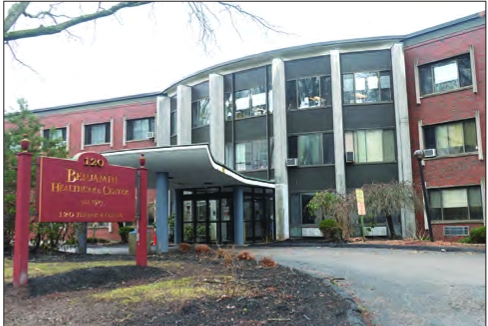
The Edgar P. Benjamin Healthcare Center on Mission Hill, shown March 6.
The sale of the Edgar P. Benjamin Healthcare Center is marching forward,
although the original goal of finishing the process by the end of
September has been delayed.
Representatives of the receivership, which was appointed to oversee the facility in spring 2024 after allegations of mismanagement threatened a closure, gathered in Suffolk County Superior Court Sept. 16, alongside lawyers for the attorney general’s office and the state’s Department of Public Health.
Facility leadership is in the process of selling the Mission Hill nursing home to New Jersey-based Allaire Health Services, a for-profit nursing home operator with 23 facilities in New Jersey, Pennsylvania and Vermont.
Allaire was recommended by Joseph Feaster, the Roxbury attorney serving as the Edgar Benjamin’s court-appointed receiver, at a Superior Court status conference on July 31. He selected Allaire out of a field of seven bids.
At the status conference, Justice Anthony Campo set a target date to close the sale by Sept. 30, but by the September hearing, both Feaster and Assistant Attorney General Mary Freeley indicated that the proposed timeline was unrealistic.
The slowdown stems from the official transfer processes required by the state.
Feaster said that he’s “an Uber passenger at this point,” and noted that the Department of Public Health and the attorney general’s Public Charities division are driving the process.
Freeley, in turn, said the timeline is “not in our control right now” and until Allaire submits official notice of its intent to take over operations, the processes can’t move forward.
According to state regulations, the transfer of ownership of a long-term care facility requires the new owner to file paperwork to signal their intent to take over operations. That documentation kicks off a months-long clock and approval process.
During the status conference, Suzanne Anair, Allaire’s vice president of marketing and business development, said Allaire has been in the process of conducting due diligence, including in-person visits to the facility and recent steps to look at the Edgar Benjamin’s clinical operations.
She said that so far, Allaire has no concerns and that she was confident the official notice of intent to acquire would be filed by early October.
The transfer process could be slowed further by provisions in the state’s code of Massachusetts regulations, which allows community members to request a public hearing if they have concerns about the suitability of the prospective new owner. That hearing must be held 45 days ahead of the proposed transfer date.
The attorney general’s office has a role to play as well. Because the sale will mean the transfer of assets from a nonprofit to a for-profit organization, the Edgar Benjamin must provide notice to the attorney general’s Public Charities Division at least 30 days ahead of the proposed transfer.
Freeley said the attorney general’s office is working with Timothy Fraser, an attorney representing the receivership, to draft the official documentation to be filed with the Public Charities Division.
Campo said the court would like the process to move forward as efficiently as possible, for the sake of stability for residents at the facility.
“Clearly, it’s this court’s objective to see those who are being cared for at the Benjamin are cared for at the Benjamin,” he said.
As the process goes on, Feaster said he is working with Allaire to select a new administrator for the facility after former administrator Delicia Mark, who was tapped to head the facility in the receivership’s early days resigned earlier this year. The end of her tenure was marked by infighting between her and Feaster, as well as his executive assistant Dianne Wilkerson.
The Sept. 16 status conference marked a more congenial gathering than some in court since the receivership was installed in April 2024, following attempts by Tony Francis, the former administrator, to close the facility and relocate its residents.
At the time, Francis faced allegations of mismanagement after staff went unpaid repeatedly and it came to light that in 2021 his salary exceeded $628,000. In March, Feaster and the Edgar Benjamin filed a civil suit alleging he stole and embezzled $3 million from the facility over his decade-long tenure.
The almost 18-month process since the receivership was appointed has been marked by disagreements between Feaster and representatives for the commonwealth, with the receivership seeking increased financial support as it tried to stabilize operations and the attorney general’s office and Department of Public Health asking for greater clarity about how Feaster has been managing the receivership and the facility’s operations.
The Department of Public Health has continued to send its staff to inspect the facility, Feaster said, which he has previously objected to, but is within the rights and responsibilities of the Department of Public Health. Court proceedings, however, have been going more smoothly.
For example, the commonwealth had no opposition to another extension of the receivership through Nov. 30 to keep the process moving; in July, the court extended it through the end of September, and the commonwealth has previously hedged on its approval, asking for greater oversight or transparency.
Campo said he thinks everyone is coordinated to get operations at the facility to a position where it can be stabilized in the interest of its residents, “the people who need it most.”
The receivership will return before the court Oct. 6 for another status conference, at which time, Campo said he expects the required official paperwork to have been filed with the Department of Public Health.
“At that time, I’m sure I’ll be told the application is on the desk of whoever it needs to be on,” he said.