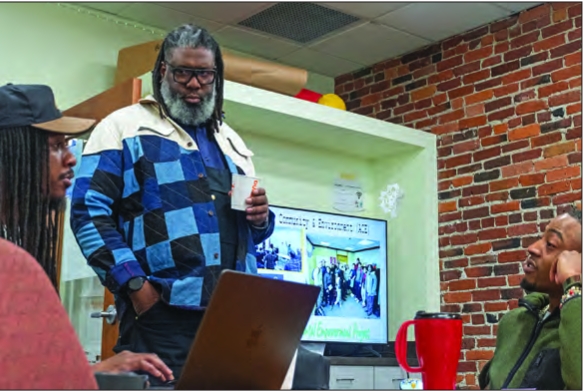
Dwaign
Tyndal (center), executive director at Alternatives for Community and
Environment, talks with ACE staff, on Feb. 26. The Roxbury-based
nonprofit focuses its efforts on environmental justice and racism. A READER ASKS: What does an ‘environmental justice community’ designation mean?
For much of Massachusetts’ history, polluting infrastructure has been pushed into communities of color, lower-income communities, and areas with less English proficiency — largely impacting those with less political clout to fight back.
That’s why Roxbury lives with diesel fumes from the Nubian Square bus yard, and Lawrence still bears the toxic legacy of mercury-leeching incinerators.
“You have these things that people don’t want in their neighborhoods but it’s essential — they somehow get into our neighborhoods. That’s what environmental racism is,” said Dwaign Tyndal, executive director at Alternatives for Community and Environment, a Roxbury-based environmental justice nonprofit.
Environmental racism is more than exposure to hazardous waste — it’s underscored by the ways communities of color are systemically marginalized in environmental decision-making, while also having less access to environmental benefits like clean air, safe water, and green space.
This entrenched history of environmental racism sparked a response in the form of the designation of an “environmental justice community.”
Officially, that designation is made by census block — the smallest statistical area used for the U.S. Census — and looks at three demographic criteria: Do minority populations make up 40% or more of the population?
Do
households who identify as speaking English less than “very well” — a
question asked on the census — make up 25% or more of the population? Is
the annual median household income no more than 65% of the statewide
annual median household income?
A
fourth looks at minority populations and income status in tandem; a
census block can qualify if minorities make up 25% or more of the
population and the annual median household income doesn’t exceed 150% of
the statewide annual median household income.
Those criteria were set by the state’s Executive Office of Energy and Environmental Affairs.
“Low-income
communities, communities where there’s new immigrant populations and
communities of color have been disproportionately targeted in the past
by both the state and industry for the siting of ecologically hazardous
facilities,” said Daniel Faber, senior research fellow at the Global
Center for Climate Justice and a professor of sociology at Northeastern
University.
Once
designated, it becomes an element for use in legislation or policy. For
instance, under the Massachusetts Environmental Policy Act, it’s meant
to increase public participation and engagement to ensure community
members can have their voices heard.
Or
in the climate omnibus legislation passed in 2024, the designation of
environmental justice communities is used to prompt further
consideration of the impacts of electric vehicle charging stations or to
indicate who should be on commissions.
The city of Boston has also used the state’s designation to
guide efforts like its 2022 urban forest plan, which relied on EJ census
blocks as a key indicator for determining where to expand tree
coverage.
Beyond the
Massachusetts designation, the term can also, more broadly, refer to
communities that have been recognized as those facing increased burdens
now or historically, even without the specific criteria.
A
federal policy under the Biden administration called Justice40 was
aimed to direct 40% of the overall benefits from some federal climate,
clean energy, affordable and sustainable housing and other investments
to disadvantaged communities, based on factors like income, unemployment
rates, air pollution levels and proximity to environmental hazards.
That policy was scrapped by President Donald Trump on the first day of his second term.
In Massachusetts, where the designation persists, it is, however, only part of the solution, Tyndal said.
Even
with legislation or policy using the designation to implement
environmental protections, there still must be enforcement, which may
rely on political will from the same communities that have an
environmental justice designation to try to counteract less political
clout.
“I think it’s good on paper, but then the execution and enforcement is still questionable,” Tyndal said.
He
said he is not optimistic about the merits of the designation
in-and-of-itself, given a historical record of things like legislation
around fair housing that still see discrimination.
“What
I’m saying is that the fight has just started and any illusion that the
remedy is written in legislation is what I push aggressively against,”
Tyndal said.
And an environmental justice designation may not cover all the necessary factors around needed protections.
For
Faber, the designation is a good start, but it doesn’t cover all the
factors that could be indicators of environmental injustice.
He pointed to other metrics, like communities with elevated health
risks for certain conditions or cumulative environmental burden — what
and how many other environmental harms have been constructed in the
vicinity?
“In the
past, I would say those designations were somewhat rigid,” Faber said.
“There are communities that, in my view, … were clearly overburdened and
did not qualify if you use purely demographic terms.”
There
has been some progress to expand the lens through which environmental
justice is viewed. A spokesperson for the Executive Office of Energy and
Environmental Affairs said that factors like physical ability, access
to transportation, health, and age can also affect whether a community
is disproportionately affected by environmental burdens, and that EEA’s
Office of Environmental Justice and Equity is working to develop
additional tools to reflect those additional barriers.
Faber
said that there have been steps to consider health factors like the
rate of heart attack hospitalizations, elevated blood lead levels, low
birth rates and high asthma rates. He said other health conditions, like
cancers, however, should be included but currently aren’t.
“There’s
a whole range of health indicators of environmental problems that are
not part of the equation yet but need to be,” he said.
The
cumulative environmental burden, too, has started to become part of the
conversation. In 2024, the Massachusetts Department of Environmental
Protection announced it would require the analysis of cumulative impacts
for air quality permits near environmental justice populations,
becoming the first state to do so.
For
Faber, it is also important that conversations around environmental
justice not only focus on determining where harm is sited, but limiting
harm generally, wherever possible.
“The
goal of the environmental justice movement should not be solely to
ensure that all people are polluted equally. It makes for a horrible
bumper sticker; it’s not a great slogan,” Faber said. “The EJ movement
needs to be in the forefront of the movement to ensure that no one be
polluted at all, that environmental justice is not about protecting
what’s in my backyard, but it should be about protecting what’s in
everyone’s backyard.”
The
fight to further environmental justice — the broader concept of
addressing inequitable environmental harm, not just the official
designation — has been a slow one for some activists. But Faber said the
state has made some progress in recent years, as some advocates have
landed official positions in the Massachusetts government.
For
example, before she was appointed as the state’s inaugural
undersecretary of environmental justice and equity, Maria Belen Power
served as associate executive director of Greenroots, a Chelsea-based
environmental justice organization.
But,
even with improvements, Tyndal said that steps like the designation of
an environmental justice community is only one piece of the puzzle.
Other work like education, community organizing and continued advocacy
is necessary to make sure that designation means something.
“This
is just a part of the cocktail,” Tyndal said. “It’s like, if you’re
sick, they say to get rest, take your medicine, drink liquids, and if
you don’t do all of them and you won’t be able to get healthy.”
The Bay State Banner
wants to hear your questions about the climate and environment. This
article was produced as part of a new project called Encyclopedia
Climatica, in response to a reader-submitted question. Do you have a
question about climate or environment? Submit it to us at
tinyurl.com/banner-climatequestions or email to [email protected].