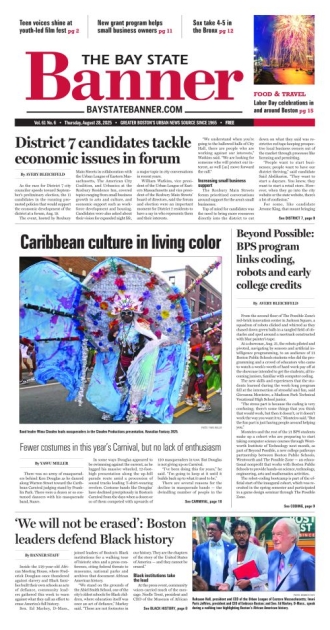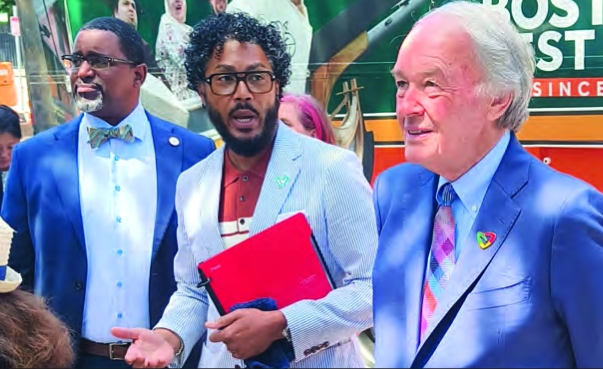
Rahsaan Hall, president and CEO of the Urban League of Eastern Massachusetts; Imari Paris Jeffries, president and CEO of Embrace Boston; and Sen. Ed Markey, D-Mass., speak during a walking tour highlighting Boston’s African American history. 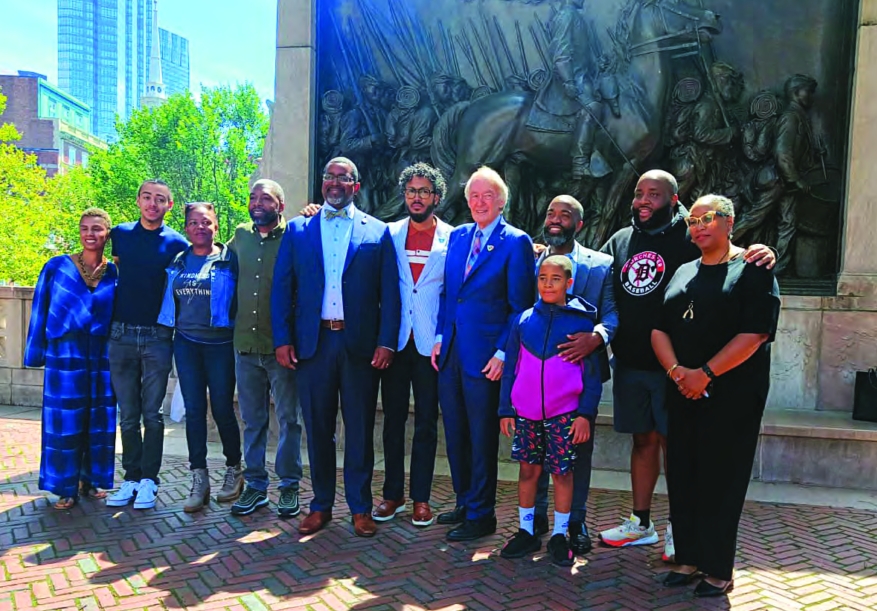
Sen.
Ed Markey, D-Mass., joins supporters in front of the Robert Gould Shaw
and 54th Massachusetts Regiment Memorial on Boston Common. The memorial
honors the first all-Black regiment in the Union Army during the Civil
War.
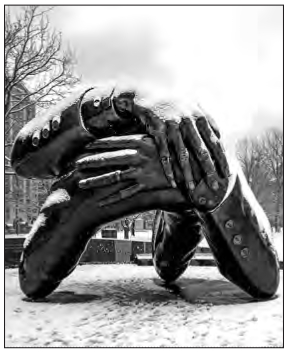
The Embrace sculpture on Boston Common honoring Martin Luther King Jr. and Coretta Scott King
Inside the 219-year-old African Meeting House, where Frederick Douglass once thundered against slavery and Black families built their own schools as acts of defiance, community leaders gathered this week to warn against what they call an effort to erase America’s full history.
Sen. Ed Markey, D-Mass., joined leaders of Boston’s Black institutions for a walking tour of historic sites and a press conference, citing federal threats to museums, national parks and archives that document African American history.
“We stand on the grounds of the Abiel Smith School, one of the city’s oldest schools for Black children, where education itself was once an act of defiance,” Markey said. “These are not footnotes in our history. They are the chapters of the story of the United States of America — and they cannot be erased.”
Black institutions take the lead
At the press event, community voices carried much of the message. Noelle Trent, president and CEO of the Museum of African American
History, reminded the audience that the meeting house itself, built in
1806, was constructed by and for Boston’s Black community.
“Every
person who enters into this building is literally walking in the
footsteps of history,” Trent said. “Even efforts to remove the
uncomfortable and complex part of our collective history are an erasure.
This is not a rhetorical exercise. My colleagues and I deal with this
threat every day.”
Trent
said the museum remains committed to preserving the truth despite
funding uncertainties. Earlier this year, the institution faced the
potential termination of a significant federal grant, which was
subsequently reinstated. She urged visitors to support museums like hers
through memberships, admissions and donations.
“Our
pledge is rooted in the spirit of resilience that occupied this space
from the early 1800s through the Civil War,” Trent said. “We will not be
erased.”
Monuments as memory
Dr.
Imari Paris Jeffries, president and CEO of Embrace Boston, linked
public space to democracy. He pointed to Boston’s Black Heritage Trail,
where visitors can follow the footsteps of abolitionists, and to
monuments such as the Shaw 54th Regiment Memorial and The Embrace
sculpture on Boston Common.
“Monuments
are a city’s vocabulary,” Jeffries said. “They either invite, or they
exclude. They either teach the whole truth, or they rehearse a lie.”
He
said parks and monuments are where history breathes, and where a
community defines itself. Confederate statues, he argued, were not
memorials to the dead but “signposts to the living” that told Black
communities where not to stand or vote. By contrast, Boston’s memorials
tell stories of courage, love, and democracy.
“Public space is not neutral,” Jeffries said. “Every
ranger who opens a gate does the quiet work of democracy. Every
inscription that names the enslaved, the soldiers, the organizers, the
artists, lays another brick on the road from memory to justice.”
History under pressure
Rahsaan Hall, president and CEO of the Urban League of Eastern Massachusetts, reminded the audience of the Memphis Massacre
of 1866, when white mobs killed 46 Black residents following the Civil
War. The violence spurred Congress to pass the 14th Amendment, which
guarantees equal protection under the law.
“The
way we know about that massacre is because there’s a marker,” Hall
said. “Eliminating monuments and whitewashing history sustains the
attack not just on Black America, but on all of America.”
Hall said today’s attempts
to downplay or erase history echo the same struggles Black communities
have faced for centuries. “Today, we demand that history not be erased.
On today, we demand that the National Park Service continues to be
funded and is not manipulated into a tool of oppression,” he said.
Markey’s pledge
Markey
criticized the current administration for instructing the National Park
Service to remove references to slavery, Harriet Tubman, and the
Underground Railroad from websites, along with mentions of transgender
people at the Stonewall National Monument. Some of the erased historical
material was later restored after public outcry.
“President
Trump and his minions are not just rewriting policy,” Markey said.
“They are trying to rewrite the history of the United States of
America.” He pledged to fight in the Senate for funding and transparency
in the National Park Service and museums. He also cited his past work
with Representative Seth Moulton to expand the boundaries of the Salem
Maritime National Historic Site to tell a fuller story.
“History
belongs to the people, not to presidents, not to political parties,”
Markey said. “We must stand with museums and curators, teachers and
historians, and refuse to be complicit in the lie.”
Call to action
Speakers
urged attendees to act locally by visiting museums, supporting cultural
institutions financially, and documenting monuments and markers as part
of campaigns such as “Save Our Signs.” “We will not be erased,” Trent
said again, echoing the words of Frederick Douglass: “Power concedes
nothing without a demand. It never did, and it never will.”